Showing posts with label Adaptation. Show all posts

Monday, 18 December 2017

Adaptation: Doom


The A-word.
It's the bane of cinephiles, everywhere.

That book you love; the comic you remember; the show you used to watch; the game you lost an entire summer playing? Oh, someone's adapted it and it's getting made into a movie! Whether a cause for pre-emptive celebration or foreboding caution, it leads to only one thing: expectation. And expectation is the death of the 'clean' movie-viewing experience; no matter how closely the film sticks to its source material, or how much it tries to distance itself, it will be faced with the hurdle of comparison.

And while the movie industry loves the pre-built marketing buzz of 'now a major motion picture!', they loathe the comparative references which will be made from the first review onwards. Because many punters will expect to get exactly the same reaction from a completely different medium, to a story they already know. And therein lies the problem.

In this monthly series, we'll look back at some of the most respected and best-loved properties which have made the perilous journey to the big screen; often with some controversy, and almost always with far too much hype. This isn't so much a review of the films themselves, more an appraisal of their suitability as an adaptation.



Doom (DOS / SNES)
Doom (DOS / SNES)
ID Software (1993)

Onwards and upwards; consoles are out, computers are where it's at now, grandad! The mid 90s saw game developers begin to properly harness the power of machines which had previously been used primarily as office tools. And while the advent of the Windows operating system made these more accessible, early games were still in good old DOS*1. The console-format wasn't dumped for good, obviously, and would be taken to the next level with Sony's Playstation, but the boom in PC gaming coincided (not that it was a coincidence) with the growth of domestic internet connections. Not only could titles be shared down a phone line (!), but programmers could distribute their own levels, upgrades and amendments ('mods') via the same method. And we'd only ever dreamed of remote multiplayer matches before. All of a sudden, we were living in the future. All that was needed was the right game to seize the possibilities…

Back in the late 80s, we'd had Freescape, an engine which allowed players to wander around three-dimensional environments, solving puzzles and the like. Technically impressive (given the hardware limitations of the Spectrum/Amstrad/Commodore generation), but sedate. Shortly after came the first flurry around virtual reality, in which the non-gaming civilian populace suddenly became aware of how immersive computer software could be. Again, fine, but it wasn't really accessible to home-tech users and something was missing for those of us who'd already been playing in other worlds for years. And that something was Shooting People In The Face™. Hard.

And so, back to living in the future. The memories of your first job. Sitting in the back-room of a high street print-shop after hours with a couple of colleagues and some beers from the offy next door, taking turns on the one solitary Windows 3.11 computer, skulking round the corridors of a military base on the moons of Mars and shooting imps and demons*2, letting up only when it was time to leg it for the last train home. Okay, they're memories of my first job, although I don't think I'm entirely alone in recollections like those.

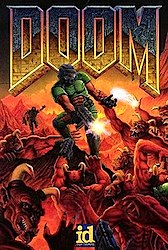
All of this is idealistic nostalgia, of course. How does classic Doom actually hold up in 2017? Well, once we're installed with full functionality*3, pretty bloody well I'm happy to say. Sure, the game is pixelly in its visuals and basic in its mechanics, but it runs with a smoothness that was almost unheard of in 1993. Much like last month's Street Fighter II, the key thing about Doom is that the backstory is essentially irrelevant*4. Some stuff about being the last surviving human on a military base on Phobos, one of the moons of Mars, holding off hordes of monsters emerging from a portal to Hell. Scenes.

But this is all in the manual. There's no in-game catchup, no cut-scenes or cinematics, just one nameless space-marine ploughing through levels against increasingly tough foes with increasingly ridiculous weaponry. All the player actually needs to know is how the movement, firearms and switch-systems work; find the exit to the next level, kill anything which gets in your way. That's it. The door/key and switch combinations present some basic puzzle-solving, but if a player makes a point of clearing each room as they come across it, the game more or less solves itself. Also similar to last month's entry, Doom wasn't the first game of its kind, but it quickly became the most popular, the most iconic and the benchmark by which all others were measured*5.

1995 saw the release of Doom on the Super Nintendo Entertainment System*6, one of the last titles for a console on its wind-down and converted for the cartridge by Ocean Software. It's a noble effort. The smoothness of movement around the maps is maintained by reducing the play-area on the screen substantially, and this is even blockier than its DOS forbear. Movement is aided by the controller's L and R buttons becoming strafe-directions, but these can't be employed at the same time as turning so there's very little 'sliding into a room and letting rip with the chain gun'. Speaking of which, collision detection is absolutely atrocious here. That's handy if you're shooting into a crowd of zombies as they'll be picked off one at a time with barely an aiming-action from yourself. It's less handy if you're in the room with more than one adversary, since you start being injured as soon as they're there, irrespective of distance or line-of-sight. Surrounded by the hordes of Hell? Forget it. It's this element, unfortunately, which makes the SNES port barely playable. In fact I'll go further - if you're not familiar with Doom at all - the maps, the enemies, the wanting to actually see the thing which is spanging ten health-points off you every three seconds - the SNES port will be unplayable*7. I love that this version of Doom exists. I'm even more glad that it's not the only one I've got.

But the bottom line; Doom's still got it where it counts.
If you can live with the pixels...



Doom (movie)
Doom
Andrzej Bartkowiak (2005)

And so, the million-dollar question*8 rears its ugly head once again: how do you make a movie from a game with no narrative?

Well, there are going to be changes. The portal between Phobos and Hell becomes one from Mars to Earth, and the zombies and imps aren't the manifestations of Hades, but the product of Evil Nasty Scientists Meddling With Things They Don't Understand™. The last surviving marine treading the line between carnage and insanity becomes a squadron, called in to investigate a distress-call from the UAC research-base on Mars (ie, not its moons, Phobos or Deimos), and there's an awful lot of human interaction for a property which was essentially about isolation and agoraphobia.

Naturally, the team we're following all have their own distinct personality-traits, but these are amplified to the point of psych-defects, where not a single one of them would be selected for active duty in any armed unit. And while we're on, despite an impressive array of firearms, none of the team are wearing any protective headgear or night-vision equipment to go padding around darkened corridors in a locked-down military base. Although you get the impression that troops like these wouldn't bother with either anyway. But since the film follows the marines as a group-unit, it stands to reason that there's not really a central character to root for (which is the very opposite of the game-mechanics). And since these characters all inherently ittitating, it really doesn't matter when they start being picked off by the undead remnants of UAC office staff.

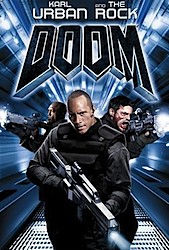
The brawn-end of the flick is headed up by Dwayne Johnson (at the time, still being billed as The Rock) and Karl Urban, with Rosamund Pike picking up the 'brainy scientist' reins as Karl's estranged sister. A bunch of familiar faces with ludicrous squad-nicknames make up the numbers, and the rest is autopilot. There are still nods to the game with weapon-types, but everything else about this suggests a screenplay that was sitting in a cupboard, hastily re-tooled when Universal called with the news that they'd got the license from ID Software. It often feels like a mid-80s action movie that's been made with a mid-00s budget and technology. In fact it's probably not unfair to say that screenwriters Dave Callaham and Wesley Strick owe so much to Aliens and Predator that they've had to take out a loan from Resident Evil just to keep up the repayments. The film's self-congratulatory First Person Shooter centrepiece sequence doesn't happen until an hour and a half in, and even then it's only five minutes long and executed at an oddly sluggish pace.

The movie is nowhere near as awful as the Rotten Tomatoes score would suggest, but expectation killed its chances faster than the BFG-9000. If anything, Doom feels more like a prequel or lead-in for the game, albeit one which dismantles the plot before the main event. The film certainly plays like a bunch of the stitched-together cutscenes which the first two games never had, at any rate, and while it makes a decent screen-adaptation of the squad-based shooters from later years, it's just not Doom. Yet at the same time, it's hard to imagine a viable screenplay that would be…*9

Although hats off to the bit where the marines are denoting areas they've cleared with fluorescent marker on the doorways. I like the thought of a bunch of trained killers being subject to an impromptu stationery audit…

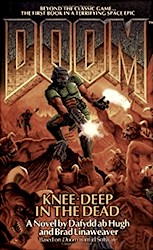


Doom (novel)
Doom: Knee Deep In The Dead
Dafydd ab Hugh & Brad Linaweaver (1995)

Firstly, a disclaimer: I have read this novel before, some time around 2005. And while that puts it before the beginning of this blog, an ongoing exercise which has trained my brain to think more critically about the content presented to it, I have to say that I recalled it as being passable tie-in fiction based on a game with no real story. With that brief in mind, and much like the film up there, the authors have pretty much carte blanche to do as they please, so how could that go wrong, yeah? Reader, I have to tell you that the Doom novel is fucking awful. Things don't get off to a great start when you realise this aspires to be a hard-nosed military thriller, seemingly written by people whose sole experience of the armed forces comes from Ross Kemp documentaries and an unhealthily thumbed collection of Andy McNab novels.

With our central hero ('Flynn Taggart', a name which couldn't have much more testosterone if his middle name was 'Bollocks') being a grizzled marine from Florida who finds himself shipped to Mars while on an insubordination charge (of course he fucking does), the book is obviously deliberate in how over-the-top it is. Unfortunately, I can't work out if it's deliberate in how bad it is. When it's not all muscles, guns and decapitating demons, our hero is also given to musing about the opposite sex, and coming off like Alan Partridge in the process…
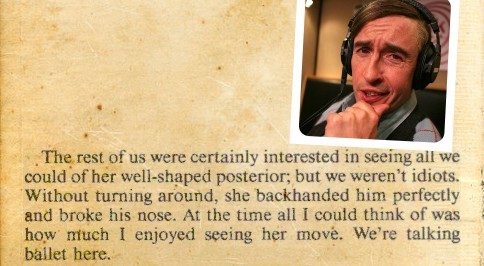
Doom: He's got an eye for the girls…
He's got an eye for the girls…


…but a couple of pages later once the gore began to kick in, it occurred to me that this is textbook Garth Marenghi, and that's the inner-monologue voice which stuck thereafter…
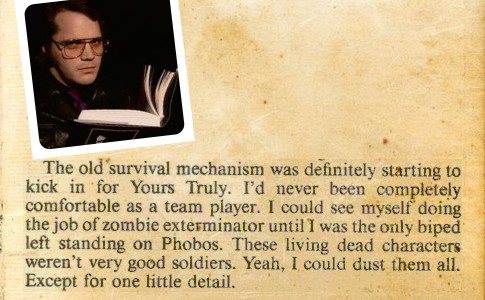
Doom: …and an eye for the GUNS!
…and an eye for the GUNS!


There are human characters besides Flynn and his lust-object colleague Arlene Sanders of course, but everyone somehow manages to be less likeable than the invading hordes of the netherworld. Naturally, being A Guys' Book for The Guys to read like The Guys would, the authors (and they're each authors of other stuff as well, mind - it's not like they knocked this one out and were never published again) have added dashes of wry humour to break the otherwise inescapable tension of their tome…

Doom: And reader, neither will you...
And reader, neither will you...


The first undead soldier our hero runs into when he's on Phobos is called William Gates. Yes, Bill Gates. I think this is what passed for hilarity in 1995. And it's not just the corny nature of the asides which caused me to recoil in horror, as we get to play Spot The Grammatical Error, too…

Doom: Proof-readers? Where we're going we don't need… 'proof-readers'.
Proof-readers? Where we're going we don't need… 'proof-readers'.


This, as well as glaring internal inconsistencies...
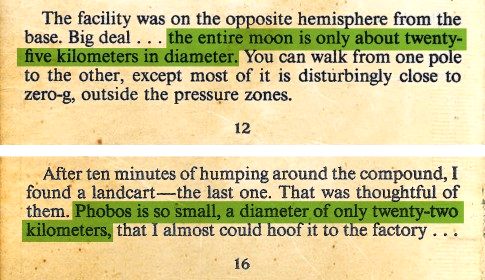
Doom: Help! Come quickly! The moon is SHRINKING!
Help! Come quickly! The moon is SHRINKING!


I guess that's what happens when you have two authors who don't have each others' phone number. That said, Phobos is actually an irregular shape, which could allow for the confusion. Except that I don't expect the novel to be an encyclopaedia. Make it any fucking size you like guys, just choose one and stick to it. That's what you're being paid for. But better than all of the above is this absolute beauty…
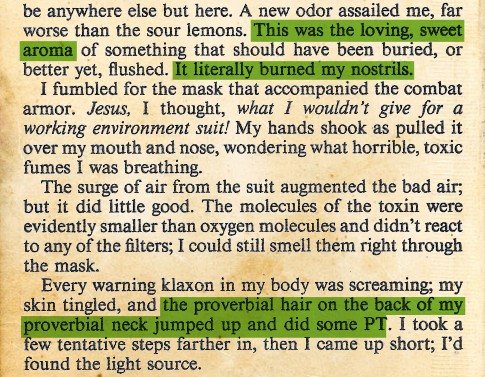
For an author to not know the definition of 'literally' is unfortunate. To demonstrate one's corresponding unfamiliarity with 'proverbial' ON THE SAME PAGE is catastrophic…


I've read a few game tie-in novels before, none of which have been as inept as this. Reader, I do not mind admitting that I gave up on Doom: Knee Deep In The Dead before finishing it*10. A bad movie takes the same amount of time to watch as a good one. A bad book is like slow-motion self-flagellation for the brain. Ridiculous.

There are, apparently, three more of these novels. Sweet Christ…
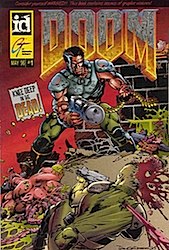


Doom (comic)
Doom: Knee Deep In The Dead!
Steve Behling & Michael Stewart (1996)

Well, it's shorter. If the Doom comic has one thing going for it, it's that the Doom comic is shorter than the Doom novel. I mean, it makes less sense to the point where it's not even trying to be coherent, but the whole thing will only take fifteen minutes off your life. If you read it twice. The opening page credits-panel bears the words "Vol.1 Issue 1" in a way which suggests that writers Steve Behling and Michael Stewart have no comparative references for the words 'optimism', 'hubris' or 'delusion'. No further issues were produced (and if anything, this went on to become something of a collector's item, albeit for the wrong reasons). The credits-page also claims that the publication has been edited. Although given the fifteen pages which follow, one dreads to think what manerial didn't make the printing press…
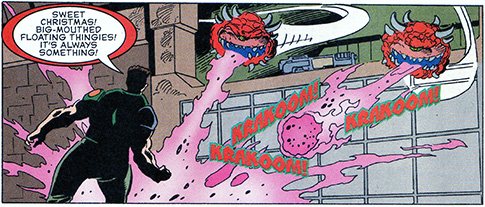
Doom: Reader, this dialogue was actually published...
Reader, this dialogue was actually published...


The story is still on Phobos. Well, I say 'story'. The events of this comic take place on Phobos. Well, I say 'Phobos'. The events of this comic take place in an industrial/military complex filled with the bad guys from Doom and the guy in a green combat suit running around taking them all out. Well I say 'comic'. It's sixteen pages long, whereas standard-format is twenty-two. Comics are a primarily visual medium, but they are supposed to be about visual storytelling. Leaping in medias res with not so much as a location-card, Knee Deep InThe Dead! is a series of barely connected, sketchily drawn panels, narrated by a character with no character and by writers who confuse word-count with meaning. If the novel tries to create a story out of nothing, the comic shovels in dialogue where none should exist at all…
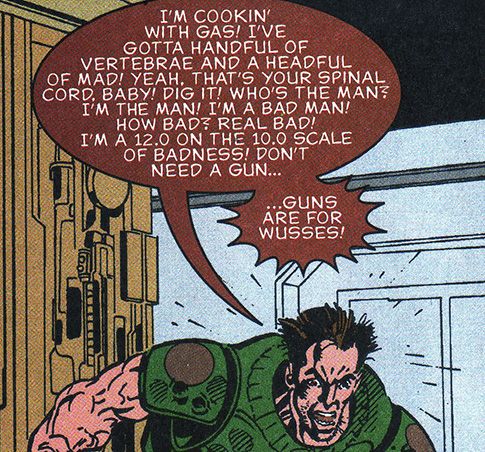
Doom: I'm glad this panel has so many words, because I have none...
I'm glad this panel has so many words, because I have none…


With such a slight pagecount, it's almost admirable that the writers don't try to create a plot where none exists, but to think that two people are responsible for the babbling which fills the vacuum as a result is incredible. You'd think that the art would take centre stage in a comic-adaptation of an iconic game. Ah. Tom Grindberg's*11 loose,sketchy style is heavy on the ink meaning all that's needed for the colours is mostly flat blocks behind the linework. The end result looks very cheap and with a final product like this it's hard to know if that's aesthetically intentional or just budget constraints. Although credit where it's due, Tom clearly enjoys drawing the monsters from Doom. Even if he's as slapdash at that as he is everything else.
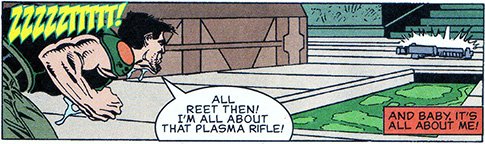
Doom: Our protagonist appears to be from Newcastle, which could explain a lot of you think of this as Biffa Bacon on absinthe, viagra and mescaline…
Our protagonist appears to be from Newcastle, which could explain a lot of you think of this as Biffa Bacon on absinthe, viagra and mescaline…


The Doom comic is every bit as bad as the Doom novel, although mercifully far more brief. It's perhaps telling that the live-action movie spinoff wouldn't see the light of day until nine years after this.

If you remain to be convinced, you can read the comic here. You can say you were sent, but you can't say you weren't warned…*12



Is the original thing any good, though?
Uh-huh.
It is the best thing
.


Is the film-version any good, though?
It's better than you've heard, but not as good as you'd hope.


So, should I check out one, both or neither?
Game, definitely.
Movie, probably.
Comic, not likely.
Novel, not at all
.


Oh, is there a Wilhelm Scream in it?
Not in the game and not in the movie that I heard.


Yes, but what's the Star Wars connection?
Level 1: The film's got General Antoc Merrick in it.


*1 Note for younger readers: since a significant amount of processing power was allocated to running the operating system alone on those machines, not leaving a lot for the dynamic demands of full-screen slaughter, we had to exit Windows completely and launch the game by typing a command line. It sounds prehistoric now, but bear in mind that when we switched the computer on in the morning, we also had to start Windows with a similar typed command. You kids don't know how lucky you are with your PinPods and your PlayBox 4's… [ BACK ]

*2 In The Face™. Hard. [ BACK ]

*3 Note for non-Steam using nostalgists (or readers landing here from a Google search): If you happen to be loading up the game from the Doom Collectors Edition CD, you'll need to create a DPLAY.DLL file after installation, and you'll have the Doom95.exe executable, which doesn't include mouse-support in Windows XP or higher. While it's technically possible to play the game without using the mouse to look left and right as you strafe with the keys, that's not a fun experience. You can download David Kay's Ultimate Doom mouse-installer at the link on this page, and it's an absolute godsend. It should also be noted that I'm including this link for my own future reference, since I'll probably have lost the link by then. Truth be told, I lost the link between installing the game and drafting this paragraph... [ BACK ]

*4 And all the more irrelevant because of how much sense it doesn't make. Think for example, how impractical this military base would have been before the portal opened and the aliens invaded.
"How do I get though this door, Terry?"
"Oh, the unlock-switch is three quarters of a mile away, down one of those similar-looking corridors there…"
"Standard…"
[ BACK ]

*5 The same colleague who installed Doom on the works-computer also procured, at a later date, a mod which swapped out all the bad guys for Stormtroopers and Imperial Officers from Star Wars. You can imagine my excitement. You can also imagine how far apart my mind was later blown by playing Lucasarts own bandwagon-jumper, Dark Forces, to this day one of my favourite Star Wars games. [ BACK ]

*6 Which, much like Mario Bros and Street Fighter II, I happen to own, hence my appraisal of it for Adaptation. And yes, in scheduling the gaming-section of this series, I did essentially just open my drawer of SNES games and go "right, which ones of these have been made into movies?". Although I bought the PC version of Doom from off of Ebay. Come on, it's not like I put no effort into this… [ BACK ]

*7 I managed to get to the end of Command Control (level 4 of Knee Deep In The Dead) before sacking the whole thing off and going back to the PC version. Although I've never been known for my patience as a gamer... [ BACK ]

*8 Well, in the case of the Doom movie it's more of a $60 million dollar question, since that was its budget. But hey, at least it made back $56m of that, right..? [ BACK ]

*9 I, for one, cannot imagine for a second why Universal decided not to create an 18-rated gorefest full of Satanic imagery and literal, non-rational demons. It's not like they completely nerfed the project by making it a 15-cert starring an ex-wrestler, they just removed the uncompromising cornerstone of what made the original so entertaining… [ BACK ]

*10 And I did not do this lightly, having only ever abandoned two books before (Alan Dean Foster's 1979 Alien novelisation - the book transforming a masterclass in cinematic tension into an almost indescribably boring shopping-list of events, and James Frey's A Million Little Pieces - a borderline illiterate and attention-seeking memoir from a confessed fantasist and liar). That said, since I've read the Doom novel to completion in the past, I suppose it doesn't really count as part of that list after all… [ BACK ]

*11 Tom Grindberg is his real name, by the way, not some amusing gory-pseudonym adopted especially for the comic (he's listed as Tom "Gallows" Grindberg on the credits-page). He's actually a proper comic-book artist. He's worked for Marvel and DC and 2000AD and everything. Without having looked into his wider canon, I'm going to assume the Doom project was a pad he kept down beside the toilet. [ BACK ]

*12 And again, thanks for reading all these. Twelve footnotes may seem excessive, but this has been a long post. Although if it's any consolation, nowhere near as long as the 'research' which went into writing it. And look on the bright side: This is the final Adaptation, so you won't have to wade through any more pieces this unwieldy. Well, probably… [ BACK ]


DISCLAIMERS:
• ^^^ That's dry, British humour, and most likely sarcasm or facetiousness.
• Yen's blog contains harsh language and even harsher notions of propriety. Reader discretion is advised.
• This is a personal blog. The views and opinions expressed here represent my own thoughts (at the time of writing) and not those of the people, institutions or organisations that I may or may not be related with unless stated explicitly.

Thursday, 23 November 2017

Adaptation: Street Fighter II


The A-word.
It's the bane of cinephiles, everywhere.

That book you love; the comic you remember; the show you used to watch; the game you lost an entire summer playing? Oh, someone's adapted it and it's getting made into a movie! Whether a cause for pre-emptive celebration or foreboding caution, it leads to only one thing: expectation. And expectation is the death of the 'clean' movie-viewing experience; no matter how closely the film sticks to its source material, or how much it tries to distance itself, it will be faced with the hurdle of comparison.

And while the movie industry loves the pre-built marketing buzz of 'now a major motion picture!', they loathe the comparative references which will be made from the first review onwards. Because many punters will expect to get exactly the same reaction from a completely different medium, to a story they already know. And therein lies the problem.

In this monthly series, we'll look back at some of the most respected and best-loved properties which have made the perilous journey to the big screen; often with some controversy, and almost always with far too much hype. This isn't so much a review of the films themselves, more an appraisal of their suitability as an adaptation.


Super Street Fighter II: The New Challengers
Super Street Fighter II:
The New Challengers
(SNES)
Capcom (1993)

Moving on slightly from Mario but still at the heart of SNES gaming, Street Fighter II is the very paradigm of Bushnell's Law; ridiculously easy to learn, ridiculously difficult to master. The beat-em-up genre has been around as long as games have had the capability to represent fists of course, and the explosion of home computing in the 1980s raised the bar with side-scrolling, co-operative, multi-sprite brawling titles, and of course ushered in the End Of Level Boss. But as a sequel to their 1987 1-on-1 combat title, Capcom's Street Fighter II quickly developed a life of its own, in both arcades and living rooms around the world. The port to the Super Nintendo Entertainment System was the first, and is generally accepted as the purest, home-version of the game, and the title went on to have multiple re-releases with various tweaks and additions. For this comparison I've chosen to play 1993's Super Street Fighter II: The New Challengers, the reasons being that 1) characters debuting in this release of the game are included in the movie adaptation I'll be watching (plus in the bonus-round), and 2) again, it's the version I've got upstairs with my SNES.

So. It's a classic, obviously. The secret to Capcom's success with SFII wasn't so much the array of characters, each with differing speeds, fighting styles and special moves, but rather that the player can choose to control any of them to begin with (as opposed to the 'character unlocking' method). What's more, when the player is beaten by an opponent, they can choose a different avatar to have another try (or just keep on with the same one and extra determination/optimism). While the first version of the game held the four 'bosses' off-limits, meaning only the original eight characters were playable, everything from second, Champion Edition, release onwards puts them on the selection screen. Additionally, The New Challengers throws an extra four into the mix, bringing the total to sixteen. Beating the game using all the players at your disposal is easily possible. Beating the game using only your favourite requires dedication. I imagine it's also theoretically possible to work through the entire game as every individual character, in completely separate sessions. And while I'd love to have that amount of spare time on my hands, even I have to admit I'd use it for something else. But as I said, Bushnell's Law and all that.

So, shortly after SFII's domestic release (meaning kids could play in the comfort of their own homes and didn't have to keep weighing down machines with 10p coins), the game entered that secondary level whereby it became part of popular culture. While it didn't quite have the broad demographic appeal of Mario, the fanbase was no less committed. And although the merchandising opportunities are slightly narrower for a property which involves each of its principals knocking the living shit out of every other one, the range of dynamic internal character design lent itself to numerous toys*1, comics and anime movies, all of which have continued to be produced over the years, alongside sequel and spin-off entries on various consoles.

But at the heart of it all was one breakout game, held on a single 16mb cartridge. It's not the first beat-em-up (not even the first in its series), and it stands in a very crowded arena, but Capcom's Street Fighter II is one of the few that can be genuinely described as culturally iconic.

It's been 24 years and I can't always do a Hadouken.


Street Fighter
Street Fighter
Steven E. de Souza (1994)

First things first, I should point out now that I haven't actually seen this film before*2. And not that I was doubting anyone's previous judgement for a single second, but yeah it's bad. Indescribably bad. But bear with me dear reader, I'll try…

Despite the lack of narrative development in the famed 1-on-1 fighting title, the problem writer/director Steve de Souza faces here is not necessarily 'how do you adapt a game with no story?'. As of the New Challengers release, SFII actually has sixteen stories, some of which overlap, but are generally self-contained. The only points at which these characters meet in-game is, as noted above, when they're out in a street somewhere knocking the living shit out of each other. And that's not going to make for a great mainstream, family-friendly screenplay. Anyhow, Steve decided that the best way forward would be to write a new independent, thoroughly incoherent narrative, desperately shoehorning all your favourites together for no reason, many unrecognisably until they're either excessively introduced by the script or some other character name-checks them pointedly.

This really is all kinds of shite. Wobbly sets, costumes which look like they were designed for Flash Gordon but rejected and some of the worst ADR I've ever seen (and then heard around a second and a half later). From Raul Julia over-channeling his best Darth Vader*3, homages to schlocky Hong Kong action cinema, James Bond and 70s exploitation movies, the film would happily forget it's supposed to be adapting Street Fighter. That is, it would if it didn't have another yet character to reference, introduce or squander with alarming regularity.

The movie sets up a ticking-countdown-timer-ending before the fifth minute is out, then another one begins at 40 mins, then another one at around 80 mins. Incredible. Although I actually had to stop myself taking detailed notes after 22 minutes when a truck drives four feet away from Chun Li and she goes into a ground roll for no reason…

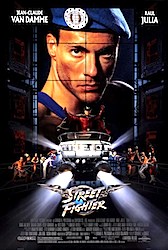
It seems clear that some of the cast thought they were taking part in something which would be better. I certainly won't blame them for trying, unfortunately everyone else has their tongue so firmly in-cheek that dialogue becomes impossible. Heading up the roster is Belgian Jean-Claude Van Damme as the American Guile, atrocious even by his own standards*4 and quite frankly so incompatible with the character that he'd have been more convincing as Balrog.

Australian Kylie Mingoue stars as the British Cammy, Chinese-American Byron Mann as the Japanese Ryu, American Andrew Bryniarski as the Russian Zangief*5, Native American Jay Tavare as the Spanish Vega, Native American Wes Studi as the Thai Sagat, and the Japanese sumo-wrestler Edmund Honda is now the Samoan-American Peter Tuiasosopo (although they've scripted his ethnicity into the film, that one's not just left out in the wild like the rest). Hey, at least Ken is still a white dude though, right? Shame Damian Chapa doesn't have the trademark blonde hair like his character, but that seems pretty fucking far down the list of issues to be honest. By the time Blanka emerges looking like Tina Turner playing The Mask, I'd all but given up.

How is this Street Fighter?

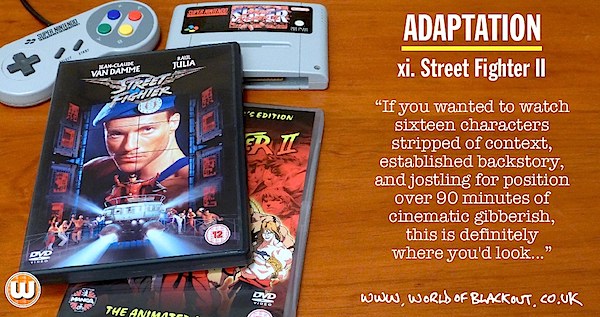
For an adaptation of a game which is 100% combat, there is surprisingly little fighting in the first hour (and even after that it's appallingly choreographed). But there's certainly no doubt that if you wanted to watch your sixteen favourite characters stripped of context, established backstory and jostling for position over 90 minutes of cinematic gibberish, this is definitely where you'd look...

How do you adapt a game with no story?
Well, how about you don't..?


Street Fighter II: The Animated Movie
Street Fighter II:
The Animated Movie

Gisaburô Sugii (1994)

What's amazing about this is that the animated movie was released four months before the live action one. Which is to say that there was a period between August and December 1994 when Steve de Souza could, I'm pretty sure, watch the publicly-released anime adaptation of the world's most popular fighting game, whilst also being one of the few people on the planet to know what was in store with his own… version. I admire the man for not having Universal pull the plug and claim that the dog ate the master copy, at any rate.

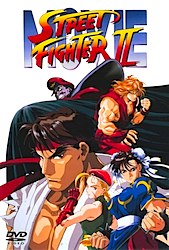
There is more attitude, anger and adrenaline in the first five, dialogue-free, minutes of this film then the entirety of its live-action counterpart. Kenichi Imai's screenplay centres around M. Bison's terrorist organisation and with Ryu and Ken at the heart of the story once again, but this time hops around the globe to meet its characters, rather than contriving to have them all coincidentally be in Raul Julia's lounge together. What's more, individual characters' backstories from the game are maintained, proving that it can actually be done coherently.

The artwork is classic Japanese anime, and I don't think I'll ever get tired of the clunky charm of a 3D scene rendered in hand-drawn 2D. It's a style which lends itself perfectly to a story which originated in the same cultural arena, and the fight-scenes are dynamic without having to go into clinical detail (exactly like the game in that respect). Which brings us onto the most important aspect - there's a lot of fighting in this. And okay, the characters are scrapping often for no reason other than 'having a street fight', but that already makes the animated movie thematically closer to the game than the live-action will ever be.

The English-language dialogue is hardly Dickens, in either its writing or delivery, but it still manages to piss all over de Souza's work. The western release also has a slightly over-engineered grunge/industrial soundtrack, with John D'Andrea and Cory Lerios scoring the incidental music and songs dropped in from the likes of Korn and Alice In Chains.

Although Sugii's movie came well after the arcade and home-releases of Street Fighter II, everything in it adds depth to the characters and increases replay value of the Nintendo classic.

Best bit: Henchman and chief scientist Senoh unveils Shadowlaw's new covert surveillance system to his master:

M. Bison: Is it ready?
Senoh: Yesss… a masterpiece of computer technology; it's splendid. We've created the ultimate high-performance monitor cyborg. It's state of the art. The images it receives are immediately beamed via satellite to the super computer…
M. Bison: (narrowing eyes) Goood…


…showing that all you needed to impress a global crime-lord in 1994 was basic internet connectivity. 2017 would likely blow his tiny mind…


Is the original thing any good, though?
It's better than good, it's definitive.


Is the film-version any good, though?
Hahahahahahaha...


So, should I check out one, both or neither?
If you wish to see the live-action movie, it's filed between Morbid Curiosity and Fucking Told You So...


Oh, is there a Wilhelm Scream in it?
In the game, there's not.
In the anime, there's not.
In the movie there actually might be, lost in a horrendous sound-mix, but I'm not going to go back and check...


Yes, but what's the Star Wars connection?
Level 1: The original game's voice-cast appears to be a mystery. Seriously, not even Capcom are talking about it. However… the live-action movie has James McTeigue as the second-assistant director; he was first assistant director on Attack of the Clones*6. The anime movie (well, the English-dubbed one) features the voice of Zeb Orrelios.


*1 Although let's be honest, the 1993 G.I. Joe tie-in line is pretty dreadful. That said, I suppose the figures make an ideal artistic accompaniment to the 1994 live-action flick. And I deliberately haven't mentioned the single they released up there in the main review. But since you're lovely enough to read the footnotes, don't click on this link. I'm not saying it's worse than the same era's Mario Rap, but I also definitely am. [ BACK ]

*2 As buzzed as I was at the time about the mere prospect of a Street Fighter movie, younger readers should understand that even in the days before the advent of the domestic internet connections, the trailers and advance publicity for the Street Fighter movie began to paint an all-too-accurate picture of what was ultimately in store. A studio didn't have Rotten Tomatoes to blame for their movie tanking, back then. The feature was the subject of mockery and derision by the time it actually opened on UK screens, and the decision by my local cinema to not show it outweighed any curiosity I still harboured. Similarly, by the time the movie hit VHS shelves, I was not inclined to investigate. I have seen various clips over the intervening years, but this is the first time I have actually watched the film in its entirety. Because obviously, having pulled over 900 movies apart on this blog, I am now in a position to be incredibly forgiving to its perceived flaws... [ BACK ]

*3 Although credit where it's due, M.Bison wearing a smoking jacket and mixing cocktails is fucking gold. [ BACK ]

*4 Coincidentally to *2, the same decision was made by that same cinema to not show Van Damme's Timecop either, despite running trailers and having a full-on display stand in the foyer. It should surprise no-one to learn that when I finally caught that movie on video, I wished the time-travelling technology existed, if only so I could go back and warn myself not to bother…
[ BACK ]

*5 Whose Russian-accent keeps dipping into the 'Allo 'Allo representation of Italian… [ BACK ]

*6 I mean I love AotC, but seriously - imagine having that and the Street Fighter live-action movie on your CV… [ BACK ]


DISCLAIMERS:
• ^^^ That's dry, British humour, and most likely sarcasm or facetiousness.
• Yen's blog contains harsh language and even harsher notions of propriety. Reader discretion is advised.
• This is a personal blog. The views and opinions expressed here represent my own thoughts (at the time of writing) and not those of the people, institutions or organisations that I may or may not be related with unless stated explicitly.
Tuesday, 31 October 2017

Adaptation: Super Mario Bros.


The A-word.
It's the bane of cinephiles, everywhere.

That book you love; the comic you remember; the show you used to watch; the game you lost an entire summer playing? Oh, someone's adapted it and it's getting made into a movie! Whether a cause for pre-emptive celebration or foreboding caution, it leads to only one thing: expectation. And expectation is the death of the 'clean' movie-viewing experience; no matter how closely the film sticks to its source material, or how much it tries to distance itself, it will be faced with the hurdle of comparison.

And while the movie industry loves the pre-built marketing buzz of 'now a major motion picture!', they loathe the comparative references which will be made from the first review onwards. Because many punters will expect to get exactly the same reaction from a completely different medium, to a story they already know. And therein lies the problem.

In this monthly series, we'll look back at some of the most respected and best-loved properties which have made the perilous journey to the big screen; often with some controversy, and almost always with far too much hype. This isn't so much a review of the films themselves, more an appraisal of their suitability as an adaptation.


Super Mario World
Super Mario World (SNES)
Takashi Tezuka (1990)

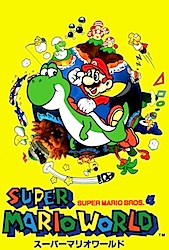
As Adaptation speed-runs through the first level of its button-mashing quadrant, there are three reasons why I've specifically chosen to play Super Mario World. 1) This is the game I lost a couple of Summers to in the early 90s (as referenced up there in the introduction), 2) This is the game which introduces Yoshi the dragon, who also appears in the film-version (and so provides the closest chronological influence for the film), and 3) This is the game I've got upstairs with my SNES*1. Hey, path of least resistance and all that...


It's certainly true that the moustachioed plumber was a thing before this particular installment of the franchise, of course. Mario has become to gaming what Darth Vader is to cinema; an iconic figure of the artform, a mainstream touchstone symbolising the progression and durability of the hobby, familiar even to people who've never so much as picked up a game-controller, let alone thrown one down in a fit of pique. The game harks from that golden era where domestically-affordable computing power had raised graphics and gameplay mechanics above the NES and Gameboy limitations, but before the 3D conversion-influx that the N64 inevitably brought.

But Super Mario World. Man, what a game. 96 levels, 24 of which are hidden, and the option of playing through them all linearly or taking secret short-cuts to skip the ones which are stumping you. Much like the London Underground, there's often more than one way of completing your journey (and much like the Underground, the hardened fanatic will take the extra time to visit each station anyway - that's where the fun lies*2). While this isn't exactly sand-box gaming, the ability to hop back through the world-map for power-ups and activate retrospective key-reveals makes the replay value absolutely massive.

Relatively short levels mean a high-level of 'unputdownable' gameplay, as you think 'Okay, I'll just complete this level before going to bed/work/court'. This is the hook of course, as it's rarely that simple. The skills learning-curve is steady, making Super Mario World ideal for younger (and older) players who might find the controller less intuitive. But like all good games, there comes a point where you have to sit up and start really concentrating, or be doomed to fall down the same pit for hours on end.

I've briefly tried other iterations of Mario after this, but the 2D platformer is my preferred format, and the SNES is my preferred presentation.
A fantastic game, as timeless as its hero*3...


Super Mario Bros.
Super Mario Bros.
Annabel Jankel & Rocky Morton (1993)

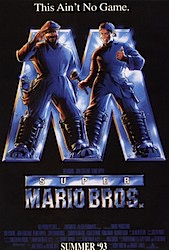
Perhaps the most remarkable thing about 1993's Super Mario Bros movie is that at a point between post-production and release, someone watched the whole thing back and still gave it the green light. Bob Hoskins stars as Mario Mario, an American-Italian plumber working out of Brooklyn with his younger brother Luigi Mario (played by John Leguizamo*4). Luigi falls in love with an archeologist named Daisy (Samantha Mathis), and the brothers find themselves on a mission to rescue her when she accidentally falls through a dimensional portal at a dig-site and is captured by the evil King Koopa (Dennis Hopper).

The problem is that other than the character names and a couple of shoehorned references to red/green overalls, the film bears almost no relation to the very property it's shamelessly exploiting as its sole marketing focus. Cinematically notorious as a worst-case-scenario of the game-to-movie genre, it's actually no worse than many other family-oriented adventure flicks of the era. Although they were dreadful as well. And of course the whole world didn't see most of those, since they weren't misguided tie-ins to a globally successful game franchise.

The script is leaden and simplistic (not that it's the worse offender), utilising some manner of 'de-evolution machine' in its story as if the concept of natural-selection had even been in the same room as this screenplay. The way the premise and princess-kidnap-plot are wangled from the pixellated fantasy origins and into 'the real-world' is a bit like when theatre producers go 'yeah, we'll set Hamlet… in space!!', and then leave the original 16th-century dialogue in place so that the whole thing doesn't work. Despite the full-length 99-minute runtime not a lot actually happens here, and what does happen makes little-to-no sense even with industrial amounts of exposition. Oh, and Dennis Hopper's dinosaur-based villain is a actually just middle-age man scowling with excessive amounts of product in his bleach-blonde hair*5. When he's padding around the soundstage representing a filthy, dystopian city, it feels for all the world like Michael Bay got pissed and decided to re-adapt Blade Runner for kids.

Co-directors Annabel Jankel and Rocky Morton have a legally-binding credit in the film's opening sequence (laid over the movie itself rather than an inserted-card), yet are somehow not mentioned one single time in the closing reel. Almost as if the traditional attribution had been removed on purpose so that the audience wouldn't be able to scribble down the names of those responsible. The first words to appear in that end-scroll are a nod to Roxette for the closing music. Imagine being so mortified with your own work that you'd dump Roxette in the shit over it. Well, quite.

On a technical level, the sound-mix on my 'remastered' DVD is atrocious with background noise rushing to fill any auditory gaps and then flopping over the dialogue. I can't imagine how bad it must have been in the vanilla-print (not that I'll be hunting it down to find out). This perhaps wouldn't matter so much if the disc actually had a basic subtitle-track but it doesn't and now I can't believe I'm complaining about this like it would have made the damned thing any more bearable*6.

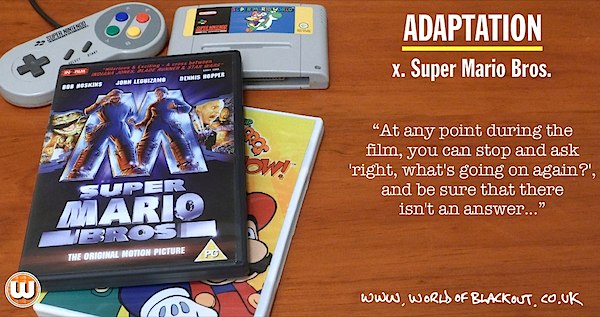
At any point in this film you can stop and ask "right, what's going on again?", and be sure that there isn't an answer.

Super Mario Bros isn't even "delightful hate-watch" bad, it's just crap. The whole endeavour is based on what-iffery. The title-sequence opens with an entire monologue of it. "What if the dinosaurs weren't all destroyed? What if the impact of that meteorite created a parallel dimension? And, hey! What if they found a way back?".

Apparently at no point during the creation of this movie did a producer lean forward and say "…yeah, what if we all don't bother though?"


The Super Mario Bros. Super Show!
DiC Animation (1989)

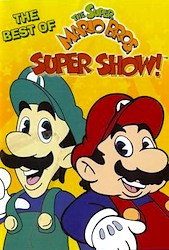
First things first, I watched the cartoon-segments of this. The 'Super Show' consisted of a live-action Mario Bros sitcom acting as a framing device for animated shorts of the plumbers (and The Legend of Zelda in some episodes). Anything which isn't cartoons is awful. All I'm saying is that 'The Super Show' was the scheduling-name for the combination of everything, but when a Best-of DVD was published, someone decided that 'Best-of' didn't go so far as including any of the live-action segments. But hey, by all means see for yourself. Anyway, I watched a couple of hours' worth of the Mario animations. They're uncomplicated but quite a lot of fun, especially for fans of 1980s animation.

Starring Mario, Luigi, Princess Toadstool and little Toad, each episode is self-contained and takes a theme as the basis for the week's story (Jack & The Beanstalk, Aladdin etc). The first chapter on the Best-Of DVD is Star Koopa, which opens with Mario and gang on a spaceship being pursued by Darth Koopa. Cue the Koopa-troopers in white armour, the transparent equivalent of Carbonite and some non-copyright-infringing (and stun-only) lightsabers. If anything, what would normally be a heavy-handed pastiche works more as an actual homage, due to the visual and tonal similarities to Nelvana Animation's Holiday Special and Droids cartoons. This particular episode is the sort of thing I'd usually hate, but the overall charm of the series pulls it off.

Even with the disposable writing-format restricting any kind of development, and its always-changing, context-free location settings, the Super Mario Bros cartoon still makes infinitely more sense than anything in the 1993 movie...


Is the original thing any good, though?
Yes, yes, yes and yes.


Is the film-version any good, though?
No*7.


So, should I check out one, both or neither?
…maybe just enjoy the game?


Oh, is there a Wilhelm Scream in it?
In the game, no (there's no sampled dialogue), in the movie there's not that I heard (although I was just short of screaming inside my head for an hour and half) and I didn't hear one in the cartoon eps that I watched.


Yes, but what's the Star Wars connection?
Level 1: The game's character-writer Shigeru Miyamoto was a crewmember on Nintendo's 1996 Shadows of the Empire N64 game, whereas the film-version stars one of TPM's Gungan Guards and the cartoon features the voices of Thall Joben and Vlix from Droids.
That's pretty good-going, all things considered.


*1 An actual SNES, as opposed to the recently-released SNES-mini. No snobbery against the new version (I'm all for it, in fact), but there's not a lot of point in me buying one when I still have a functioning, vintage SNES and all the games I want to play on it anyway. [ BACK ]

*2 FYI, I'm not a train geek, I just love that train geeks exist. In all fairness, I suspect I'm not a train geek because Star Wars got its foot in the door first and I've only got so much disposable cash. As a wise man once observed, 'collectors are like freemasons, but without the handshake...'. [ BACK ]

*3 Yeah I know technically it's heroes and Luigi is available as a player as soon as someone picks up the other controller, but it's not called Super Luigi World, now is it? We all know that Mario's brother is the hanger-on in this partnership. While Mario's doing the skilled work of re-plumbing a toilet-main, Luigi's mopping up the sewage with that slack-jawed expression on his face. No, don't look at me like that, no-one likes Luigi. He's basically Scrappy-Doo in overalls... [ BACK ]

*4 Okay, Bob Hoskins may not be entirely Italian-looking, but John Leguizamo is fucking Colombian. What does this suggest about the casting director? Does the film's artistic license extend to the point where the brothers aren't actually from the same continent, never mind the same mother? And let's not go into the dynamics of a family where there's a 22-year age gap between brothers... [ BACK ]

*5 And okay, the fresh-faced John Leguizamo was only 29 with this movie was released, but Bob Hoskins and Dennis Hopper were actual, established actors by that point. Granted, neither has a perfect decision-making record even outside of Mario Bros (Leguizamo also guilty on that front), but I mean really guys, what the actual fuck? [ BACK ]

*6 The best part? I've actually seen this film before. In 1993. In the cinema. No, really. I don't remember actively hating it, although a nagging disappointment certainly factored into my reactions. But now, enough time seems to have passed that I'd forgotten how bad it could be. Anyway, I am next due to watch Super Mario Bros in 2041. Can't wait. [ BACK ]

*7 NO. [ BACK ]


DISCLAIMERS:
• ^^^ That's dry, British humour, and most likely sarcasm or facetiousness.
• Yen's blog contains harsh language and even harsher notions of propriety. Reader discretion is advised.
• This is a personal blog. The views and opinions expressed here represent my own thoughts (at the time of writing) and not those of the people, institutions or organisations that I may or may not be related with unless stated explicitly.