Yesterday (part two of two, SPOILERS)
Cert: 12A / 116 mins / Dir. Danny Boyle / Trailer
This is part two of my Yesterday review, and it contains spoilers. If you haven't seen the film yet and you're just wondering whether you should/shouldn't bother (you should), you can read part one here. Under the normal run of things, this would be what I call a second-pass review, hopefully picking up new notes and observations from a repeat screening. This time however, it's more a list of things I noticed the first time round, wanted to confirm with a second viewing and couldn't include in a spoiler-free review anyway.
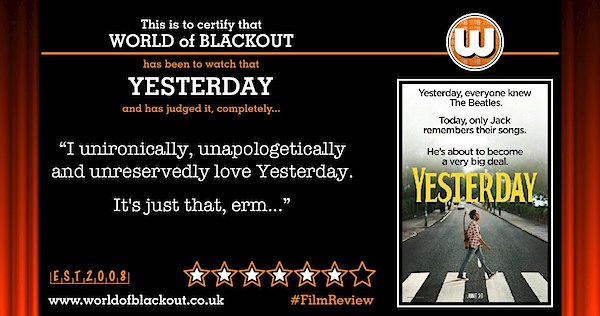
Before I begin this laundry-list of complaints, I should point out again that I unironically, unreservedly, unapologetically love Yesterday. It's twee, it's corny, it's got people in it who I don't like and parts of the film just don't work on a logical level, but I don't care. The phrase 'feel-good' is often used to damn with faint praise, but on this occasion I can think of no greater compliment. Yesterday is glorious.
It's just that, erm...
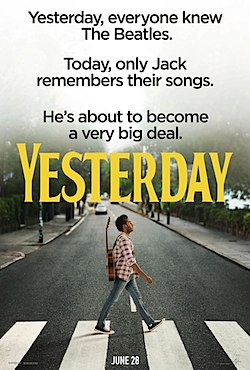
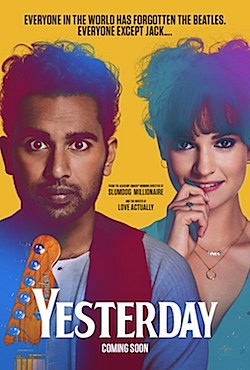
Well it doesn't work, does it? The premise I mean, or particularly its execution. Now I've seen various reviews and articles describe the setup as Jack waking up from his accident to a world where no one remembers The Beatles (including one of the film's own posters, alarmingly). That's not what happens here. Jack wakes up to a world where The Beatles never existed, and there's a massive narrative difference between the two. This isn't a case of global amnesia, the recognised timeline has been altered at some point in the past, then Jack is re-inserted at the juncture point with only memories of the now-alternate reality. If anything, this is an extension of the mechanics explored in Richard Curtis' earlier piece, About Time.
And true to form, Curtis (and to a lesser extent the co-writer of the story, if not the screenplay, Jack Barth) displays a grasp of causality every bit as firm as his one on time travel*1. In the words of Red Dwarf's Holly, "there's no such thing as small" when it comes to changing time. And removing one of the most influential cultural phenomena to ever exist then spinning forward half a century isn't even meant to be small. So let's dive in...
KNOWLEDGE It starts with Oasis. Shortly after realising that no one has any knowledge of The Beatles, Jack decides to check his record collection and sure enough, those discs have disappeared. So the next stop is Google and sure enough, there's no trace of the band on the internet either. Jack begins looking for other artists, to see how widespread the problem is. Bowie, yes. The Stones, yes. And there's a Fratellis poster still on his bedroom wall. But Oasis have disappeared. It's well documented that the Mancunian band were heavily influenced by The Beatles, so Jack sighs and looks at his computer monitor. "Yeah, that figures", he mumbles. Good joke. Everybody laugh.
But we've already seen a flashback of the time that Jack first impressed Ellie at a school concert in 2004, as the youngster played a cover version of Wonderwall by... Oasis. So without the existence of The Beatles and therefore Oasis, Jack wouldn't have played Wonderwall at the gig. He'd have played something else of course, and evidently it still created the pan-dimensional bond with Ellie. But what song was it instead? Why wouldn't this be the next question to pop into Jack's mind? Why doesn't he pick this up with Ellie and ask her details about the concert he can't now remember properly? When Jack's busy in L.A. plagiarising The Beatles in the recording studio, why doesn't he throw a couple of Oasis songs in there, too?
Surely a movie which centers around the enduring legacy of The Beatles should show that their influence spreads throughout pretty much everything which followed in popular music, to some level. Even bands who don't attempt to ape the sound or song structure are aware of The Beatles work, sometimes avoiding those tropes for the same reason as others tribute them. The musical landscape of 2019 would be unrecognisable if The Beatles hadn't formed.
BURST And it's not just the music itself. Countless people have met, bonded, loved and even fought over the some of the greatest songs of the 20th century. The reality that Jack snaps into after his accident would be massively different all over, and there's a fair chance that the people he knew - if they even existed in the new timeline - wouldn't recognise him. To assume that in the absence of The Beatles everything else would continue bimbling along but with a different soundtrack completely undercuts the point of the narrative. If anything, it shows the world is essentially no different for their loss.
And yet there are some bizarre offshoots which get raised. Jack repeatedly asks for Coca Cola and Coke, and no one has a clue what he's on about. Pepsi still exists in this new timeline, but not Coke. We never get to the bottom of this. The implication (since it's not explored) is that a knock-on effect from no Beatles is that Coca Cola has gone, too. But Coca Cola first appeared in 1886, some 54 years before the eldest band members were even born. So are we to believe that The Coca Cola Corporation went bust because the song 'Come Together' was never written and their product didn't get a mention? That was a throwaway line, not an advertisment. The Beach Boys made a reference to the drink too (five years earlier), and Elvis did an actual product placement run in '77. I think Coke were doing alright without the Fab Four.
Then there's the cigarette moment. Apparently in the altered universe, cigarettes either don't exist or just aren't called cigarettes. This all happens in under a minute, also isn't properly explored, then is never referred to again. But the term was coined in 1830, in the French town of the same name. So is the implication that without John, Paul, George and Ringo, the habit died out in the 1960s and now nobody even remembers cigarettes? Well no, because Jack's Google search would have brought up their history until that point. Instead it returns only the name of the town.
Which leads me to believe that something much bigger has changed further back in time, and The Beatles are casualty of this ripple in exactly the same way as fags and Coke. None of this is delved into of course, because we're here for the music*2…
LEATHER ARSE Or at least we are until Curtis and Barth realise that because they haven't properly explained their alternate world and certainly not the actual cause of the rift, there's no way to reset the glitch. The Beatles can't suddenly pop back into existence, because then either everybody's got to suddenly remember them again or everybody's got to magically forget that Jack became famous with their songs. And if Jack pops back into his own timeline then the whole film has been for nothing. So if the previous order isn't restored, the story doesn't have a proper ending.
Instead, Jack makes his confession to a Wembley Stadium full of people with precisely zero of a million questions from everyone afterward, and apparently also not having the arse sued off him by the record company with whom, at that point, he has definitely signed a contract which he voided in a very public fashion. He just goes back into teaching, having dumped a load of tracks on the internet which he intends not to capitalise upon, meaning the record company will claim copyright on the songs themselves anyway since these mythical 'original authors' are nowhere to be found. Great work, Jack.
So because the music-story doesn't end properly, Jack and Ellie's tale just sort of peters out too, lacking the emotional wallop it really deserves after two hours. There's the impression that a lot more is said between them, all off-screen, but by that point the editor has one eye on the credits sequence and the run-time already submitted to the BBFC.
Overall, Yesterday feels like its most interesting aspect has been glossed over to make way for the rom-com, and it feels like the rom-com has been glossed over to facilitate the soundtrack, and it feels like the soundtrack has been hobbled by cramming in too many songs for the film's running time.
And somehow none of that matters, I still absolutely love it…*3
This will be a high water-mark on everyone's CV for some time to come.
Yes, even Ed's.
If you start dissing it, that's possible.
There isn't.
Level 1: I'm sticking with Young Lando. Go on, change my mind.
*1 And much like the retort to any nitpicking of time travel movies, saying "Oh but it's all fictional so it doesn't matter" is not a defence for sloppy writing. The story has to work internally, because if the logic is irrelevant then so are the characters, so is the emotion, and so is the reason for paying £10 to sit in a dark room for two hours watching it. [ BACK ]
*2 Well snippets of the music, as previously noted. I'll go on record now as saying I would happily watch a three-hour cut of this film where each song is played in full rather than clipped out, much like Inside Llewyn Davis and Sing Street. In fact, let's make that a four hour version if someone could throw in a proper deconstruction of the timeline, too. [ BACK ]
*3 And I dread to think what kind of hits this post is going to get by using 'Leather Arse' as the last crossheader, but there we go![ BACK ]
DISCLAIMERS:
• ^^^ That's dry, British humour, and most likely sarcasm or facetiousness.
• Yen's blog contains harsh language and even harsher notions of propriety. Reader discretion is advised.
• This is a personal blog. The views and opinions expressed here represent my own thoughts (at the time of writing) and not those of the people, institutions or organisations that I may or may not be related with unless stated explicitly.
Yesterday (part one of two, spoiler-free)
Cert: 12A / 116 mins / Dir. Danny Boyle / Trailer
There are certain movies where you know you need that soundtrack before the ink has dried on the first act. Inside Llewyn Davis is one, so is Sing Street. And now Yesterday joins that list. And it's not just because of the tracklisting (who doesn't already know that The Beatles are fantastic?), but rather the performance of the songs in the movie*1. But I'm getting ahead of myself.
SINGER Yesterday follows Jack Malik (Himesh Patel), a 27yr old aspiring singer/songwriter from Suffolk who works in a discount supermarket by day and plays largely audience-free gigs by night. Downhearted, Jack is on the verge of quitting and returning to his old job of teaching, much to the annoyance of his friend/agent/manager Ellie (Lily James). But when cycling home one night, a far-reaching power blackout sees Jack involved in a serious road accident.
When he awakes in hospital, all seems normal (other than bruises and the abscence of a couple of teeth), but it quickly becomes apparent that nobody except Jack has ever heard of The Beatles. How has this happened? More to the point, what can be done? Armed with an acoustic guitar and a fairly encyclopaedic memory of lyrics and chord structures, it seems that our hero's musical career is now set on a solid path. Because what can go wrong when you're just invented some of the greatest songs of all time?*2
WILDE Yes, writer Richard Curtis returns to our screens with the utterly fantastical proposition that anyone could know Lily James socially, and not spend all their time in her presence basically crying because they're so utterly in love. James and Patel are fantastic, the dual-pivot around which the entire movie hangs. Himesh gets the lion's share of the screen-time in jetting to America for the big time of course, but carries it off effortlessly, every bit as charming when he's speaking as when he's singing.
And it's not just the leads who do well here. The movie is filled with a cast who are happy just to be a supporting part of something much bigger (am I the only one who grinned like an idiot when Meera Syal and Sanjeev Bhaskar are introduced Jack's parents? It'd arguably be lazy casting if the pair of them weren't so fantastic to begin with). I never thought I'd see the day where I genuinely enjoyed a vehicle carrying Ed Sheeran and James Corden, yet here we are*3.
MCFLY The script is occasionally ungainly but of course yes, it's Richard Curtis, so the whole thing ultimately runs like it's on rails. Wasting little time, the film begins with an air of Quantum Leap or Tales of The Unexpected, albeit for an audience who want absolutely no surprises. The sub-plot with Justin Edwards’ and Sarah Lancashire's characters is thoroughly and mercilessly telegraphed, then largely unexplored save for one wish-fulfilment scene that feels slightly tacked on.
But if you've come for the music of The Beatles, you won't be disappointed. Then again, you might. While Patel's central turn here is outstanding, it's notable that we don't get any complete renditions of songs, more a 'greatest clips' selection to facilitate a realistic runtime and higher turnover of titles (read: soundtrack sales). Then again, The Beatles have long been a business rather than an artistic endeavour, so maybe that's to be expected. And because the soundtrack is based almost exclusively on their work, at least we're spared the pantomime of director Danny Boyle gleefully hitting shuffle on his iPod as if he's trying to impress a girl in the year above. But I digress.
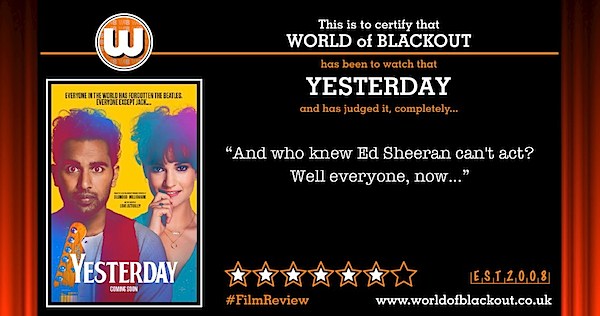
BUSTED Elsewhere we get a baffling assortment of on-screen graphics throughout the movie featuring famous song titles and place-names, like it's been produced in conjunction with the Liverpool Tourist Board and designed by the work-experience kid. And who knew Ed Sheeran can't act? Well everyone, now. In line with the narrative, we get a lengthy stretch telling us how vapid and superficial the music industry is once money becomes involved (but not the movies though, eh Richard?) before things reach an end which is emotionally satisfying but makes no sense when put under scrutiny.
But I'll write more about that in my second review.
Because despite my gripes I love this flick and I want to see it again.
Yesterday has been precision-engineered to appeal to the broadest, safest possible audience, and is often so clunkingly on-the-nose that I'd normally want to fire it into the heart of the sun. And once the inevitable mainstream gushing occurs upon the film's general release, maybe I'll feel that way still.
But right now? Yesterday is pretty magnificent.
If the cast don't melt your heart, the soundtrack will.
If you enjoyed About Time, you'll dig this immensely.
It is.
It's probably going to be one to buy once the price comes down, although at the same time I rather suspect that this film will have a long life on broadcast television.
Everyone involved can be very, very proud of this.*4
Unlikely, although I will start a lengthy conversation with you about causality. You have been warned.
*1 I'm talking about diegetic/performance albums by the way, not film scores or those ones where the soundtrack is a compilation of pre-existing tracks. Because as magnificent as the Dusk Till Dawn CD is, who among us hasn't eagerly rushed out to buy things like The Crow only to discover two - maybe three - decent tracks on it and the rest being absolute filler? And any OST boasting the words ”Music Inspired By The Film" can do one as well, frankly. If a band's song isn't good enough to make the final edit of the movie, I don't see why it should be included on the tie-in material. There. I said it. [ BACK ]
*2 Although as Christina Martin recently noted, "Gary Sparrow already fully explored the Yesterday movie concept".
Goodnight Sweetheart is at the core of my idea for bringing Dad's Army into the MCU anyway, so I'm delighted it's starting to catch on. Besides, now it'd make the time-travel element of Endgame a lot more fluid. Has anyone got Nicholas Lyndhurst’s number? [ BACK ]
*3 Hey, at least P*ers M*rgan has been confined to a cameo in the new Men In Black movie. A guest appearance on, as it turns out, precisely the platform he deserves... #Meow [ BACK ]
*4 Apart from Sheeran and Corden obviously, who should spend every remaining breath apologising for everything beforehand. WHAT? [ BACK ]
DISCLAIMERS:
• ^^^ That's dry, British humour, and most likely sarcasm or facetiousness.
• Yen's blog contains harsh language and even harsher notions of propriety. Reader discretion is advised.
• This is a personal blog. The views and opinions expressed here represent my own thoughts (at the time of writing) and not those of the people, institutions or organisations that I may or may not be related with unless stated explicitly.
This wasn't made for me. I say that about an increasing number of films of course, but probably best to get it out of the way now. I knew this wasn't made for me long before I sat down in screen 1 of course. But when I found myself the youngest person in the auditorium, watching the flag-waving trailer for Dambusters 75 and Diane Keaton sliding towards being offered gigs doing life-insurance adverts, it was a done deal.
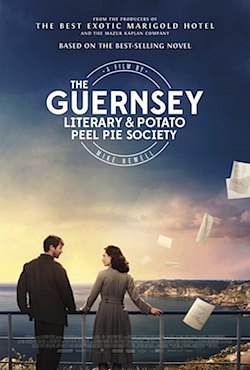
So imagine my utter delight*1 at the first scene of Mike Newell's The Guernsey Literary And Potato Peel Pie Society, beginning on the island during occupation in the Second World War, where the drunk Tom Courtenay character vomits onto the boots of a German officer while my surrounding audience chortled heartily. The film's very first gag (no pun intended) bears all the hallmarks of Brexit: The Movie, a simplified, rose-tinted, fictionalised*2 version of history that few involved are old enough to remember at all*3. And so it plays for the entirety of the first act and well into the second.
After this opening we jump to 1946, in the immediate aftermath of the war. Lily James plays Juliet Ashton, a london-based writer travelling to a fishing village on Guernsey after hearing about a secretive book-club used to keep up morale during the occupation. Once there, she finds that not all of the inhabitants are ready to be open about those years, and that the cobbled streets hold darker secrets. Meanwhile, Juliet begins to fall for the man who initially wrote to her about the Society, after finding her name in a book she once owned. Everything's slightly sepia-tinted and there's a piano and light-orchestral score. You get the picture.
Credit where it's due, Lily James leads the ensemble cast well, gives the clunky script her absolute best and is always a pleasure to watch (even if she's essentially reprising her role from Darkest Hour). However, Lily's frequently required to walk around muttering to herself and to read everything aloud, so certain is the director that the audience needs to be spoon-fed whatever remains of any subtext. Meanwhile, Katherine Parkinson seems to have been given the script from another film. Again, she's always fun to be around but her boozy, spiritualist character becomes more disparate from the setting as the run-time increases. Penelope Wilton is turned up to 10 for the duration, her wild-eyed mistrust of anyone from the mainland sure to be a hit with island communities everywhere, and Matthew Goode appears to be playing a role which has been written specifically for Jeremy Irons.
Despite the wardrobe department and set-dresser's best efforts, none of what we see feels like it's happening in 1946, but in a modern-day facsimile. The shadow of this artifice is always in-shot, with the performances spirited but ultimately a bit pantomime. There is a decent story buried beneath the layers of smugness and sanitised post-war defiance and denial, though. The strand about Jessica Brown Findlay's Elizabeth, her affair with an occupying soldier and the child they had deserves its own movie, quite honestly, suggesting that if this one took itself a bit more seriously it would have much more to offer.
The main problem (ie not just me saying "I didn't enjoy this") is that the screenplay is never quite sure which plate it should be spinning. You can have the story about how books can bring people together and inspire during dark times, you can have the story about the islander who fell in love with an enemy soldier and how their relationship was doomed from the start, or you can have the story about the wide-eyed outsider who goes off to a close-knit community and falls in love with the pig farmer*4. But choose one. The gear-change between each strand is jarring as it effectively becomes a different film each time.
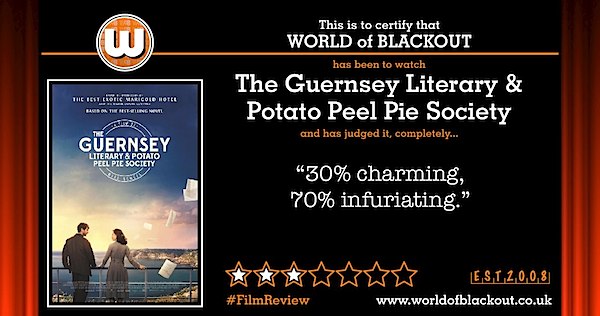
Despite moments of demonstrable heart, this is nowhere near the movie it could be. 30% charming, 70% infuriating. I never thought I'd write these words, but in the hands of Richard Curtis, The Guernsey Literary And Potato Peel Pie Society could have been quite wonderful. But it wasn't, and it isn't.
Behind the closing credits we get an audio-track of the cast reading passages from famous novels, an attempt to remind the audience that the story was about books and convince them that they've watched something well-written.
Best bit: The start of the movie where the fledgling book-club all bond together by getting pissed on homemade gin and killing a pig.
*2 There's absolutely nothing wrong with historical fiction, of course. Most movies of this ilk can't wait to get the 'based on true events' card onto the screen, but not here. The Guernsey Literary And Potato Peel Pie Society is adapted from a bestselling novel, which is to say, it is made-up. And while that doesn't necessarily preclude the themes of the work being based in reality, this particular film is so far removed from the reference section that it wasn't even filmed on Guernsey. And watching the tourist board trying to spin that one is, quite frankly, fucking hilarious. [ BACK ]
*3 Although unlike Brexit, this movie has the bonus of at least being an optional pursuit.
Yeah, bit of politics there. Beiß mich. [ BACK ]
*4 With Juliet being a struggling writer, the script builds to a moment in the third act where she finds herself newly-single and back home from the island, when the inspiration finally strikes home for her to write her masterpiece (in montage-form, naturally). While she does this primarily for her own satisfaction, it's nonetheless well-received by the island natives she's grown fond of, in particular the one who still holds her heart. And it's at that point that I wished I'd just watched Forgetting Sarah Marshall instead... [ BACK ]
DISCLAIMERS:
• ^^^ That's dry, British humour, and most likely sarcasm or facetiousness.
• Yen's blog contains harsh language and even harsher notions of propriety. Reader discretion is advised.
• This is a personal blog. The views and opinions expressed here represent my own thoughts (at the time of writing) and not those of the people, institutions or organisations that I may or may not be related with unless stated explicitly.
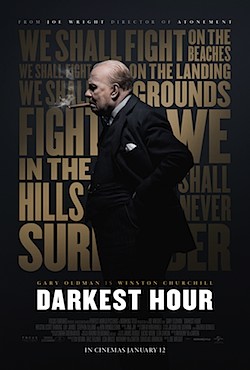
Oh, Gary. The make-up's good, but your Alfred Hitchcock-voice needs some work, mate. As January continues to raise everyone's expectations for the year ahead and bring us All The Worthy Films, we find ourselves once again back in May 1940. The Second World War rumbles on, nervous glances abound in UK parliament and there's barely a likable person left in the country. Apparently. Yes, it's Darkest Hour, the brooding political thriller from the director of 2007's Atonement starring Gary Oldman as Prime-Minister-of-the-moment Winston Leonard Spencer-Churchill, Kristen Scott-Thomas as his long suffering wife Clemmie, Lily James as his more-recently-suffering secretary Elizabeth Layton, and a wide range of Him You Saw In That Thing performers as various members of the British government and military.
And I wish I'd enjoyed it more.
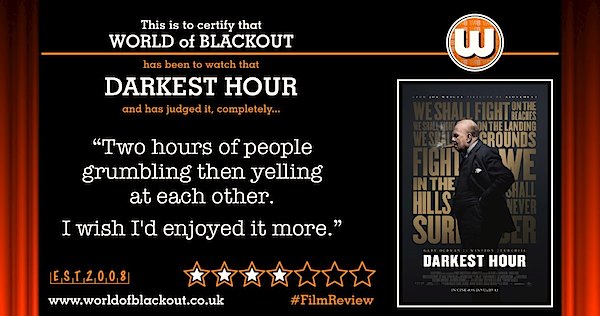
Oh, the film's got pedigree, though. Pedigree coming out of its ears. But from the excess of desaturated wooden panelling, wry acerbic gags*1 and furious imperialistic bickering, Darkest Hour begins like a car crash between a Richard Curtis melodrama and a Brexiteer's wank-fantasy. This is the gear it stays in, more or less, throughout. The primary problem is, where do you take the story of a man whose life has been chronicled (obviously and rightly so) extensively since 1945? The apparent answer is to make this depiction slightly less-than-flattering, and it's to director Joe Wright and writer Anthony McCarten's credit that neither shies away Churchill's reputation as an unrelenting a-hole, one who apparently succeeds by shouting down his adversaries rather than using tactics, skill and stoic determination. Unfortunately, most of the film's other characters are also cut from the same cloth. This is effectively two hours of people grumbling then yelling at each other, at least one of whom you know for a damn fact was absolutely right in doing so. But hey, we can't change history.
Not that I'm an expert in the field, by any means. I didn't know the full ins-and-outs of the situation before sitting down in Screen 1, yet I still wasn't surprised by anything I saw there. The film is an easy target for raking in the grey pounds, and one which throws few challenges at an audience (unless you count the aforementioned unlikeability, of course). A few attempts are made at humanising the statesman, but they feel like spurious anecdotes which have morphed over the years into a party-story nobody believes any more*2. Wright's direction is certainly more delicate than Anthony McCarten's writing, although obviously these play off each other. The film lacks the quiet introspection of Wright's work on Atonement, but then the sceenplay's not there to support that, anyway.
The next speedbump we hit is that since the story follows Winston from his appointment to the office of Prime Minister in early May to right before the Dunkirk evacuation in early June, the entire audience can just knows That Speech is being saved for the film's crescendo. So like the sinking of the Titanic, that's all everyone in the room is waiting for. And, as mentioned, this is all accomplished with great gusto and absolute conviction but the film never feels like it's shining a new light on its subject. Whereas Dunkirk at least played with the narrative form and raised tension accordingly, Darkest Hour feels more like a dramatised documentary. All that's missing is intercut shots of David Starkey pacing around Whitehall with an ongoing narration.
There's some great photography, some great performances, and the whole thing generally failed to interest me. I have to accept, of course, that all my niggles with the film are entirely intentional on the part of the film-makers, and this is just Not The Movie For Me. Gary Oldman is, as reported, very good*3.
The best bit comes in one scene where Winston's dictation to his secretary tails off, and around a minute later she bashfully admits "...I didn't understand you sir, you were mumbling".
We need more of this exact character in films starring Tom Hardy and Jeff Bridges, please.
This film wants to get off the tube at the same stop as Dunkirk, but ends up walking up the stairs just ahead of Their Finest.
If you like stirring tales of That Sort Of Thing, I imagine it is.
Only the hardcore will want to keep this on the shelf for re-watching.
Put it this way, if (as is being rumoured) Gary Oldman finds himself nominated for the Best Actor Oscar, I think he should only be allowed to pick it up if he does so in-character.
*1 With the delivery of these laboured witticisms and the requisite knowing-chuckle from the audience, I exhaled a little further each time. [ BACK ]
*2 At one point Winston Churchill decides - on a script-signposted whim - to ride the London Underground for the first time. "How do I get to Westminster?" he inquires, perusing a Tube-map.
"District Line east, one stop", says the young woman next to him. Somehow managing to not add "Are you a tourist? You're in the centre of London mate, that's walking distance. Like, it's less than half a mile. Even a fella in your shape could do that in five minutes. You'll be covering more distance by hoiking down here, getting onto the train then going up at the other end. And that's not taking into account how long the train is going to inexplicably wait on each platform while you apparently discuss government policy with the filthy proles. 'Loose lips', and all that. 'Sir'.", before rolling her eyes and deciding to get the bus instead.
Oh, and during that tube-scene, where (apparently) the actual Prime Minister of an actual country at actual war bolsters his own gut-feeling by getting the hasty. self-righteous opinions of half a dozen strangers with no objective view of the situation, I may well have broken The Code by mumbling "Oh fuck off" even louder than I did during the 'I am Spartacus' bit in The Commuter. Like I said, the film's A Bit Brexit at times, which is faintly ironic given how committed its protagonist was to the European ideal.
[ BACK ]
*3 But then why wouldn't he be? He's Gary Oldman. Why are people so surprised at this? [ BACK ]
*4 In this context, it almost certainly is. THAT DOESN'T MAKE ME WANT IT ANY LESS. [ BACK ]
DISCLAIMERS:
• ^^^ That's dry, British humour, and most likely sarcasm or facetiousness.
• Yen's blog contains harsh language and even harsher notions of propriety. Reader discretion is advised.
• This is a personal blog. The views and opinions expressed here represent my own thoughts (at the time of writing) and not those of the people, institutions or organisations that I may or may not be related with unless stated explicitly.
Well okay, this will be a review of two parts: the first is for people who haven't yet seen Baby Driver, the second for those who have. There are no real spoilers in the latter section, but without the context of having seen the film it'll only make limited sense. So, here goes...
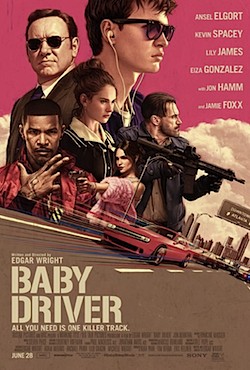
Baby Driver is the new heist movie from British writer and director Edgar Wright. A smart, funny standalone action flick, it holds stylistic and thematic nods to his previous work, but no narrative ones. The story follows a young, automotively-gifted getaway driver who goes by the name of Baby (Ansel Elgort), and the interaction with his boss Doc (Kevin Spacey) as he tries to distance himself from an accomplished criminal career and an ever-changing crew of robbers, killers and outright psychopaths.
So as mentioned above the film is smart, the film is funny and there is plenty of action. While many are hailing this as an antidote to the Fast & Furious franchise, that's an unfair comparison as Baby Driver is a story about people, not machines. The car-chases here serve to drive the story forward, not the other way around. The film's not quite as smooth and zippy as its trailers might suggest, but that's because the promo-reels touch more on the style rather than the substance, and while the film never goes into melodrama mode, Wright carefully builds his central characters along the way, to the point where standoffs and shootouts feel genuinely perilous, rather than the through-the-motions setpieces we've become used to over the years.
The whole thing is also heavily soundtracked of course (more on that below), so if you get overwhelmed by the fast-paced scripting and editing, you can at least tap your along with your foot in the meanwhile.
The Summer-season is turning out to be a bit of a mixed bag. Baby Driver will be one of the highlights. It's great fun, see it soon…
So, why didn't I love this? Oh I liked it very much, but I'd be hard pushed to go further than that. Part of the problem could be the near-universal praise Baby Driver has had heaped upon it before the film is even on general release. I'm used to my brain wanting to automatically rail against that and find things wrong with a movie, but when it's a filmmaker I admire as much as Edgar Wright it almost becomes personal: 'I know what you're capable of because I've seen you at your best, so impress me - raise the bar'.
But the guy's bar is not only way too high to begin with, it's also beginning to recede into the distance. While I've enjoyed all his big-screen outings, I tend to rank Shaun of the Dead at the top and everything else pretty much on a (only slightly) downward-scale from there. I remember feeling slightly put-out that Wright had left Ant-Man mid-production, not least because I ended up loving that movie and wondered what there was about the final product that he'd disagreed with to the point where he'd quit altogether. So then I look at the tonal in-fighting there is throughout Baby Driver and think 'what was the utopian vision for this movie?', because I don't think the film I watched embodied that. There's a layer of genuine sentimentality across the whole screenplay which is more than welcome, but sits ill-at-ease with the snark and cynicism practiced by the characters. Neither comes across as genuinely as they should in an Edgar Wright movie, and the whole thing shudders as a result.
Speaking of which, the players. Ansel Elgort is refreshingly enjoyable in the central role*1, but still feels essentially miscast. For my money, Michael Cera would have been ideal for this, not least since he'd have had to leave his own comfort-zone as an actor. Lily James is also great to watch as always (although she gets comparatively little to do), but feels a little too clean for the role of a burned-out yet still optimistic waitress. Meanwhile, Kevin Spacey can't quite pass off the hard-edged cynicism he needs to as gang-boss and blasé murderer, Doc. But nor can he bring the warmth to the moments where he shows that he has some genuine fondness for his favourite and long-time driver.
On the plus-side (and with comparatively less screen-time), Jamie Foxx, John Hamm and Eiza González all fantastic as opportunistic career-criminals. Jon Bernthal has a minor role as Jon Bernthal™ but with a beard, which he pulls off with his accustomed ease.
But the biggest bugbear I have with Baby Driver is probably the relentless diegetic soundtrack. It's not that I disliked any of the tracks used*2, nor were songs were shoehorned in (I'm looking at you, DC), or that the idea was feeling strained (ditto, Marvel). More that it's over-used, to the point where a device which is to all intents and purposes a character in itself, loses relevance the closer the film gets to its third-act*3. And having punches, gunshots and explosions synced in time with the soundtrack works in a trailer but becomes distracting throughout an entire film. In fact many of the action sequences have the air of being tweaked in post-production to add more dynamic energy, but have instead come out feeling cluttered.
But for all my grumbling, I should add that it's not a case of 'this film should be better', just 'I should have enjoyed it more'. There were parts of the movie which had me grinning like a lunatic, but there were far more that I found disjointed, or like a work-in-progress from an earlier draft of the script*4.
All of this is me just groping for a way to justify saying that Baby Driver is very good, but not Wright's best work (future or past) by a long shot. But the pre-built hype and my predisposition to enjoy the director's work makes it feel like saying "it's good" isn't enough, somehow. Fully aware I'm in a minority here, although I take no joy from that.
Oh, absolutely - it's big and loud and full-on enough to justify the ticket, certainly.
I think it does, but also that it could have achieved so much more.
It's not.
I won't.
There isn't.
Level 2: Lily James is in this, and she was in that Wrath of the Titans along with Liam 'Qui-Gon' Neeson and Toby 'Additional Voices in The Old Republic' Kebbell.
*1 Regular readers might recall the time Elgort played a terminally-ill teenager who I spent a film's run-time wishing would hurry the fuck up about it all. Although don't get me wrong, I found his character in this film deeply annoying for the first twenty minutes or so. Thankfully two things then happen: 1) we get to know a bit more about him and 2) he tones it down a lot, anyway. [ BACK ]
*2 Serious note though, writer/directors: your taste in music is nowhere near as quirky, clever, cool or interesting as you think it is, I promise you. I've currently got Slayer, Lady Antebellum and Così fan tutte on my iPod, but I wouldn't dream of shoehorning them into a screenplay for geek-points. At the risk of beginning a rant, I'm getting a bit tired of sitting in the cinema and imagining the initial phone call to the producer's office: "Hey guys! I've got a great idea for a soundtrack! …er, I mean film! Yes a film, that's it! I mean both, obviously, whatever…". Going to see an action/hero movie is increasingly becoming like arriving at a party to find one guy guarding the stereo in the corner because he's brought all his own records. And he then insists on describing why he's chosen each one as he goes (this is a broad simile of course; I don't go to parties. And if I find myself at one, I try to stay as far away from All The People as possible). [ BACK ]
*3 And as a slight aside, I should mention that it's explained in the film that Baby suffers from Tinnitus due to a childhood accident and almost constantly plays music 'to drown it out'. While I'd put money on there being some level of personal experience in the writing of his character, members of the audience who also suffer from the hearing disorder will be fully aware that while music is indeed a welcome distraction, the pasttime doesn't replace the humming/ringing/screeching noise, more that the listener gets music plus Tinnitus. Which, over time, leads to more Tinnitus.
Just saying, because that's not addressed in the script... [ BACK ]
*4 And for those of you who've seen the film, is there a significance behind the lack of internet/smartphones? Baby's obsession with cassettes and analogue recording works in the context of the story, but Doc hands out flip-phones to his crew for the duration of each job, and at one point his son Samm is seen with a PSP. I'd thought at first that maybe the film was set in the mid 00s, but since we get a flashback showing a 3-4yr old Baby receiving his first (and 1st-generation) iPod, it's reasonable to assume that took place circa 2001 and the story-proper takes place around sixteen years later, ie now. So is Doc keeping his criminal network nicely undercover by having them use phones that your grandad would get laughed at for using in public? Also ref the iPod, Baby's got a range of different devices all loaded up with different playlists (a nice touch), yet I don't recall seeing him use a computer at all (they ain't going to sync themselves)? I'm hoping there's a PC (with like, thirty user profiles on it) in the background of a shot in his flat, and I just didn't notice it... [ BACK ]
DISCLAIMERS:
• ^^^ That's dry, British humour, and most likely sarcasm or facetiousness.
• Yen's blog contains harsh language and even harsher notions of propriety. Reader discretion is advised.
• This is a personal blog. The views and opinions expressed here represent my own thoughts (at the time of writing) and not those of the people, institutions or organisations that I may or may not be related with unless stated explicitly.