Blade Runner 2049 (3D / second-pass / SPOILERS)
Cert: 15 / 163 mins / Dir. Denis Villeneuve / Trailer
It's funny how these things clump together, but this was my second second-pass of a second-installment this week. Pretty sure if I managed to do that again after the weekend I'd get some sort of badge or certificate. I digress.
Having left this Obviously Not Long Enough, I decided Blade Runner 2049 really needed another going over. A work best experienced on a massive screen, the ideal place for this is the cinema of course. And whereas home-based deconstruction can take place whenever you've got a couple of free hours, cinema scheduling means that you've really got to decide within 3-4 weeks if you can get more out of a movie. I'm sure I'll be watching this for years anyway, but I really want to get the most out of it now.
Before I get stuck in, I should say how much I liked the flickering, juddery, interlaced studio idents at the start. Nothing which follows uses this faux-interference aesthetic until the closing credits, and I can only imagine they've been put there to piss off the people who download the film illegally and have that deflating feeling of wasted bandwidth upon pressing Play. Top work!
So. Magnificent though Blade Runner 2049 is, as I suspected rewatching the movie brought no great revelations. Whether Denis Villeneuve's sequel needs more time to bed in culturally and generate more general discussion, or whether the story just has less to say (or more specifically, ask) than its progenitor remains to be seen. With the best will in the world, I suspect it's the latter. This is a fine looking presentation in 3D, even if Roger Deakins says otherwise, although like all post-production conversions, it never feels intrinsically necessary.
Ana de Armas is great as Joi, and Carla Juri also shines as Ana (somewhat confusingly). But this film belongs firmly to Sylvia Hoeks' Luv, the replicant quality administrator and assassin*1. Hoeks owns every single scene she's in here, showing both the aspirational pinnacle and ultimate downfall of perfected human simulation with furious bursts of anger, jealousy and childish petulance. More human than human, indeed.
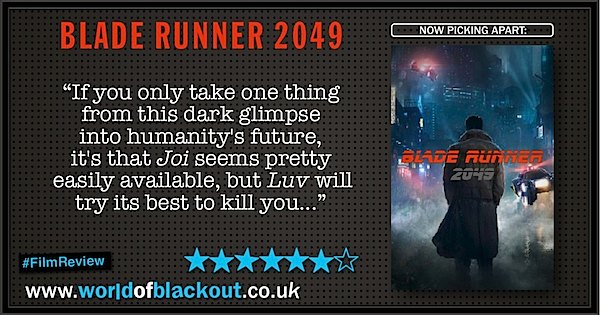
If you take nothing else away from Blade Runner 2049, Joi seems easily available in a consumer society, but Luv is more intense and will end up killing you…
As a story about manufactured evolution, it's both prescient and timeless. The intricacies of the central plot are much clearer the second time around, even if this robs the film of its smaller and larger conundrums whilst watching. Whereas Blade Runner famously asked more questions than it answered, the more philosophical aspects of BR2049 seem largely wrapped up within its not-inconsiderable run-time.
The discussion throughout the first movie of course was 'can a bioengineered replicant with an organic AI brain be treated as human once it becomes self-aware?. Irrespective of the 'other' as-yet-unanswered question, the answer to this is yes. The creation may not be biologically human, but it's emotionally human. So when BR2049 asks 'yes, but can a holographic simulation with an AI brain be treated as human once it becomes self-aware?, the answer is also clearly yes. Humans are just machines made of meat rather than electronics, and the existence of a metaphysical soul can be neither proved nor disproved using both examples. Discuss.
There's also a brief (and less-explored) pondering over 'if you're implanted with someone else's memories, how can you tell which ones are yours?. But Agent K's belief in his past experiences affects his judgement and actions in the present. Those burned-in reactions and instincts become part of his mind's operating-system, so yes, they're his memories as much as his interpretation of events which occurred the day before. He might not have been there when key childhood events took place, but he remembers them so they're his memories in a very real sense. He didn't 'make' them, but you (probably) didn't make the clothes you're wearing - they're still yours. Discuss.
Additionally, in terms of who is and isn't a replicant and how that affects their outlook and prospects, Villeneuve (or more properly, screenwriter Hampton Fancher) is far more transparent this time around, so the only real lingering discussions are based on the ongoing one from the first Blade Runner anyway*2. All I had after that were plot-based niggles:
• Does the 'natural lifespan' of the new replicants include the time normally allowed for humans to pass through childhood and adolescence, or is it adulthood-onwards? We see them 'born' in their adult bodies, and Sapper certainly appears to have aged - if only because you wouldn't make a replicant which looked like that grizzled 'out of the box', now would you?*3
• How come Sapper wears glasses? Is it because a) He’s trying to disguise himself and/or blend in with the humans to avoid detection? (in-universe explanation), b) As part of his natural lifespan, his eyes are starting to wear out and he can’t get them replaced or repaired without drawing attention to himself? (in-universe explanation), c) The glasses Sapper wears are like those tiny wire-framed ones you typically see in movies with Second World War Jewish refugees wearing them, largely due to their lack of materials/resources at the time, and the film is drawing a visual parallel between the persecution of the Jews and the authorities in Blade Runner hunting down the last of the Nexus 8s, not least to allow for control-freak Niander Wallace’s ‘superior’ models? (out-of-universe explanation), or d) All of the above. Discuss.
• Speaking of superior, how come Agent K just manages to drown Luv so (relatively) quickly? I know these are bio-engineered creations as opposed to wires and pulleys, but you’d think Wallace would have adapted them to either draw the required oxygen from water if they become submerged, or at least be able to hold their breath longer. Wasn’t the original point of the replicants to perform work which was too hazardous for humans, like maintaining the off-world colonies and ships (ie working in freezing and low-oxygen environments)? And now it turns out that if one of them falls asleep in the bath, that’s Game Over? Ridiculous.
• Most importantly: wait, who's looking after Deckard's dog?
*1 A job title I'm currently pushing for myself, but my employer won't have it. [ BACK ]
*2 There's no way of dressing this one up, that CGI Rachael is passable until she begins speaking on-camera, then it's absolutely atrocious. One of the few genuine weak-points of the entire film Too much movement in all the wrong parts of the face. It felt less weird when the holographic girlfriend simulation was syncing with an android hooker. Seriously, Rachael and Rogue One Leia need to get in the sea.
I like that Deckard points out to Wallace "Her eyes were green...", because if that's the only thing he can see wrong with this picture then his own clearly aren't working properly, either. From a story perspective, surely Deckard is more likely to have been persuaded to help Wallace if he'd made a 'projected current age' replicant, implying that the pair could somehow go on to make up for lost time, rather than unequally resetting the relationship with an age-gap. This would also have entailed getting the actual human Sean Young back in the studio, and I wouldn't be typing all of this in the first place.
The irony hasn't escaped me, of course, that all of the other replicants in the film are flawless facsimiles of humans since they're played by humans, whereas the Rachael-bot is a literal replicant, and who is so far down The Uncanny Valley that the Los Angeles Pot-holing Society have been called out to rescue her... [ BACK ]
*3 Imagine the day the Ryan Gosling replicant was created, though. The boss comes in and is like "I know you've made this one stab-impervious Terry, but why are the eyes so close together? You do know we have to sell these, right? Would you buy this? ...well I suppose the LAPD might take him, but they're going to pull our trousers down over a discount..."[ BACK ]
DISCLAIMERS:
• ^^^ That's dry, British humour, and most likely sarcasm or facetiousness.
• Yen's blog contains harsh language and even harsher notions of propriety. Reader discretion is advised.
• This is a personal blog. The views and opinions expressed here represent my own thoughts (at the time of writing) and not those of the people, institutions or organisations that I may or may not be related with unless stated explicitly.
Blade Runner 2049 (first-pass / SPOILER-FREE)
Cert: 15 / 163 mins / Dir. Denis Villeneuve / Trailer
You've come here for a review of Blade Runner 2049, and in much the same way as Kingsman, you've arrived with two questions. Again, the answer to the first is "yes, very much so" and to the second, "no, but how could it be?". Because you're an impatient soul, I've put my lengthier-than-usual pre-amble in the first footnote. You're welcome. Discussion of the film begins after the next paragraph.
First things first: before going to see Blade Runner 2049, I'd advise you to watch the three prequel/lead-in shorts, Black Out 2022, 2036: Nexus Dawn and 2048: Nowhere To Run. Along with the timeline over at Collider, they cover key events which occurred between the first Blade Runner set in 2019 and the new movie. This isn't essential homework, but any background exposition in BR2049 is fleeting and largely conversational, so it's handy to have this grounding beforehand.
The story follows Los Angeles detective and Blade Runner, Agent K (Ryan Gosling) as a routine retirement job opens a potentially huge can of worms. K's boss Lt. Joshi (Robin Wright), anxious to avoid the ire of her superiors and attention of the powerful replicant-manufacturing corporations, orders her young charge to tie the case up as efficiently as possible (ie not sparing the gunfire). But K's inquisitive nature leads him along a trail to former assassin Rick Deckard (Harrison Ford), in a place where the ghosts of the past are buried almost as well as the conspiracies of the present…
So the first thing which strikes the viewer about Villeneuve's sequel is how light it can be in L.A. Whereas Ridley Scott's telling took place almost exclusively at night, the tale's pickup point features scenes at various times and varied run-down environments. It's never sunny of course, with only the dregs of humanity left behind on a near-ruined planet, whatever passes for natural daylight only serves to illuminate the brittle shell of a world even more harshly. Although undoubtedly existing in the same timeline, this only really looks like the same Blade Runner on the occasions we see the city's filthy skeleton lit only by neon and gunfire. But if the visual theme in 1982 was of darkness and rain, 2017's is more desperation and rust.
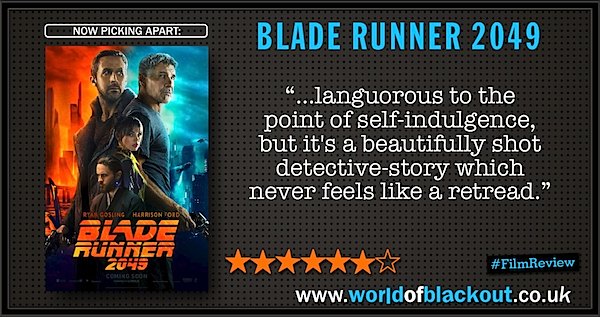
And this difference is the key to the film's greatest strength: BR2049 never feels like the retread that would have been the path of least resistance so far as writing is concerned. Screenwriter Hampton Fancher returns, in the company of Michael Green, and together they've created a continuation of the story, rarely slowing to nod at the audience with knowing familiarity*4. Of course, the pressure is on Villeneuve to deliver a work as profound as its forebear, but going in with that expectation is likely to lead to over-symbolising what is essentially a beautifully shot detective movie. Villeneuve doesn't explore the same avenues as Scott did, or leave the viewer with the same (or even as many) questions. That's not to say there isn't plenty to think about afterwards of course, but there's no book to cross-reference it all against, this time.
At a run-time which won't give you much change out of three hours, the pace is languorous to the point of self-indulgent, but Roger Deakins' cinematography earns that effortlessly (although Sony's shameless product placement is at an all-time high). And for a production with such a wide-ranging cast-list, the lion's share of our time is spent with Gosling, Ford and Sylvia Hoeks' antagonist Luv (who deftly steals every single one of her scenes). Gosling seems almost perfectly cast in his role as our guide through the shattered landscape, and Ford brings more of latter-day Solo than latter-day Jones to his reprisal (thankfully*5).
To say any more would probably be to delve into what makes this so enjoyable, and begin to spoil it in the process. Other than a grounding in Blade Runner and the shorts linked above, try to see this 'clean'. But do try to see it.
Was I blown away by Blade Runner 2049? No.
Do I think the film will have a cultural longevity which will become more intriguing as each year passes? No.
But did I think exactly the same when I first saw its predecessor? Yeah.
What do I know?
Well, Blade Runner.
To the point where it's fairly essential that you've at least seen the first one.
The cinema is the natural home of this outstanding-looking piece of work, yes.
I think it just about does.
But I also think the film could have set out to achieve more.
For the most part no, although there could be a couple of exceptions in there.
I shouldn't imagine so.
There isn't. For shame.
Couple of perfect moments for one, too.
*1 This is the pre-amble which was too long to feasibly put as part of the main review. It was written before watching Blade Runner 2049. And as flowery and self-important as this seems (okay, is), it felt worse to give the introduction its own separate blog post, somehow. That's the kind of treatment usually reserved for Star Wars, after all.
So. Where to begin? Although as a youngster I'd read the comic adaptation which filled out the page-count in Marvel UK's Return of the Jedi Weekly, I first came to the actual film of Blade Runner in the mid 90s. And I first began to fully appreciate it about five years later (and even that's been a constantly increasing curve rather than an off/on switch). Ridley Scott's 1982 neo-noir masterpiece is the gift which keeps on giving; still finding new audiences, still beguiling old ones, still being discussed and dissected after thirty five years. And comparing the movie with Philip K Dick's source-novel only raises more questions as that's a thematic whirlpool of its own, yet the works seem to feed off each other with each re-visit. I don't think I'll ever be done with either.
So it may seem unduly harsh to say this, but Blade Runner is a film which categorically does not need a sequel. The loose ends of Rick, Rachel and replicant-retirement don't need tying up. Indeed the movie's ambiguity is what makes it so satisfying, its point-blank refusal to put a bow on the story, despite a superficially happy ending. So in helming the follow-up, director Denis Villeneuve has his work cut out, even with (or perhaps more accurately because of*2) Ridley Scott's return in an exec-producer role.
And yet, am I happy a sequel exists? Hell yeah. But if Blade Runner 2049 is to be a worthy follow-up, there's no way I can begin unpacking it after a first viewing*3. If I leave the cinema understanding everything I've seen then the film has failed on some level. I expect to be talking about BR2049 for a long time to come. So y'know, no pressure Denis.
With all this in mind, what follows above is a first-reaction. More of a 'should I see it?' than 'why should I see it?'. You already know if this flick is going to be for you, and for obvious reasons you can take your own baggage and tailor your own expectations accordingly. But tonight we're gonna party like it's 2049. [ BACK ]
*2 My own concerns with Mr. Scott have been written about elsewhere, but it's hardly controversial to say that his return to the Alien franchise has had a mixed reception. And yes, footnotes within footnotes. It's very much that kind of film [ BACK ]
*3 I haven't even got round to going back to Villeneuve's Arrival yet, even though I know it fully deserves the time. But it's his work on that movie in particular which tells me he's the right choice for Blade Runner 2049. [ BACK ]
*4 Although the writers do place one rather ungainly elephant in the room by means of unnecessary callback, but I'll leave that until my next review. [ BACK ]
*5 And I say this as one of the twelve people in the world who actually like Crystal Skull, but Harrison Ford's dramatic range isn't particularly wide. He's only great at being varying shades of Harrison Ford™, and thankfully the one we get here is Weary Ford rather than Curmudgeonly Ford. [ BACK ]
DISCLAIMERS:
• ^^^ That's dry, British humour, and most likely sarcasm or facetiousness.
• Yen's blog contains harsh language and even harsher notions of propriety. Reader discretion is advised.
• This is a personal blog. The views and opinions expressed here represent my own thoughts (at the time of writing) and not those of the people, institutions or organisations that I may or may not be related with unless stated explicitly.
CAUTION: Yen's blog contains harsh language and even harsher notions of propriety. Reader discretion is advised.
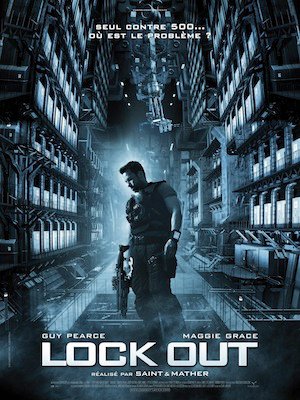
Lockout 110 mins / Dir. James Mather , Stephen St. Leger
Let me get this straight, you've made Escape from New York with Mike out of Neighbours and Eli Dingle out of Emmerdale Farm, yeah? Mental...
The Plot: A man wrongly convicted of conspiracy to commit espionage against the U.S. is offered his freedom if he can rescue the president's daughter from an outer space prison taken over by violent inmates.
The Good: So is this what happens when game-designers write a screenplay? Our hero Snow (no, don't laugh - it gets sillier in the film, but I won't spoil that) has a brief backstory introduction (read: cutscene) at the start, then gets his overall mission which is broken down into smaller tasks (read: levels) and maguffins to chase, and even has a remote guide once he's on the prison-station which acts as a mapping system and health-monitor for the president's daughter. Downtime between action sequences is filled with heavy exposition from Snow's guides back on the police-station which serve to outline exactly what's going to happen for the next 15 minutes or so. It's so transparently like a game that I can't help but admire it; especially as most game-to-movie conversions are nowhere near as enjoyable as this.
And that's the odd thing. I found Lockout immensely fun, even though just about every aspect of the film has been flogged to death in the past. A brisk script helps matters (when they're not explaining things patiently to Snow / The Audience), and as silly as the concept clearly is, all the cast are playing it as straight as the script will allow. Many (and I mean many) of Guy Pearce's lines are the kind of dry witticisms that would fall flat or be overkill with other actors. But Guy aims for John McClane and manages to come out closer to Han Solo a lot of the time, and he's ridiculously likeable, if not at all original, as the rogue-hero of the movie.
The other thing that sets it apart from its contemporaries is the large amount of British casting (not 'all', but a lot of the key roles, certainly), and having the two lead inmates sport Scottish accents was a nice touch, even if they were brothers but didn't sound like they came from the same part of Scotland. Joseph Gilgun (Eli from Emmerdale, Woody from This is England) had enormous fun as the loose cannon Hydell, an inmate that's a beserker even among his peers. Lennie James (Morgan from The Walking Dead, Sol from Snatch) is also on good form and manages to put in quite an understated performance, albeit with his weird Massachusetts accent going on.
And other than that it's just, sling on the body armour, grab a shotgun, stay alive, infiltrate a prison, stay alive, rescue the girl before the prison sinks back into the Earth's atmosphere or is destroyed by the government, stay alive and be witty while you're doing it. And maybe prove your innocence as well. It won't be the greatest film you ever see, but it doesn't try to be anything other than a big noisy rollercoaster; it's only practical purpose is your enjoyment.
Oh, and there's a Wilhelm Scream too, which always makes me smile.
The Bad: Location/character title frames that are on-screen for too short a time to read, ridiculously fast cutting between shots and mumbled/garbled dialogue make the first 10 minutes of the film a little like hard work. Then you either acclimatise to this, or realise that the names and exposition aren't that important; I couldn't quite figure out which.
The Ugly: The credits feature a title card saying "Based on an original idea by Luc Besson". I'd contest the accuracy of that statement.
All-in-all: Don't take it at all seriously and you'll have a lot of fun.
DISCLAIMERS: • ^^^ That's dry, British humour, and most likely sarcasm or facetiousness.
• This is a personal blog. The views and opinions expressed here represent my own thoughts (at the time of writing) and not those of the people, institutions or organisations that I may or may not be related with unless stated explicitly.