This wasn't made for me. I say that about an increasing number of films of course, but probably best to get it out of the way now. I knew this wasn't made for me long before I sat down in screen 1 of course. But when I found myself the youngest person in the auditorium, watching the flag-waving trailer for Dambusters 75 and Diane Keaton sliding towards being offered gigs doing life-insurance adverts, it was a done deal.
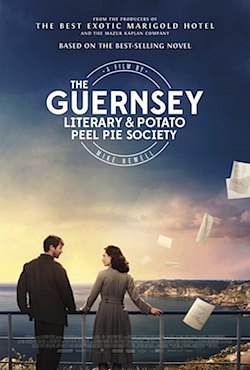
So imagine my utter delight*1 at the first scene of Mike Newell's The Guernsey Literary And Potato Peel Pie Society, beginning on the island during occupation in the Second World War, where the drunk Tom Courtenay character vomits onto the boots of a German officer while my surrounding audience chortled heartily. The film's very first gag (no pun intended) bears all the hallmarks of Brexit: The Movie, a simplified, rose-tinted, fictionalised*2 version of history that few involved are old enough to remember at all*3. And so it plays for the entirety of the first act and well into the second.
After this opening we jump to 1946, in the immediate aftermath of the war. Lily James plays Juliet Ashton, a london-based writer travelling to a fishing village on Guernsey after hearing about a secretive book-club used to keep up morale during the occupation. Once there, she finds that not all of the inhabitants are ready to be open about those years, and that the cobbled streets hold darker secrets. Meanwhile, Juliet begins to fall for the man who initially wrote to her about the Society, after finding her name in a book she once owned. Everything's slightly sepia-tinted and there's a piano and light-orchestral score. You get the picture.
Credit where it's due, Lily James leads the ensemble cast well, gives the clunky script her absolute best and is always a pleasure to watch (even if she's essentially reprising her role from Darkest Hour). However, Lily's frequently required to walk around muttering to herself and to read everything aloud, so certain is the director that the audience needs to be spoon-fed whatever remains of any subtext. Meanwhile, Katherine Parkinson seems to have been given the script from another film. Again, she's always fun to be around but her boozy, spiritualist character becomes more disparate from the setting as the run-time increases. Penelope Wilton is turned up to 10 for the duration, her wild-eyed mistrust of anyone from the mainland sure to be a hit with island communities everywhere, and Matthew Goode appears to be playing a role which has been written specifically for Jeremy Irons.
Despite the wardrobe department and set-dresser's best efforts, none of what we see feels like it's happening in 1946, but in a modern-day facsimile. The shadow of this artifice is always in-shot, with the performances spirited but ultimately a bit pantomime. There is a decent story buried beneath the layers of smugness and sanitised post-war defiance and denial, though. The strand about Jessica Brown Findlay's Elizabeth, her affair with an occupying soldier and the child they had deserves its own movie, quite honestly, suggesting that if this one took itself a bit more seriously it would have much more to offer.
The main problem (ie not just me saying "I didn't enjoy this") is that the screenplay is never quite sure which plate it should be spinning. You can have the story about how books can bring people together and inspire during dark times, you can have the story about the islander who fell in love with an enemy soldier and how their relationship was doomed from the start, or you can have the story about the wide-eyed outsider who goes off to a close-knit community and falls in love with the pig farmer*4. But choose one. The gear-change between each strand is jarring as it effectively becomes a different film each time.
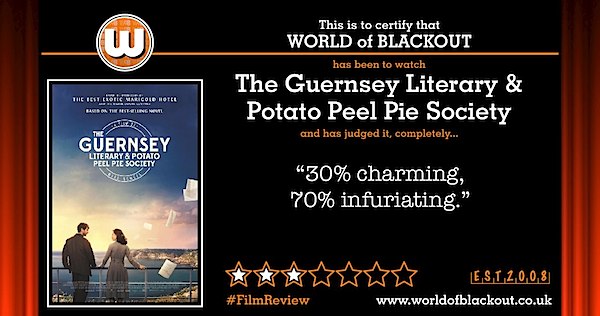
Despite moments of demonstrable heart, this is nowhere near the movie it could be. 30% charming, 70% infuriating. I never thought I'd write these words, but in the hands of Richard Curtis, The Guernsey Literary And Potato Peel Pie Society could have been quite wonderful. But it wasn't, and it isn't.
Behind the closing credits we get an audio-track of the cast reading passages from famous novels, an attempt to remind the audience that the story was about books and convince them that they've watched something well-written.
Best bit: The start of the movie where the fledgling book-club all bond together by getting pissed on homemade gin and killing a pig.
*2 There's absolutely nothing wrong with historical fiction, of course. Most movies of this ilk can't wait to get the 'based on true events' card onto the screen, but not here. The Guernsey Literary And Potato Peel Pie Society is adapted from a bestselling novel, which is to say, it is made-up. And while that doesn't necessarily preclude the themes of the work being based in reality, this particular film is so far removed from the reference section that it wasn't even filmed on Guernsey. And watching the tourist board trying to spin that one is, quite frankly, fucking hilarious. [ BACK ]
*3 Although unlike Brexit, this movie has the bonus of at least being an optional pursuit.
Yeah, bit of politics there. Beiß mich. [ BACK ]
*4 With Juliet being a struggling writer, the script builds to a moment in the third act where she finds herself newly-single and back home from the island, when the inspiration finally strikes home for her to write her masterpiece (in montage-form, naturally). While she does this primarily for her own satisfaction, it's nonetheless well-received by the island natives she's grown fond of, in particular the one who still holds her heart. And it's at that point that I wished I'd just watched Forgetting Sarah Marshall instead... [ BACK ]
DISCLAIMERS:
• ^^^ That's dry, British humour, and most likely sarcasm or facetiousness.
• Yen's blog contains harsh language and even harsher notions of propriety. Reader discretion is advised.
• This is a personal blog. The views and opinions expressed here represent my own thoughts (at the time of writing) and not those of the people, institutions or organisations that I may or may not be related with unless stated explicitly.
The A-word.
It's the bane of cinephiles, everywhere.
That book you love; the comic you remember; the show you used to watch; the game you lost an entire summer playing? Oh, someone's adapted it and it's getting made into a movie! Whether a cause for pre-emptive celebration or foreboding caution, it leads to only one thing: expectation. And expectation is the death of the 'clean' movie-viewing experience; no matter how closely the film sticks to its source material, or how much it tries to distance itself, it will be faced with the hurdle of comparison.
And while the movie industry loves the pre-built marketing buzz of 'now a major motion picture!', they loathe the comparative references which will be made from the first review onwards. Because many punters will expect to get exactly the same reaction from a completely different medium, to a story they already know. And therein lies the problem.
In this monthly series, we'll look back at some of the most respected and best-loved properties which have made the perilous journey to the big screen; often with some controversy, and almost always with far too much hype. This isn't so much a review of the films themselves, more an appraisal of their suitability as an adaptation.
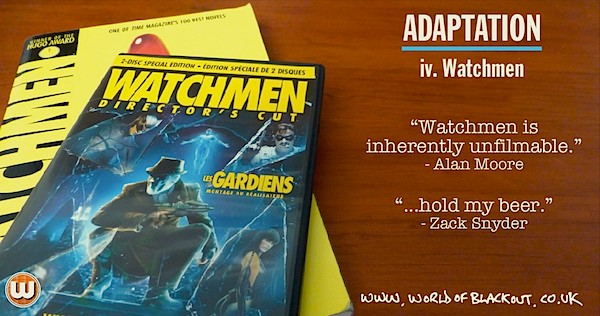
Watchmen Alan Moore (w. Dave Gibbons, John Higgins) (1986)
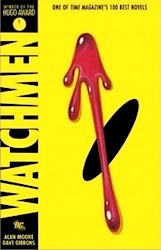
And so, the next phase of this series - centering around the works of Alan Moore - begins with what could well be the most heavyweight of his adapted works, indeed, the archetypal Graphic Novel™. First released over twelve issues in 1986(/7) and set in an alternate 1985, Watchmen begins as a slightly offbeat murder mystery in a world where costumed heroes fought crime alongside the police, but have since been outlawed. The book's first page opens with three horizontal panels; a receding aerial view of the smiley badge once belonging to former Watchman and all-round a-hole The Comedian, lying in a gutter awash with blood. The sequence is narrated by the detective-vigilante Rorschach's journal and sets the tone of the book perfectly; rigid in its layout, nihilistic in its content, visceral in its meaning. This is topped later only by scientist-turned-demigod Dr Manhattan explaining that the difference between life and death is, to him, barely even worth mentioning.
This is only the third time I've finished the book, yet I still struggle to write anything approaching a 'review', probably not least because it's way more complex than the novels I do manage to read when I'm not sitting in a cinema or writing about sitting in a cinema. The first time I read it (before the Zack Snyder's film-version was released), I freely admit to being pretty much lost for the first four issues or so, although never to the point where I wanted to stop.
As well as the more straightforward flashback sequences as we go along here, tangent threads drift in and out of the main narrative, coalescing as the story evolves from all directions. Additionally, the last 3-4 pages of each issue present passages from in-universe books and magazines, giving the reader even more background to the characters and surrounding events. And not to get too hung up on the difference between a comic, a trade-paperback, a novel and a graphic novel, but Watchmen can be classed as A Novel on the sheer density of the text alone. And the aforementioned panel-structure means there are no placeholder or filler-pages. Every single line of every single frame matters, even though it may not seem to the first time round. This is a book which rewards re-reading. It also rewards patience; do not think 'oh, it's only twelve comics, I'll be able to zip through that in no time'.
Watchmen is a brightly coloured neo-noir with a heart as dark and cynical as the poor saps who populate its pages. It is also an absolute joy to read, if only because it's nice to know that no matter how fucked up our world has become in the thirty years since its release, things could always have turned out worse...
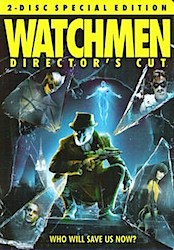
Ah, the DC ensemble hero-movie it's still cool to like ;) Joking aside, this film is the reason I can't give up on Zack Snyder, no matter how unsure his footing becomes these days. And oddly, Watchmen was one of the first movies I reviewed here, back in the day.
Landing in our cinemas in 2009, Watchmen hardly ushered in the 'dark superhero' movie, but it's arguable that films like 2005's Batman Begins paved the audience's way for a story like Watchmen to be told properly. The fact that the tale itself predates the cinematic trend for scowling heroes works even more in its favour. And speaking of timelines, in the alternate 1985 we see here, there are shades of the 'Bad Hill Valley' from Back To The Future Part II (and also in some of the ageing prosthetics, if I'm being fair). And while that film arrived with us three full years after the publication of Watchmen, it's worth noting that the cinematic version arrived twenty years after that. I like to think there's a bit of circular-influence going on, theatrically at least.
Of course there are differences between the storytelling techniques you can employ on the page and the ones which will work on-screen. The film can't dot around its own timeline in quite the same way, so most of the background world-building is taken care of with a montage behind the opening titles. Screenwriters David Hayter and Alex Tse capture the episodic feel of the story's published forbear, and while it's not as minutely-complex as the book, the plot itself it still largely intact. Although as my director's cut is just over three hours and still skips through some of the intricacy and nuance, it's hard to imagine what more it could have done, realistically. This isn't a panel-for-panel transcription of the original source-material, but it's as close as we were ever going to get*1, and hats off to Snyder for making that happen. Visually, tonally, emotionally, this is an outstanding adaptation.
Not that I heard. This time.
Although there is a very similar one when someone gets thrown over the railings in the prison-riot sequence.
Level 2: Well, Matthew Goode's in this (may god have mercy on his accent), and he was in that Stoker along with Ralph 'Ric Olié' Brown.
*1 Okay, apart from the space-squid. But I completely understand why they changed that for the screen. The 3hr director's cut doesn't even touch on the Tales Of The Black Freighter sub-story, either, and it's still arguably got far too much going on. Slightly ashamed to say I haven't braved the Ultimate cut, yet. But only slightly. I've got the Black Freighter DVD which was released separately, but viewed outside the confines of the film it loses its relevance and just becomes a short animated feature, so I didn't include it here. [ BACK ]
DISCLAIMERS:
• ^^^ That's dry, British humour, and most likely sarcasm or facetiousness.
• Yen's blog contains harsh language and even harsher notions of propriety. Reader discretion is advised.
• This is a personal blog. The views and opinions expressed here represent my own thoughts (at the time of writing) and not those of the people, institutions or organisations that I may or may not be related with unless stated explicitly.
Allied Cert: 15 / 124 mins / Dir. Robert Zemeckis / Trailer
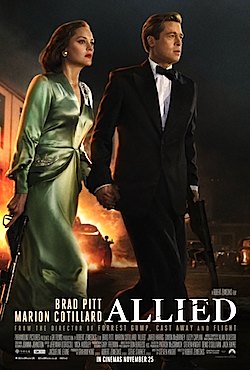
Ah, that awkward feeling when you realise you're watching Marion Cotillard being outstanding in a film which is only quite good. If anything, it reflects quite badly on director Robert Zemeckis that an actress who was probably pregnant for a lot of her scenes was the one required to do all the heavy lifting. But I'm getting ahead of myself…
Morocco, 1942. Canadian allied-forces spy Max Vatan is airdropped outside of Casablanca*1 and instructed to meet fellow operative Marianne Beausejour. Posing as a married couple, they are to carry out an assassination of a high-ranking Nazi official. After completing their mission (that's in the trailer, it's not a spoiler), they relocate to London and marry while Max continues working for the Ministry of Defence. But when his superiors have reason to believe that Marianne is a German spy filtering information back to the Fatherland, Max has to ask himself how deep her cover really is, and if he even knows the real Marianne at all…
An odd recipe this, putting Mr Pitt of 'no fixed genre' with thespic heavyweight Cotillard, written by Steven Knight (of Eastern Promises' parish) and directed by Robert 'Back To The Future' Zemeckis. And that list of primary ingredients is as uneven as the film which comes out of the cinematic oven after two hours.
Ultimately, Allied doesn't seem to know what it wants to be, be it a tense espionage thriller or angst-ridden romantic drama. As a result the film ends up convincing as neither, although it is quite a lot of fun in the meanwhile. The action set-pieces are nicely executed, as is the overall sense of creeping tension. Pitt seems to struggle when he's required to show emotion (although I can't tell how much of that is his perma-spy character not wanting to show his true colours), whereas Cotillard more than makes up for it with a performance which is far too subtle for a film like this. While each scene moves the story in the right direction, the film is baggy at just over two hours, often feeling like it's stalling the audience. Elsewhere there's some neat cinematography in the Casablanca section of the film (even if much of it screams 'soundstage'), and the damp, muted colour-palette of London complements it perfectly. We've also got long-time Zemeckis cohort Alan Silvestri on scoring duties, routinely playing his game of 'hide the BTTF opening-line' where everyone can hear it. Bless him.
The other awkward feeling comes in the film's closing moments, when a quiet, reflective coda suggests that the audience have been watching something emotionally engaging rather than just quite entertaining. For all the ducking, shooting, whispering and shouting though, the relationship at the centre of the film just didn't convince me. And that is supposed to be the point of the film.
I want to score Allied more highly, because it is enjoyable. But I know for a fact that in about a week, I won't remember a thing about it…
Well, it wants to be Inglourious Basterds with a heart, but it ends up more like Mr & Mrs Smith with a grimace.
As much fun as it is, there's nothing inherently cinematic about it, unfortunately.
Judging by the last few minutes?
Apparently not.
It's not.
I won't.
There is.
First firearm-related casualty of the movie.
Textbook stuff.
Level 2: This film stars messrs Brad Pitt and August Diehl, both of whom rocked up in Tarantino's Inglourious Basterds, a movie which featured a voice-over from Sam Windu Jackson.
I mean seriously, who casts Pitt and Diehl in a WWII thriller together again? Mind you, Daniel Betts is in this, and he starred with Pitt in Fury, another WWII drama. Thinking about it, the problem could just be Brad Pitt…
*1 Bear in mind, the film Casablanca wasn't released until 1942. This film is set in 1942. At the time it came out, it was another run-of-the-mill, quick-turnaround drama; well-received an'all, but it didn't gain its iconic status until years later. I only mention it because that line in the trailer where Marianne's like "You'll go on the roof. In Casablanca, that's where men go…" is a trope she wheels out every three minutes or so. Like there's something really special about this Nazi-occupied city that all the others in mainland Europe haven't got. "In Casablanca, we don't drive slowly" / "In Casablanca, men don't kiss their wives with their top shirt-buttons undone" / "In Casablanca, we start with the cutlery from the outside but we use the steak-knife to butter the bread". I genuinely expected Max to stop and yell "Oh, are we in Casablanca? I WISH YOU'D SAID SOMETHING EARLIER, I'VE DRESSED FOR CROYDON!"…
DISCLAIMERS:
• ^^^ That's dry, British humour, and most likely sarcasm or facetiousness.
• Yen's blog contains harsh language and even harsher notions of propriety. Reader discretion is advised.
• This is a personal blog. The views and opinions expressed here represent my own thoughts (at the time of writing) and not those of the people, institutions or organisations that I may or may not be related with unless stated explicitly.
You can't really go wrong with Benedict Cumberbatch. There. I said it. I wouldn't class myself as a fanboy by any means, but I've yet to see him in a role where he's disappointed me*1. Benedict is really the selling-point for The Imitation Game. And this is just as well really, as everything around him is certainly 'good', but rarely rises above that, somehow.
Telling the story of mathematician Alan Turing's work during the Second World War to break the infamous enigma code used by the Nazi forces, the film shifts between 1928 when Alan is a pupil at Sherborne School, 1941 when he's recruited to help crack the code at Bletchley, and 1951 when he lives as a troubled recluse (which is essentially the wraparound segment). The main narrative takes place during wartime, of course, with the other two stories being intercut to support the themes of the film. All in all the device works well, but I couldn't help notice that occasionally we'll be treated to a '1928' (or '1941' or '1951') caption; but not always. To the point where it seems intrusive when the person in charge of the captioning machine seems to have woken up again. As a viewer, you're never lost*2, but either caption all the cuts, or none of them, surely?
So, as I've intimated, Cumberbatch is fantastic as Alan Turing. Awkward yet enthusiastic, shy yet blunt, we get a sense of a man who was a genuine pain in the arse to work with but still wasn't inherently unlikeable, and I genuinely can't think of another performer who'd have brought him to life in this way. Elsewhere the cast is largely solid; Charles Dance plays his role as Commander Deniston straight down the middle*3, Matthew Goode is understatedly great as always as Turing's long-suffering colleague Hugh Alexander, and Keira Knightley seems to have been woefully miscast as Joan Clarke, the team's only female member (this was the 1940s, and that sort of thing simply wasn't done under the normal run of things). It's not that Knightley is awful in her role; the scenes in which Joan is prim-and-proper and quietly determined suit her down to the ground. But at the film's denouement she's called upon to do some actual, emotional acting, and she seems to struggle terribly with it. It's not a deal-breaker, but it is one of the film's weaker points.
With Cumberbatch's performance seemingly more far delicate than the rest of the story, he prevents things from becoming mawkish, even at his most vulnerable. An admirable film which seems to have trouble meshing 21st century values with their post-war counterparts, The Imitation Game never quite grasps what it's reaching for, but it's still an outstanding film and worth watching for what it's actually about rather than how that's done, necessarily.
Wow, that sentence was far too long, even by my standards.
All in all, The Imitation Game is very good; you should see it.
Hmm, well, ...ish?
For the most part, yes. As much as I wanted to? No.
I'd say it probably does.
You'll lose nothing by watching this on a Sunday afternoon at home.
Nope.
At some point, but probably only the once more.
I didn't hear one. Which means no.
Spoilers ~ highlight to read: Really, though? It took them that long before they figured out the words 'heil Hitler' may be a key phrase in Nazi communications and they could use that as a kickstart to breaking the code? I'd probably have been too embarrassed to mention that part if I'd been in the team. Which makes it all the more admirable that they did, I suppose…
*1 Not saying that can't or won't happen, it just hasn't yet. Them's the breaks.
*2 Unlike the other Cumberbatch film which switches unannounced between two timelines which look pretty much identical. Yes, I'm still annoyed by that. Still. *3 But it's at least an atonement for Dracula Untold...
DISCLAIMERS:
• ^^^ That's dry, British humour, and most likely sarcasm or facetiousness.
• Yen's blog contains harsh language and even harsher notions of propriety. Reader discretion is advised.
• This is a personal blog. The views and opinions expressed here represent my own thoughts (at the time of writing) and not those of the people, institutions or organisations that I may or may not be related with unless stated explicitly.
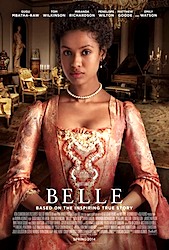
Far closer in tone to 2013's Lincoln than the 12 Years train the media seem to be pushing it onto, Belle doesn't come across quite as powerfully as its makers intended it to, although it's still a very fine film.
Gugu Mbatha-Raw and Tom Wilkinson are exceptional as the central character Dido Elizabeth Belle and her well-meaning, if fusty uncle, Lord Mansfield. Everyone else's performance seems a little over-worthy however, and the cast often stumble over their formal, stilted dialogue. We're treated to an altogether impressive ensemble, but it seems almost as if they're too hesitant in the scenes which require them to be the outright racists the screenplay requires, like they're afraid the clips will be used out of context, somehow. Because of this, the film lacks the conviction you know it should have. If anything, I'm surprised at how 'gentle' the drama is, given that some aspects of the story have already been adapted for the screen.
Belle is certainly an engaging enough period-piece, but in different hands it I think it could have been so much more; a picture which needed to be painted with bolder colours.
Pretty much.
For the most part.
I don't think it does.
This is a Sunday-night DVD.
Nope.
At some point, but there's no burning urge at the moment.
There isn't. Who would have thought it?.
Is Tom 'Draco Malfoy' Fenton actually going to get some roles which don't require him to be A Sneering Arsehole™? Only I'm starting to think he's either been typecast, or he's not actually acting at all…
DISCLAIMERS:
• ^^^ That's dry, British humour, and most likely sarcasm or facetiousness.
• Yen's blog contains harsh language and even harsher notions of propriety. Reader discretion is advised.
• This is a personal blog. The views and opinions expressed here represent my own thoughts (at the time of writing) and not those of the people, institutions or organisations that I may or may not be related with unless stated explicitly.