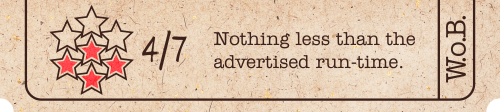
As the BBFC card boldly proclaimed "American Assassin: 18, strong, sadistic and bloody violence", a hush descended over the not inconsiderably-sized audience. The film, dealing as it does with themes of terrorism, revenge and moral accountability opened with a disco-backed montage of worldwide political unrest and narrated by President Carter's Crisis of Confidence speech.
'Well', I thought, 'this is a very similar start to the still-playing Tom Cruise movie American Made. I can't imagine that it's entirely deliberate but it will be interesting to contrast each film's approach to core values of democracy and intrinsic freedom'. Then within thirty seconds, the scene cut to Tom Cruise sitting in the cockpit of a plane, and half a dozen members of the audience (including me) found ourselves walking jointly toward the foyer to point out that they were playing the wrong film*1.
PROJECTION SCHEDULERS: You'll have to do more than just look at the first word of the title, yeah?*2 Anyway, American Assassin began around two minutes after that.
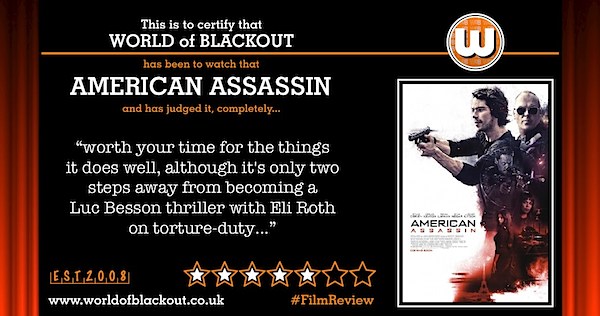
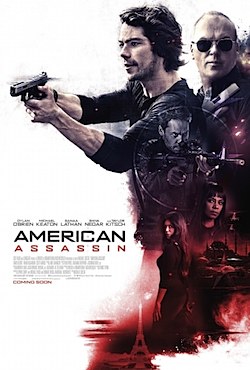
American Assassin opens with Mitch Rapp (Dylan O'Brien) on holiday with his girlfriend Katrina in the Bahamas, when a terrorist attack kills hundreds on the beach including his beloved. Over the next 18 months, Mitch fuels his grief into working-out, target-practice and infiltrating the terrorist cell he holds responsible, with a view to wiping them out in an act of morally justified revenge*3. But the mission falls at the final hurdle when he inadvertently steps on the toes of a CIA black-ops team, who then recruit Mitch to put his talents to more structured use. Under the charge of Agent Kennedy (Sanaa Lathan) and Agent Hurley (Michael Keaton), Rapp is taken to Rome where the mysterious 'Ghost' (Taylor Kitsch) is assembling a nuclear device for the highest bidder*4…
So, 'the beach-scene' is a powerful start to an intriguing, if uneven, film. It's not quite gleeful in its application of violence, but cinematographer Enrique Chediak works an unflinching camera. The fast-cutting in scenes of gunfire is used to navigate to the shots that hurt, not around them. O'Brien is an incredibly strong lead, too; his best work definitely still to come, I think. And I'd genuinely forgotten what it was like to look forward to a Michael Keaton flick, but this year has been so good to us in that regard. His supporting performance as the Navy Seal turned counter-terrorist is nothing short of masterful. The narrative itself can feel a little heavy-handed, but that's understandable given the subject matter (although from an idealogical point-of-view, the film's first-act is borderline Western propaganda).
It's not all plain-sailing, of course. As arresting as the opening is, once the action hits the streets of Rome it's only two steps away from becoming a Luc Besson thriller with Eli Roth on torture-duty*5. For a story that starts with such urgency, American Assassin quickly takes to treading a well-worn path, with shell-casings in abundance but free of emotional engagement. We need to talk about Taylor Kitsch too, overacting in just about every scene, reminding us why he's been out of the cinematic limelight for so long*6. Together, Kitsch and O'Brien are like two differently-aged versions of the same character. And from a certain point-of-view that's absolutely crucial, but it's also distracting as fuck when you're watching it play out. And naturally, no action-thriller would be complete without a ticking-countdown ending of course, especially if that timer is attached to a nuke*7...
There's the feeling in the final push that American Assassin doesn't have quite as much to say as it thought it did when it stood up and dinged its knife against the glass. But as a hard-edged political action-flick, it's head and shoulders above the rest of its class, and well worth your time for the things it does well…*8
It'll probably work better on a big screen than a small one.
Well it's adapted from a novel (/some novels), so if its aim is "bring a series of books to the big screen in the transparent hope of franchising the fuck out of the property" then it probably does.
It's an incredibly strong turn for everyone involved, but not best...
Nope.
There ain't.
Level 2: Mr Dylan O'Brien was in The Scorch Trials, of course, along with Alan 'K-2SO' Tudyk.
*1 Serious point, though: the BBFC card was for American Assassin - while I know the ads and trailers are interchangeable throughout a film's cinema-run, I thought the BBFC card was hard-coded to the digital print of the film? I've heard of age-inappropriate trailers being screened before, but not this. Projection managers, please tell me how this can happen, thank you. [ BACK ]
*2 Oh and apparently, films beginning with the adjective 'American' (Eg.1, 2, 3, 4, etc) are not all part of one collective continuity. Which is in clear contravention of the law set down by The Rev. Ian Carry-On in 1958 and as such is frankly outrageous. [ BACK ]
*3 And call me cynical, but there doesn't seem to be a huge glut of stories about all the absolute arseholes that must also get killed in terrorist atrocities. I mean statistically, they've got to be there too, right? People are largely awful, after all. Not quite sure how you'd build a compelling film around this, but that's why I'm not a screenwriter. Yet. [ BACK ]
*4 And bonus points for the subliminal Back To The Future reference in the film. At one point we see Taylor Kitsch's character in the back of a transit van, examining a (conspicuously radioactive) antique clock, which he's buying on behalf of Libyan terrorists. In the next scene, Michael Keaton is watching a news bulletin reporting stolen Plutonium. Fantastic stuff. [ BACK ]
*5 Although sorry to be that guy, but the gunshot effects in the beach-scene look shite. In all fairness, I couldn't tell at first-pass if they were prosthetic shite or CGI shite, but the result was much the same. [ BACK ]
*6Spoilers - highlight-to-read:Mind, there's a shot in this of Kitsch's character wearing U.S. Navy-whites as a younger man. Is American Assassin actually an unofficial sequel to Battleship??[ BACK ]
*7Spoilers - highlight-to-read:Right hang on, you're telling me you can detonate a nuclear device in the sea less than five miles off the coast of Italy and everything will be basically fine again within a matter of minutes? OH, OKAY THEN...[ BACK ]
*8 And thank you, dear reader, for reading all of these. You're very patient. [ BACK ]
DISCLAIMERS:
• ^^^ That's dry, British humour, and most likely sarcasm or facetiousness.
• Yen's blog contains harsh language and even harsher notions of propriety. Reader discretion is advised.
• This is a personal blog. The views and opinions expressed here represent my own thoughts (at the time of writing) and not those of the people, institutions or organisations that I may or may not be related with unless stated explicitly.
The Importance Of Being Earnest (Live Broadcast from The Vaudeville Theatre, London)
Cert: 12A / 118 mins*1 / Dir. Adrian Noble (& Ross MacGibbon) / Trailer
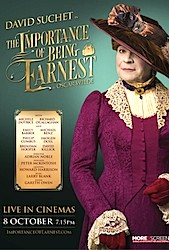
It's an awkward position to be in, that's for sure. To think of oneself as an ardent admirer of Oscar Wilde, whilst at the same time to have never-before seen his much-lauded masterpiece. That a play as acerbically modern-minded as The Importance Of Being Earnest premiered in 1895 seems almost unbelievable*2; indeed, the comedically brutal matriarch of British theatre has become in institution in itself, like the West-End Farce or Pantomime. Sadly, considering it's the godfather of the former, there's slightly too much of the latter in Adrian Noble's presentation of the play for its own good…
The main attraction of the production (in terms of bums-on-seats, at least), David Suchet, is clearly having a whale of a time as Lady Bracknell, the aforementioned Matron Aunt of the piece, casting disapproving scowls and withering glances on all and sundry. But Suchet seems to ramp up the comedy to the point of pantomime-dame; no great tragedy in itself (and he is marvellous), except that the rest of the cast are hell-bent on keeping up with him. The razor-sharp script full of deadpan quips and intoned punchlines is almost lost under the exaggerated delivery of the cast, apparently playing solely to the back of the room (because if the general feel is of pantomime, the Act II sequence between Michele Dotrice's Miss Prism and Richard O'Callaghan's Reverend Chasuble is like watching 'Allo 'Allo…).
Michael Benz and Philip Cumbus give great turns as Jack and Algernon respectively (or Ernest and Ernest, if you will), and Emily Barber and Imogen Doel feel slightly more at ease with their roles as Gwendolen and Cecily. Yet somehow the ensemble doesn't seem to quite hang together, and it occasionally feels like a collection of actors waiting to say their lines. Which is precisely what you don't want when you're watching a live performance (or any performance, to be fair).
But what the hell do I know about live theatre? Massively enjoyable (but for 'what it is' rather than 'how it's done'), The Importance Of Being Earnest is the archetypal timeless classic and tonight's show means I'll now investigate it in more forms (film, TV, audio and indeed live when the opportunity arises), if only because I don't think this is quite the best it can be. A great play which succeeds in spite of its excesses, here.
If Oscar Wilde's flippant sarcasm illustrates only one point, it's that the modern-world has always been this ghastly…
If you can, do.
Well, many of these cine-broadcast shows are now finding their way to various (fully legitimate) streaming sites, so you may well be able to enjoy this in the comfort of your own favourite space soon. (My own favourite space happens to be the cinema of course, but that's by the by)
From my (admittedly) limited viewing experience with the cast, not quite.
I think it does.
Not at all.
Not at all.
David Suchet played Hercule Poirot, of course, in the episode The Murder of Roger Ackroyd, which also starred Oliver Ford 'Sio Bibble' Davies.
*1 Okay, unbecoming sweary-rant: The actual stage-time of the production is around 118 minutes. There are three acts of 37, 50 and 31 minutes, with two 15 minute intervals. That's fine. No seriously, that's great, because the entire set needs to change between them, I get that. But don't put 7pm on the fucking cinema tickets (and the website, and the in-cinema foyer-display screens), when the handout the staff give the audience says "Broadcast LIVE from the Vaudeville Theatre to this cinema at 7.15pm", and everyone's sat in the auditorium by 7:01pm and the house-lights are up and nothing's happening, then a still-card appears on-screen saying "29 minutes to Curtain Up" and the only thing to then change is the gradual decrement of that number. A couple of interviews begin at 7:20 (director Adrian Noble and actor David Suchet) prior to the performance, but for fuck's sake at least have the decency to run some fucking adverts after getting everyone to the cinema twenty fucking minutes early to sit and look at nothing. You absolute bastards.
Oh, and for obvious reasons, I am in no way holding my cinema responsible for any of this. They go with the times they're given and they run the satellite-feed, and I'm absolutely cool with that.
The experience wasn't as infuriating as the broadcast-delay before The Emperor's New Clothes, but since tonight's was entirely intentional on the part of the organisers, it felt worse. [/rant]
*2 Although we always like to think we're far more sophisticated connoisseurs of art and performance than our forebears were, the play was evidently successful enough to have survived this long in its various adaptations. Whether Wilde was ahead of his time or not, it turns out some of those Victorian folks could even have been as cool as some of us, like a frock-coated equivalent of a Stewart Lee audience, thinking they're somehow better than the collective they're exactly a part of.
DISCLAIMERS:
• ^^^ That's dry, British humour, and most likely sarcasm or facetiousness.
• Yen's blog contains harsh language and even harsher notions of propriety. Reader discretion is advised.
• This is a personal blog. The views and opinions expressed here represent my own thoughts (at the time of writing) and not those of the people, institutions or organisations that I may or may not be related with unless stated explicitly.
Effie Gray Cert: 12A / 108 mins / Dir. Richard Laxton
It's happened again. The sales attendant looked me square in the eye and asked "…are you sure?". "Oh, of course," I replied, "I've brought my ladyfriend - at her request, no less - to see the British-made Victorian costume drama Effie Gray. I like 'films' as well as movies, why would this be a problem?". The young man looked at me, one eyebrow slowly raising in gentle accusation. "You do remember Jane Eyre, don't you, sir? We all do…". "Yeah, yeah, Jane Eyre was an anomaly, though. No-one could be expected to like that, even fans of Jane Eyre. And remember Great Expectations? I enjoyed that, didn't I?". I had won. "I was only pointing out that Teenage Mutant Ninja Turtles is on in Screen 1, that's all.". "Yeah, well enough of your cheek, sonny, take my money and give me my tickets. Besides which, I've seen TMNT and have no desire to repeat the process."
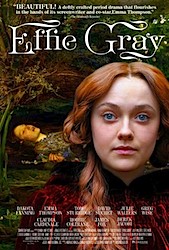
So anyway, Effie Gray follows the story of its titular heroine's troubled marriage to Victorian art critic John Ruskin, resulting in Effie procuring a marital annulment and creating a massive scandal at the time. Actually, the film doesn't cover the scandal, just the events leading up to it. And it doesn't cover the courtship, whereby an intelligent, attractive young woman somehow becomes infatuated with a sociopath harbouring mummy-issues who is, at best, 'a bit odd'. So really, the film just covers the turbulent bit in the middle. Except it's not really that turbulent. Not so much stormy, more of a persistent drizzle.
I have it on very good authority (Mrs Blackout's, no less), that the relationship between the two central characters was a lot more strained than Emma Thompson's screenplay would have its audience believe. The psychological abuse that Gray suffered at the hands of her tormentor seems to be mostly reduced to a few crossed words and funny looks, plus a scattering of huffy silences once Pre-Raphaelite painter John Millais arrives on the scene to woo Effie with his beard and wide array of facial expressions. Like many costume dramas set in the Victorian era, the film restrains itself from placing 21st century attitudes onto its characters. Sadly, this seems to rob them of their bond with a 21st century audience. I didn't dislike the film, but I wanted to engage with it more.
Mrs Blackout was less impressed than I.
A strangely muted affair, played with conviction but unwilling or unable to portray the drive and passion of its characters, or of the Pre-Raphaelite era they were ushering in. Viewers familiar with the art history of the period will raise an eyebrow at how delicately the themes are handled; viewers without that grounding will wonder when the story's really going to kick in.
A midnight storm painted in pastel watercolours, Effie Gray holds the attention, but it's no masterpiece.
Yes and no. The trailer left me none the wiser, but to be fair the film largely did that as well.
Afraid not.
I have it on good authority that it doesn't.
You'll be lucky to catch this at the flicks, but it's perfect Sunday night viewing on DVD.
Not at all.
Not very likely, if I'm being honest.
.
Is it a coincidence that Emma Thompson has written herself the part of the only person in the film who isn't at least a partial fuck-up?
DISCLAIMERS:
• ^^^ That's dry, British humour, and most likely sarcasm or facetiousness.
• Yen's blog contains harsh language and even harsher notions of propriety. Reader discretion is advised.
• This is a personal blog. The views and opinions expressed here represent my own thoughts (at the time of writing) and not those of the people, institutions or organisations that I may or may not be related with unless stated explicitly.