Adapting Jonathan Lethem's 1999 novel, Edward Norton produces, screen-writes and directs a tale of secrets and lies in 1957 New York. Starring as Lionel - assistant to private-eye Frank Minna (Bruce Willis) and fighting to keep his Tourette Syndrome under control - the murder of his boss sees our aspiring sleuth drawn into a city-wide bureaucratic conspiracy*1. When Laura (Gugu Mbatha-Raw) vocally protests against property developer Moses Randolph (Alec Baldwin), Lionel becomes involved believing this to be linked to Frank's death. The pair are then surprised to receive help from architect Paul (Willem Dafoe), and the plot thickens...
MODEL Credit where it's due for the guy doing a bit of A Dennis Waterman, Norton is a model of restraint here. Although his character's affliction comes and goes depending on his stress and distraction-levels, it would be easy to over-egg this part yet Edward rarely strays that close. Alec Baldwin is a bit more pantomime in his (metaphorical) moustache-twirling role, but Willem Dafoe brings things back to level with a 'focused' performance which channels a gaunt Brian Blessed.
Cinematographer Dick Pope's camera direction and colour palette are somehow dynamic and soporific in equal measure, bringing a soothing buzz to the intrigue of the story, while Daniel Pemberton and Wynton Marsalis' soundtrack work is outstanding, a character in and of itself; the whole thing is of its time without becoming a caricature of jazz.
PEOPLE The plot is as convoluted as a private eye conspiracy tale needs to be, but always makes sense in context of itself. Similarly, the finish is quieter than the long lead-up might suggest although it's ultimately in-keeping with the themes of right, wrong and just making the best of a bad situation.
Motherless Brooklyn is too story-driven to be strictly a character piece, yet Norton's central performance is turned up too high to let the narrative take the lead. As such, it's unclear where this will sit in the future.
It's good, though. Watch it for the soundtrack alone.
(although special shoutout to Michael Kenneth Wiliams who was supposed to have been in Solo, which would have made this a level-1).
*1 Having not read the 1999 novel, I don't know how closely Norton has adapted it for the 2019 screen, so I don't know how much of the glaring Tr*mp subtext has been trowelled onto this movie by me, the viewer. Let's just say that if the openly racist property developer and megalomaniac had bleach-blond hair, it would be simultaneously over-the-top yet entirely in keeping...
[ BACK ]
DISCLAIMERS:
• ^^^ That's dry, British humour, and most likely sarcasm or facetiousness.
• Yen's blog contains harsh language and even harsher notions of propriety. Reader discretion is advised.
• This is a personal blog. The views and opinions expressed here represent my own thoughts (at the time of writing) and not those of the people, institutions or organisations that I may or may not be related with unless stated explicitly.
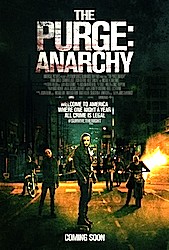
Let's not dick around, The Purge: Anarchy is hammily written, exploitative, straight-to-video, button-pushing, revenge pron, based around a concept which didn't quite work last time, and is no more or less convincing in the sequel. The arch sermonising of last year's introductory episode has all but disappeared, and the exploration of guilt, resentment, peer-pressure and pack-mentality has scarpered along with it. All that's left behind are the victims of violence, its perpetrators, and a group of radicals who are going to beat the system by joining in (no, seriously). Director James DeMonaco also hopes you've seen the first Purge film, because he doesn't waste a lot of time in here with the whys, hows and wherefores; he kind of assumes you're here for the murders.
Scattered over the top of this 100-minute melee is some good old-fashioned Capitalism-Fuelled Paranoia™, the likes of which I haven't seen since Society or They Live. Ironically it's not out of place, since there was a feeling throughout the movie that someone behind the scenes was enjoying this far more than me. Do you remember how it felt when you watched Saw II, and noticed that the writing had taken a back-seat while the set-pieces and loud bangs were doing the driving? That. The fact that this un-numbered sequel has landed 12 months after the first one also hasn't escaped my attention, and doesn't bode well for the future.
The only saving graces of The Purge: Anarchy (and even these are debatable) are that 1) whereas the first act suggests that James DeMonaco has some serious issues with both women and ethnic minorities, this is later expanded to him apparently hating all of humanity; no-one, irrespective of race, creed or class, escapes this debacle unscathed, and 2) the screenplay's dearth of ambition creates a morality-free enclosure which it's quite happy to sit contently within; because if you're not trying to make a good movie, you can't really fail, right?
Leaving aside the mechanics of the purge itself, this could be any low-budget, machine-gun-toting actioner with cardboard characters it can't quite bring itself to care about (so why should the audience?). Even with the people and situations we're presented with, there was a better film to be made here, although I'm sure that DeMonaco will keep flogging this particular horse for its sins.
If I seem like I'm being unduly harsh, it's because I'm genuinely quite disappointed. The Purge wasn't a perfect film, but had some interesting ideas and at least asked some pertinent questions about the world we live in. The only question 'Anarchy' asks is 'how much longer can this go on for?'
That's about the size of it.
I jumped when there was a protracted silence followed by a telegraphed deafening noise; does that count?
If it does then it's a worse film for it.
This will be in the £3 basket in Asda in less than a year. You can wait until then.
Strangely, I probably won't. And I have no idea why.
Doubtful.
I didn't hear one, which makes no sense as it's one more scream (and there are a LOT) that the film-makers would have had to source from elsewhere.
Does the Purge take the USA's time-zones into account? I don't think I've seen this addressed in either film. Because couldn't you like, hop over the border for an extra hour's killing come 7am? What happens if you're on the side of the border where it's 6:15am, but you shoot someone on the 7:15am side? What about the US embassies in other countries? They're classed as American soil, right?
No wait, James, answer my questions!
ANSWER ME.
DISCLAIMERS:
• ^^^ That's dry, British humour, and most likely sarcasm or facetiousness.
• Yen's blog contains harsh language and even harsher notions of propriety. Reader discretion is advised.
• This is a personal blog. The views and opinions expressed here represent my own thoughts (at the time of writing) and not those of the people, institutions or organisations that I may or may not be related with unless stated explicitly.