Showing posts with label Ryan Gosling. Show all posts

Friday, 28 July 2023

Review: Barbie


Barbie
(Spoilers)

Cert: 12A / 114 mins / Dir. Greta Gerwig / Trailer

Life is pretty good in Barbieland. Stereotypical Barbie (Margot Robbie) enjoys an idyllic existence partying, relaxing and socialising with a wide swathe of other Barbies. Beach Ken (Ryan Gosling) joins in but pines from afar, wishing their non-committal relationship could move to the next level, while also enjoying an active social life with all the other Kens. But strange things are afoot, and Barbie notices the shine beginning to rub thin on her daily activities; food tastes bad, showers are cold and she can't shake growing feelings of existential dread.

Visiting Weird Barbie (Kate McKinnon) on the outskirts of town, our heroine learns that her problems stem from angst in The Real World, where the girl who owns the doll is suffering a series of emotional upheavals. This discord has caused a tear in the space-time continuum, and the only chance Barbie has of putting things right is by travelling into The Real World (with Ken in tow) and bringing a little sparkle to Los Angeles before Barbieland falls apart...


BROKEN


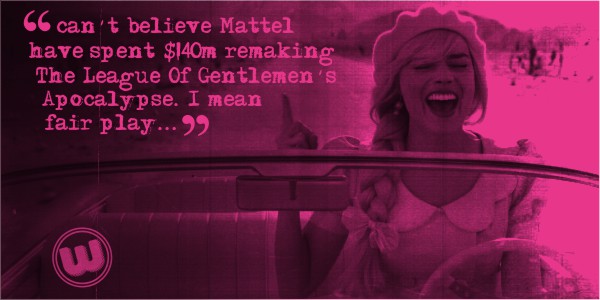
So it seems Mattel have finally broken into the live-action movie IP business by spending $140 million*1 in remaking The League Of Gentlemen's Apocalpyse. I mean fair play, I did not have that on my 2023 bingo card, but at least they've got the action figures on the shelves already so this is a bonus (HASBRO TAKE NOTE).

After riffing on Kubrick's 2001 as per the teaser trailer, Barbie's opening act is everything you'd expect from A Barbie Movie naturally, and archly self-aware as it is, still feels like being kidnapped by a hen party and waterboarded with Lambrini. That said, the production design is a thing of surgically precise beauty, a wry homage to the brand rather than a parody. The players are entirely onboard and carry this in the same vein, and both Robbie and Gosling are perfectly chosen with excellent comic timing. Greta Gerwig's tight direction makes the most of her script with longtime collaborator Noah Baumbach.

There are plenty of laugh-out-loud gags throughout, both in Barbieland and The Real World. A huge supporting cast are having a blast as the various branded iterations of Barbie and Ken, and Michael Cera brings his trademark anxious demeanour as Allan. America Ferrera and Ariana Greenblatt are superb as Gloria and Sasha, the mother/daughter combo caught up in the strife which has opened a gateway between planes of existence. Will Ferrell plays the (appropriately unnamed) CEO of Mattel by playing Will Ferrell™, and Dame Helen Mirren continues to channel the late John Hurt by providing a voiceover that's so cloyingly tongue-in-cheek it actually cheapens both the film and her own IMDB catalogue.

The film wears its feminist credentials on its sleeve and does so very well, even if the message feels very much on the nose a lot of the time. But the fact that this ethos has made it out of a dozen boardrooms and onto mainstream cinema screens in such a prominent style is a feat to be applauded in itself. The version of what we see could not have been made without Mattel's endorsement, and while the impression remains that the paymasters are generally in on the joke, we're also left with the feeling Gerwig and Baumbach are filing off many of their sharper edges. What's more interesting is the boxes the film refuses to tick. Despite the ferocious branding and leaning heavily into the current, financially lucrative, version of its namesake, Barbie is not a children's movie. Children can certainly watch it (within the expected 12A parameters obviously), but it's made for adults - specifically, ones who remember Barbie but don't necessarily have a house full of them any more. And yet at the same time, this isn't an empty, cash-grab nostalgia exercise. It's promoting the product definitely, but it's more about selling the idea of Barbie. Or an idea, at any rate.


POISON


In terms of the actual mechanics of the storytelling, things are a little more... well, vague. The spoilers start here, by the way. Even in a tale of fantastical allegory, the internal logistics have to work for the audience to buy-in on an emotional level. So, if Barbieland™ includes every Mattel doll that's played with then the town would have a population of billions, whereas if there's a separate, self-contained Barbieland for every girl who plays with Barbies then each one would only be populated by the dolls that girl owns. The girl in question here (it's Gloria) only has the few dolls left over from her daughter's recent childhood, not the vast array of specifically vintage and also very up-to-the-minute Barbies on display in the film. There's no clarification over why this is. The Barbieland we get seems to include one of everyone, with no details as to how many other humans are involved at a higher level or how ownership has been assigned. But okay, we'll go with it.

We're told a portal has opened due to a Barbie-fan having a hard time in The Real World, yet in the real world boardroom scene we're told this has only happened once before. As if a lot of people in the real world who've got Barbies aren't having a hard time a lot of the time precisely because of how the real world works. There'd be portals everywhere. But okay, we'll go with it. Likewise, we're told that Weird Barbie has become eccentric because her owner/handler/God went a bit crazy and drew on her with pens, cut her hair with scissors and wedged her legs into permanent splits. Again, kids are gonna be kids and there'd be a lot of these Barbies around town. But okay, we'll go with it.

We don't see the actual, plot-critical portal itself, just a recurring vehicle-montage through Barbieland then the travellers being on Venice Beach, Los Angeles; and vice-versa to return. Barbie and Ken manage to take Gloria and Sasha back through with them, so we'll accept that regular humans can make the reverse trip with no ill effects. But Will Ferrell and the entire Mattel board of directors also manage to surreptitiously follow them, so we've got to assume that it's accessible to anyone on-foot from Venice Beach, yet nobody else has accidentally wandered into this portal that's been open for the duration of the entire storyline. How much more of this do we have to go with?

The Crocodile Dundee, fish-out-of-water routine with Barbie and Ken in LA is executed very well, but doesn't last for long as the pair are soon heading back, as noted above. Meanwhile, most people in the Real World seem remarkably calm about the human iterations of two actual dolls walking around, especially the ones who know exactly what's happened. You'd think this absolute upheaval of mundane reality and revelation of a parallel universe might be a bigger deal, somehow. Similarly, when Ferrell and the gang find themselves in Barbieland, the cultural offset is mined for almost zero reciprocal material. Indeed, the screenplay has no idea what to do with these characters so just forgets about them until the climactic Beach-Off where they have pretty much no constructive part to play (the board's overall plan to 'fix' the situation by putting Barbie back into a branded packaging-box is also weirdly indistinct). For a movie that's genuinely funny, it's staggering how much comedy-potential is wasted here.

Despite all my snarking though, Barbie is good. I don't think it's quite everything it wants to be, but it succeeds in being the film that it (and its audience) needs. It's certainly more than Kenough. It is entertaining and it does also carry a worthwhile message. The feminism, however, is not its subtext - that's very much The Text. Deeper meaning is perhaps more rudimentary than a fuchsia-fuelled crusade for girl-power...


RATT


The inhabitants of Barbieland seem vaguely aware that they're dolls and that The Real World exists, but they know next to nothing about it and show little desire to change this. It's not in the dolls' capacity or programming to realise the limitations of their surroundings or question anything outside of them, and so they're completely unable to deal with deeper philosophical problems about anything that can't be quantified in colourful plastic and simple, methodical activities. Even Margot Robbie's Barbie needs to be railroaded into knowledge by McKinnon's older, cynical sister. When peace and regularity is restored to Barbieland at the end of the third act, this is performed largely by reverting to the status quo prior to the first.

Barbie herself (the Margot Robbie one) finally rejects this of course, like a Tyrell Corp replicant now aware of its lifespan and wanting more. Having understood that revolution won't (or can't) work in her hometown, Barbie opts for evolution instead and journeys to live as a human in desaturated, complicated, messy meatspace. As we close, Barbie's future is an open road, albeit a markedly and necessarily less pleasant one in the process. But she's chosen hope and possibility. Gloria and Sasha's lives may be better as the credits roll but they're not that different, and we all know that Will Ferrell's character will still be Mattel's CEO on Monday morning and Gloria will still be working for him. Stereotypical Barbie was the only character in the movie to take a chance, to make a choice that bold, that permanent. And the choice is open to everyone on-screen of course, but the availability of that choice to everybody? That's the feminism, here. That's the equality. Because of course, the price of that freedom means having to accept that some people will decide they want things to not get better...


Back in Barbieland, the remaining collective of Barbies and Kens (okay, and Allan) also have wider knowledge of how things really work now, and they choose repair their society by setting all this to one side and carrying on as before. They're not ready to make the change, yet. Similar to Never Let Me Go, this might be the most profound point the film makes - that the Barbies' and Kens' perfect, repetitive, superficial lives are our lives, as we blankly rush through our ingrained routine to spend disposable income being distracted by a two hour dopamine-boost in a cinema. Or at a party. In a restaurant. At a shopping mall. In dream houses full of wonderful organised, covetable, accumulating stuff, always thinking about tomorrow and never appreciating the nuances of today, just as we recoil in horror whenever someone mentions the truth that we will not talk about: that fact one day soon, we will die.

We could live more, feel more, choose the genuine thrill of uncertainty. But it's easier to choose not to. Stereotypical Barbie has chosen to truly live, and in doing so has chosen death. And this is a final theme upon which Barbie does not dwell of course, because it doesn't do to be overtly reminded you're wasting your life by a toy advert...*2


And if I HAD to put a number on it…


*1 Wikipedia lists the film's budget (production, not including marketing) at $128-$145m. And while that obviously is a lot of money, it has to be said that bringing in a Hollywood-grade film with a production-design this polished and featuring this cast for under 150 large ones is pretty damned impressive, especially looking at the box office returns it's making... [ BACK ]

*2 There is a very strong chance I've over-thought all this of course, but please do bear in mind that I'm the one who interpreted the U-rated Boss Baby animated movie as being a study of infant-mortality induced PTSD... [ BACK ]

DISCLAIMERS:
• ^^^ That's dry, British humour, and most likely sarcasm or facetiousness.
• Yen's blog contains harsh language and even harsher notions of propriety. Reader discretion is advised.
• This is a personal blog. The views and opinions expressed here represent my own thoughts (at the time of writing) and not those of the people, institutions or organisations that I may or may not be related with unless stated explicitly.

Friday, 13 October 2017

Review: Blade Runner 2049 (second-pass)


Blade Runner 2049 (3D / second-pass / SPOILERS)
Cert: 15 / 163 mins / Dir. Denis Villeneuve / Trailer


It's funny how these things clump together, but this was my second second-pass of a second-installment this week. Pretty sure if I managed to do that again after the weekend I'd get some sort of badge or certificate. I digress.

Having left this Obviously Not Long Enough, I decided Blade Runner 2049 really needed another going over. A work best experienced on a massive screen, the ideal place for this is the cinema of course. And whereas home-based deconstruction can take place whenever you've got a couple of free hours, cinema scheduling means that you've really got to decide within 3-4 weeks if you can get more out of a movie. I'm sure I'll be watching this for years anyway, but I really want to get the most out of it now.

Before I get stuck in, I should say how much I liked the flickering, juddery, interlaced studio idents at the start. Nothing which follows uses this faux-interference aesthetic until the closing credits, and I can only imagine they've been put there to piss off the people who download the film illegally and have that deflating feeling of wasted bandwidth upon pressing Play. Top work!

So. Magnificent though Blade Runner 2049 is, as I suspected rewatching the movie brought no great revelations. Whether Denis Villeneuve's sequel needs more time to bed in culturally and generate more general discussion, or whether the story just has less to say (or more specifically, ask) than its progenitor remains to be seen. With the best will in the world, I suspect it's the latter. This is a fine looking presentation in 3D, even if Roger Deakins says otherwise, although like all post-production conversions, it never feels intrinsically necessary.

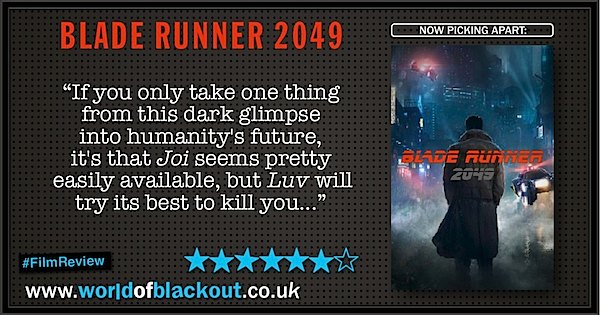
Ana de Armas is great as Joi, and Carla Juri also shines as Ana (somewhat confusingly). But this film belongs firmly to Sylvia Hoeks' Luv, the replicant quality administrator and assassin*1. Hoeks owns every single scene she's in here, showing both the aspirational pinnacle and ultimate downfall of perfected human simulation with furious bursts of anger, jealousy and childish petulance. More human than human, indeed.

If you take nothing else away from Blade Runner 2049, Joi seems easily available in a consumer society, but Luv is more intense and will end up killing you…


As a story about manufactured evolution, it's both prescient and timeless. The intricacies of the central plot are much clearer the second time around, even if this robs the film of its smaller and larger conundrums whilst watching. Whereas Blade Runner famously asked more questions than it answered, the more philosophical aspects of BR2049 seem largely wrapped up within its not-inconsiderable run-time.

The discussion throughout the first movie of course was 'can a bioengineered replicant with an organic AI brain be treated as human once it becomes self-aware?. Irrespective of the 'other' as-yet-unanswered question, the answer to this is yes. The creation may not be biologically human, but it's emotionally human. So when BR2049 asks 'yes, but can a holographic simulation with an AI brain be treated as human once it becomes self-aware?, the answer is also clearly yes. Humans are just machines made of meat rather than electronics, and the existence of a metaphysical soul can be neither proved nor disproved using both examples. Discuss.

There's also a brief (and less-explored) pondering over 'if you're implanted with someone else's memories, how can you tell which ones are yours?. But Agent K's belief in his past experiences affects his judgement and actions in the present. Those burned-in reactions and instincts become part of his mind's operating-system, so yes, they're his memories as much as his interpretation of events which occurred the day before. He might not have been there when key childhood events took place, but he remembers them so they're his memories in a very real sense. He didn't 'make' them, but you (probably) didn't make the clothes you're wearing - they're still yours. Discuss.

Additionally, in terms of who is and isn't a replicant and how that affects their outlook and prospects, Villeneuve (or more properly, screenwriter Hampton Fancher) is far more transparent this time around, so the only real lingering discussions are based on the ongoing one from the first Blade Runner anyway*2. All I had after that were plot-based niggles:

• Does the 'natural lifespan' of the new replicants include the time normally allowed for humans to pass through childhood and adolescence, or is it adulthood-onwards? We see them 'born' in their adult bodies, and Sapper certainly appears to have aged - if only because you wouldn't make a replicant which looked like that grizzled 'out of the box', now would you?*3

• How come Sapper wears glasses? Is it because a) He’s trying to disguise himself and/or blend in with the humans to avoid detection? (in-universe explanation), b) As part of his natural lifespan, his eyes are starting to wear out and he can’t get them replaced or repaired without drawing attention to himself? (in-universe explanation), c) The glasses Sapper wears are like those tiny wire-framed ones you typically see in movies with Second World War Jewish refugees wearing them, largely due to their lack of materials/resources at the time, and the film is drawing a visual parallel between the persecution of the Jews and the authorities in Blade Runner hunting down the last of the Nexus 8s, not least to allow for control-freak Niander Wallace’s ‘superior’ models? (out-of-universe explanation), or d) All of the above. Discuss.

• Speaking of superior, how come Agent K just manages to drown Luv so (relatively) quickly? I know these are bio-engineered creations as opposed to wires and pulleys, but you’d think Wallace would have adapted them to either draw the required oxygen from water if they become submerged, or at least be able to hold their breath longer. Wasn’t the original point of the replicants to perform work which was too hazardous for humans, like maintaining the off-world colonies and ships (ie working in freezing and low-oxygen environments)? And now it turns out that if one of them falls asleep in the bath, that’s Game Over? Ridiculous.

• Most importantly: wait, who's looking after Deckard's dog?


So, watch this if you enjoyed?
Blade Runner.


Should you watch this in a cinema, though?
Absolutely.


Does the film achieve what it sets out to do?
Probably. I'll have to get back to you on that one, probably in several years.


Is this the best work of the cast or director?
As great as this is, not quite.


Will I think less of you if we disagree about how good/bad this film is?
Nope.


Yes, but is there a Wilhelm Scream in it?
There could be one during the remote-strike attack at the junkyard outside the orphanage, but I can't be certain so I'll side with no.


Yes, but what's the Star Wars connection?
Level 1: Han Solo's in this.


And if I HAD to put a number on it…


*1 A job title I'm currently pushing for myself, but my employer won't have it. [ BACK ]

*2 There's no way of dressing this one up, that CGI Rachael is passable until she begins speaking on-camera, then it's absolutely atrocious. One of the few genuine weak-points of the entire film Too much movement in all the wrong parts of the face. It felt less weird when the holographic girlfriend simulation was syncing with an android hooker. Seriously, Rachael and Rogue One Leia need to get in the sea.

I like that Deckard points out to Wallace "Her eyes were green...", because if that's the only thing he can see wrong with this picture then his own clearly aren't working properly, either. From a story perspective, surely Deckard is more likely to have been persuaded to help Wallace if he'd made a 'projected current age' replicant, implying that the pair could somehow go on to make up for lost time, rather than unequally resetting the relationship with an age-gap. This would also have entailed getting the actual human Sean Young back in the studio, and I wouldn't be typing all of this in the first place.

The irony hasn't escaped me, of course, that all of the other replicants in the film are flawless facsimiles of humans since they're played by humans, whereas the Rachael-bot is a literal replicant, and who is so far down The Uncanny Valley that the Los Angeles Pot-holing Society have been called out to rescue her... [ BACK ]

*3 Imagine the day the Ryan Gosling replicant was created, though. The boss comes in and is like "I know you've made this one stab-impervious Terry, but why are the eyes so close together? You do know we have to sell these, right? Would you buy this? ...well I suppose the LAPD might take him, but they're going to pull our trousers down over a discount..." [ BACK ]


DISCLAIMERS:
• ^^^ That's dry, British humour, and most likely sarcasm or facetiousness.
• Yen's blog contains harsh language and even harsher notions of propriety. Reader discretion is advised.
• This is a personal blog. The views and opinions expressed here represent my own thoughts (at the time of writing) and not those of the people, institutions or organisations that I may or may not be related with unless stated explicitly.

Saturday, 7 October 2017

Review: Blade Runner 2049


Blade Runner 2049 (first-pass / SPOILER-FREE)
Cert: 15 / 163 mins / Dir. Denis Villeneuve / Trailer


You've come here for a review of Blade Runner 2049, and in much the same way as Kingsman, you've arrived with two questions. Again, the answer to the first is "yes, very much so" and to the second, "no, but how could it be?". Because you're an impatient soul, I've put my lengthier-than-usual pre-amble in the first footnote. You're welcome. Discussion of the film begins after the next paragraph.

First things first: before going to see Blade Runner 2049, I'd advise you to watch the three prequel/lead-in shorts, Black Out 2022, 2036: Nexus Dawn and 2048: Nowhere To Run. Along with the timeline over at Collider, they cover key events which occurred between the first Blade Runner set in 2019 and the new movie. This isn't essential homework, but any background exposition in BR2049 is fleeting and largely conversational, so it's handy to have this grounding beforehand.

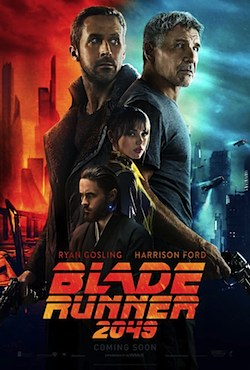
The story follows Los Angeles detective and Blade Runner, Agent K (Ryan Gosling) as a routine retirement job opens a potentially huge can of worms. K's boss Lt. Joshi (Robin Wright), anxious to avoid the ire of her superiors and attention of the powerful replicant-manufacturing corporations, orders her young charge to tie the case up as efficiently as possible (ie not sparing the gunfire). But K's inquisitive nature leads him along a trail to former assassin Rick Deckard (Harrison Ford), in a place where the ghosts of the past are buried almost as well as the conspiracies of the present…

So the first thing which strikes the viewer about Villeneuve's sequel is how light it can be in L.A. Whereas Ridley Scott's telling took place almost exclusively at night, the tale's pickup point features scenes at various times and varied run-down environments. It's never sunny of course, with only the dregs of humanity left behind on a near-ruined planet, whatever passes for natural daylight only serves to illuminate the brittle shell of a world even more harshly. Although undoubtedly existing in the same timeline, this only really looks like the same Blade Runner on the occasions we see the city's filthy skeleton lit only by neon and gunfire. But if the visual theme in 1982 was of darkness and rain, 2017's is more desperation and rust.

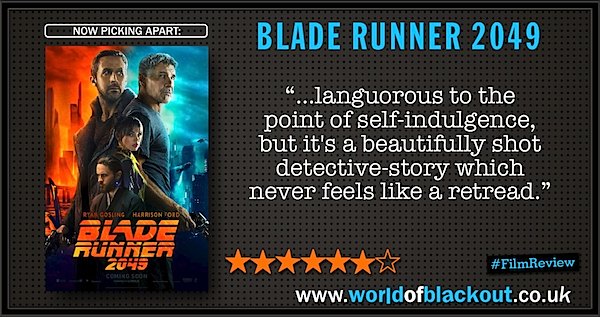
And this difference is the key to the film's greatest strength: BR2049 never feels like the retread that would have been the path of least resistance so far as writing is concerned. Screenwriter Hampton Fancher returns, in the company of Michael Green, and together they've created a continuation of the story, rarely slowing to nod at the audience with knowing familiarity*4. Of course, the pressure is on Villeneuve to deliver a work as profound as its forebear, but going in with that expectation is likely to lead to over-symbolising what is essentially a beautifully shot detective movie. Villeneuve doesn't explore the same avenues as Scott did, or leave the viewer with the same (or even as many) questions. That's not to say there isn't plenty to think about afterwards of course, but there's no book to cross-reference it all against, this time.

At a run-time which won't give you much change out of three hours, the pace is languorous to the point of self-indulgent, but Roger Deakins' cinematography earns that effortlessly (although Sony's shameless product placement is at an all-time high). And for a production with such a wide-ranging cast-list, the lion's share of our time is spent with Gosling, Ford and Sylvia Hoeks' antagonist Luv (who deftly steals every single one of her scenes). Gosling seems almost perfectly cast in his role as our guide through the shattered landscape, and Ford brings more of latter-day Solo than latter-day Jones to his reprisal (thankfully*5).

To say any more would probably be to delve into what makes this so enjoyable, and begin to spoil it in the process. Other than a grounding in Blade Runner and the shorts linked above, try to see this 'clean'. But do try to see it.

Was I blown away by Blade Runner 2049? No.

Do I think the film will have a cultural longevity which will become more intriguing as each year passes? No.

But did I think exactly the same when I first saw its predecessor? Yeah.
What do I know?


So, watch this if you enjoyed?
Well, Blade Runner.
To the point where it's fairly essential that you've at least seen the first one
.


Should you watch this in a cinema, though?
The cinema is the natural home of this outstanding-looking piece of work, yes.


Does the film achieve what it sets out to do?
I think it just about does.
But I also think the film could have set out to achieve more
.


Is this the best work of the cast or director?
For the most part no, although there could be a couple of exceptions in there.


Will I think less of you if we disagree about how good/bad this film is?
I shouldn't imagine so.


Yes, but is there a Wilhelm Scream in it?
There isn't. For shame.
Couple of perfect moments for one, too
.


Yes, but what's the Star Wars connection?
Level 1: Han Solo's in this.


And if I HAD to put a number on it…


*1 This is the pre-amble which was too long to feasibly put as part of the main review. It was written before watching Blade Runner 2049. And as flowery and self-important as this seems (okay, is), it felt worse to give the introduction its own separate blog post, somehow. That's the kind of treatment usually reserved for Star Wars, after all.

So. Where to begin? Although as a youngster I'd read the comic adaptation which filled out the page-count in Marvel UK's Return of the Jedi Weekly, I first came to the actual film of Blade Runner in the mid 90s. And I first began to fully appreciate it about five years later (and even that's been a constantly increasing curve rather than an off/on switch). Ridley Scott's 1982 neo-noir masterpiece is the gift which keeps on giving; still finding new audiences, still beguiling old ones, still being discussed and dissected after thirty five years. And comparing the movie with Philip K Dick's source-novel only raises more questions as that's a thematic whirlpool of its own, yet the works seem to feed off each other with each re-visit. I don't think I'll ever be done with either.

So it may seem unduly harsh to say this, but Blade Runner is a film which categorically does not need a sequel. The loose ends of Rick, Rachel and replicant-retirement don't need tying up. Indeed the movie's ambiguity is what makes it so satisfying, its point-blank refusal to put a bow on the story, despite a superficially happy ending. So in helming the follow-up, director Denis Villeneuve has his work cut out, even with (or perhaps more accurately because of*2) Ridley Scott's return in an exec-producer role.

And yet, am I happy a sequel exists? Hell yeah. But if Blade Runner 2049 is to be a worthy follow-up, there's no way I can begin unpacking it after a first viewing*3. If I leave the cinema understanding everything I've seen then the film has failed on some level. I expect to be talking about BR2049 for a long time to come. So y'know, no pressure Denis.

With all this in mind, what follows above is a first-reaction. More of a 'should I see it?' than 'why should I see it?'. You already know if this flick is going to be for you, and for obvious reasons you can take your own baggage and tailor your own expectations accordingly. But tonight we're gonna party like it's 2049. [ BACK ]

*2 My own concerns with Mr. Scott have been written about elsewhere, but it's hardly controversial to say that his return to the Alien franchise has had a mixed reception. And yes, footnotes within footnotes. It's very much that kind of film [ BACK ]

*3 I haven't even got round to going back to Villeneuve's Arrival yet, even though I know it fully deserves the time. But it's his work on that movie in particular which tells me he's the right choice for Blade Runner 2049. [ BACK ]

*4 Although the writers do place one rather ungainly elephant in the room by means of unnecessary callback, but I'll leave that until my next review. [ BACK ]

*5 And I say this as one of the twelve people in the world who actually like Crystal Skull, but Harrison Ford's dramatic range isn't particularly wide. He's only great at being varying shades of Harrison Ford™, and thankfully the one we get here is Weary Ford rather than Curmudgeonly Ford. [ BACK ]


DISCLAIMERS:
• ^^^ That's dry, British humour, and most likely sarcasm or facetiousness.
• Yen's blog contains harsh language and even harsher notions of propriety. Reader discretion is advised.
• This is a personal blog. The views and opinions expressed here represent my own thoughts (at the time of writing) and not those of the people, institutions or organisations that I may or may not be related with unless stated explicitly.
Sunday, 8 January 2017

Review: La La Land


La La Land
Cert: 12A / 128 mins / Dir. Damien Chazelle / Trailer


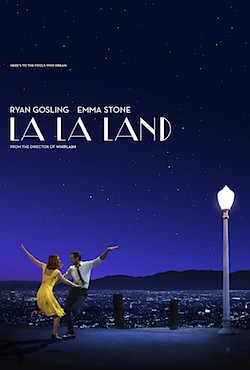
As I write these words, two things of note have happened to me in the last forty-eight hours. On Saturday morning, I went to my dentist to have an infected tooth removed. On Sunday evening, I went to my cinema to watch a preview-screening of La La Land.

As I write these words, it's Sunday night and I'm trying to work out the low-point of the weekend…


So, watch this if you enjoyed?
…if you enjoyed being invited to your niece's stage-school reimagining of Singin' In The Rain, only to remember twenty minutes in that you don't have a niece, you don't know anyone on the stage and other people's children are precocious shits anyway, but you're pretty much trapped now so the only options are a) grimace through the taped-on enthusiasm looking for any trace of subtlety and meaning, or b) stand up and yell "when does this END?" towards the stage. If, like me, you over-value politeness you'll probably go for A, knowing at least that you'll give the production a fucking rinsing as soon as you're in front of a keyboard.


Should you watch this in a cinema, though?
Well, advance screenings (of which this was one) always have a slightly earlier start-time, due to no adverts being shown and fewer trailers before the film. It's usual, therefore, for there to be several 'late arrivals' as the feature presentation is in its first ten minutes, and tonight was no exception. And how I envied those souls as time went on, if only because they'd had to sit through less of La La Land than I had….


Does the film achieve what it sets out to do?
Well if - if - writer/director Damien Chazelle was aiming for 'directionless, overly-long, overly-kitsch and self-indulgent fan-film of Hollywood's Golden Age, clearly hoping to do for the big-number musical what The Artist did for silent cinema but seemingly forgetting that the things which made those musicals great were craft, charm, characters you actually gave a shit about and above all else the music', then yeah it probably does.

Point also deducted for having John Legend in the film (whom one can only assume has been cast because of his in-movie singing rather than his acting) to lecture our lead character about being 'stuck in the past', a speech inserted artlessly into a screenplay whose only concession to the modern day is that the characters have iPhones.

If you want a film about a bittersweet, nearly-made-it love story in Hollywood between two flawed but engaging characters, watch Café Society. If you want a film about the relevance of Jazz in the twenty first century, watch Miles Ahead.


Is this the best work of the cast or director?
Oddly, both Emma Stone and Ryan Gosling are on pretty good form, here. But being a good performer in a thing that's awful doesn't make that thing any better (cf the cast of Exodus: Gods & Kings).


Will I think less of you if we disagree about how good/bad this film is?
Of course not.
Everyone seems to love La La Land so far, and I'm aware that my opinion's in a minority.

Albeit a minority of people who are right.


Yes, but is there a Wilhelm Scream in it?
There isn't.


Yes, but what's the Star Wars connection?
Level 2: This film stars that Ryan Gosling, who's also in the upcoming Blade Runner sequel alongside Harrison 'Solo' Ford.


And if I HAD to put a number on it…


DISCLAIMERS:
• ^^^ That's dry, British humour, and most likely sarcasm or facetiousness.
• Yen's blog contains harsh language and even harsher notions of propriety. Reader discretion is advised.
• This is a personal blog. The views and opinions expressed here represent my own thoughts (at the time of writing) and not those of the people, institutions or organisations that I may or may not be related with unless stated explicitly.

Sunday, 29 May 2016

Review: The Nice Guys


The Nice Guys
Cert: 15 / 116 mins / Dir. Shane Black / Trailer


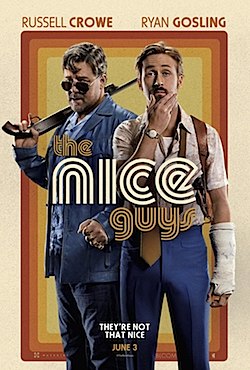
While I try to remain open minded about the film business (no really, I try), first impressions count for a lot in this game and Shane Black's new buddy-actioner was on an uphill climb with me from the first time I saw the poster. Everything checks-in tonally, but the title and tag-line combination The Nice Guys: They're Not That Nice indicated that this would be a film which revelled in explaining its own jokes. And it was because of this that I was also lukewarm to to the trailers when they arrived, promising a film which couldn't quite commit to the raucous comedy that was clearly taking place in the background. Yep, catch me on the wrong day and I'll be the worst audience you could want for your movie. But hey, at least I'm upfront about that.

Nevertheless, I was still going to watch The Nice Guys, of course. While I've never exactly raved about the principal cast, this was the new movie from the director of Iron Man 3, for crying out loud. Alas, I needn't have worried after all that. Black's crime-romp is a sort of garishly-lit 1970s noir which, while it's consistently funny, is a lot more deadpan than the pacing of the trailer suggests. The film opens with dual-voiceovers from both private investigator Holland March (Ryan Gosling) and private enforcer Jackson Healy (Russell Crowe), narrating the similarly haphazard state of their lives and the circumstances that bring them together; the untimely death of porn-actress Misty Mountains, and disappearance of the Chief of Justice's daughter, Amelia. That the two are linked is in no doubt, how the two are linked will take the investigative pair on a trail of intrigue which goes full-circle through the criminal underworld, adult film-industry, automotive industry and law enforcement itself…

Now how much you enjoy the film will probably depend on how you're watching it. Personally I had it categorised as a comedy before we started, and the film is laugh-out-loud funny in its own alternative way. The film works as an actioner, but car-chases and fight-scenes aren't the strongest weapon in its arsenal; that would be the laughs. The screenplay's humour is by no means 'dark', but the director brings a certain bleakness to this caper which undercuts the gags, turning most of them from hearty guffaws to dry chuckles*1. While there's always plenty going on, The Nice Guys often feels like it should be more fun than it is (although I also believe it's a better film for all that). Russell Crowe makes for a reassuringly solid comic straight-man and excels when he's hitting or shooting people, but struggles with his own humorous lines in comparison to Ryan Gosling (who seems far more comfortable as Hapless Fool™ than he does in many of his dramatic roles).

While the two leads carry most of the film, an honourable mention has to go to Angourie Rice as March's daughter, Holly. Her comic timing is perfect, and acting as the mature-half in the relationship with Gosling as her inept father, easily handles the most subtle role in the film with arguably more skill than any of the grown-ups handle their more pedestrian ones. Oh, and while I'm on, what's with the soft-focus on Kim Basinger's close-ups? You'd think after hiring her, they'd at least have the common courtesy of showing her face properly. If it's an in-joke to the way that 'mature' actresses used to be treated in Hollywood, then it's out-of-keeping with the realist 1970s aesthetic; if it's meant to be cinematic politeness, then it comes off as the underhanded opposite.

Too cynical and self-aware to be a mainstream smash, but too much fun for a serious statement, I think that this movie will gain more of a cult-status than the casting and marketing would suggest. As fantastic as the end result is, The Nice Guys can never quite decide if it wants to be a black comedy or a wry, self-effacing action movie.

But even though the two strands never quite join seamlessly, it still makes a pretty good stab at them both…


So, watch this if you enjoyed?
It's a sort of halfway-house between L.A. Confidential and Inherent Vice, with maybe a smattering of Jackie Brown thrown in for good measure.


Should you watch this in a cinema, though?
Only if you like 'em big and loud.


Does the film achieve what it sets out to do?
Just about, yeah.


Is this the best work of the cast or director?
Not quite, but damned close.


Will I think less of you if we disagree about how good/bad this film is?
Probably not.


Yes, but is there a Wilhelm Scream in it?
There isn't, although we do get a boot-shot and a "I've got a bad feeling about this…"
(The film is set in 1977 yet there's not a mention of Star Wars to be seen. Well played, Mr Black. No, seriously: few writers would have been able to resist that one.)


Yes, but what's the Star Wars connection?
Level 2: Let's go for the easiest route here: Ryan Gosling is due to star in the upcoming Blade Runner sequel, as is Harrison 'Solo' Ford...


And if I HAD to put a number on it…
^^ That's not necessarily a strong 6, but it's definitely a better movie than a 5 would indicate.

*1 Although not everyone took the comedy in a contemplative, genre-defying manner. One particular patron sat two rows behind me found the film so hilarious that they started laughing when the BBFC card was displayed. I wish I was joking about that. Still, they enjoyed it very much, it's safe to say…


DISCLAIMERS:
• ^^^ That's dry, British humour, and most likely sarcasm or facetiousness.
• Yen's blog contains harsh language and even harsher notions of propriety. Reader discretion is advised.
• This is a personal blog. The views and opinions expressed here represent my own thoughts (at the time of writing) and not those of the people, institutions or organisations that I may or may not be related with unless stated explicitly.