Once every so often, a film comes a long which leaves my significant other and myself a little lost for words upon leaving the cinema. The initial 'Well, what did you think..? is answered cagily either way; it's not that the movie was actively disliked at all, but we struggle to sum things up in a positive light. And although we'll attempt to push the elements we liked of the evening's entertainment to the top of our list, the rest of the journey home is spent listing the ones we didn't.
Which brings us to Mr Turner.
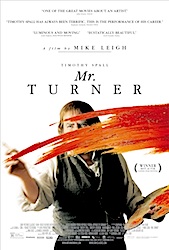
A two and a half hour film with an hour's worth of story, the director Mike Leigh often seems to mistake plodding-unpleasantness for character-building, and we're treated to Timothy Spall's admittedly robust performance of a tortured creative, struggling to balance his personal artistic vision, public favour for his work and his personal responsibilities. Except we don't actually see any of the tortured stuff. At the start of the film, Turner is a successful artist taking trips around the world for inspiration alone before returning to his central London house/studio, with its bolt-on private gallery where he sells his paintings to art connoisseurs and nobility alike. Painting is his job, his life and his passion. It's also an activity he has the financial freedom to pursue. So other than an underlying (and largely overlooked) personality disorder rooted in his past, there's really very little to 'explain' the bad-tempered, misanthropic misogynist that we spend the film with. His issues with women are illustrated frequently, but rarely explored. Leigh by no means paints him in sympathetic colours, but other than a downward spiral of angst and mental instability, there's no development of his character (and I say 'character' because I don't know enough about the actual William Turner to judge whether the screenplay is a celebration, a portrait or a full-on character assassination of the man).
And yet the character of Mr Turner himself isn't one of the film's major flaws, somehow. Timothy Spall brings enough of his own madness to the role to keep him acutely interesting, if nothing else. Even such an accomplished actor, however, is hamstrung by a horrendously unwieldy script - although his in-character monosyllabic grunts convey far more emotion than his lines. The rest of the cast have lesser rates of success with the same challenges (to the point where Ruth Sheen as Turner's estranged wife sounds as if she's reading the lines for the first time as the cameras roll), and the film really becomes more about physical acting than exchanges of dialogue.
Areas of narrative interest (the 'revealing' of his real name to his Margate landlady and prospective partner / Turner's work falling out of public favour / his relationships with his contemporaries) are either glossed over, skipped over or outright abandoned. The film plays out like a dramatised documentary with no-one narrating the events you feel should be being examined. Bizarrely, it a single scene we get not only a direct reference to the Zong slaveship which formed the central thread of the costume drama Belle, but the matter being discussed with young art critic John Ruskin, whose older self appears in Pre-Raphaelite mope-fest, Effie Gray. It occurred to me then that Mr Turner really rounds off a trilogy of visually fascinating films which should really be so much more involving, given the nature of the stories they tell.
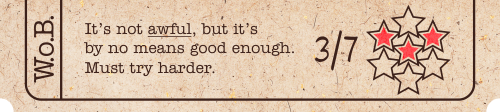
I didn't dislike Mr Turner's composition, but I disliked too many things about its execution.
And I know that the shots that are needed of Turner's beloved Margate are no longer feasible in Margate itself. The landscape and scenery has changed far too much for what's required, so I understand why those shots weren't filmed there. But if you can't actually film Margate in Margate, at least film somewhere which looks like Margate. Or even like Kent for that matter. There is not - and has never been - a tree-topped cliff on the Western side of the promenade which the sun sets behind. After all, it's not like Turner actually had any time, respect or love for the place. Y'know, like to the point where they built an art gallery and named it in his honour, or anything. So why try for accuracy, right? I rather suspect that someone has imagined the elevation of the setting in this picture to be higher than it actually was.
And I know - I know - it's an absolutely minute fraction of the audience who will pick up on this, but when you do that in your film, it looks like you don't care.
And if you don't care, why should your audience?
Yeah, whatever.
No, if I'm being honest.
I have no idea.
Sunday evening DVD, at best.
I won't want to, but I will.
I don't want to, and I won't.
There bloody well isn't.
That's it for 17th/18th century art-films for this year though, right?
DISCLAIMERS:
• ^^^ That's dry, British humour, and most likely sarcasm or facetiousness.
• Yen's blog contains harsh language and even harsher notions of propriety. Reader discretion is advised.
• This is a personal blog. The views and opinions expressed here represent my own thoughts (at the time of writing) and not those of the people, institutions or organisations that I may or may not be related with unless stated explicitly.
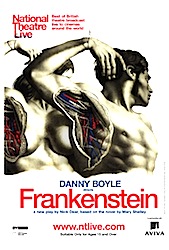
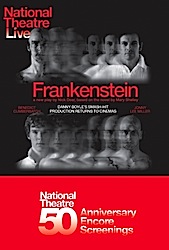
On reflection, I think that this version of Frankenstein, with Benedict Cumberbatch as the ethically-bereft doctor and Jonny Lee Miller as his first-draft creation, is my favourite of the two performances. A short featurette before the play has Cumberbatch recalling how he studied recovering stroke-patients for his portrayal of the creature, whereas Miller says a lot of his performance was based around his 4yr old son. And it's Miller's child-like interpretation of the part which swings it for me, if only because I could identify more closely with it (not that BC's creature is any less stunning, but it does have a different feel).
In addition, it seems that Cumberbatch is able to get more out of the role of Victor Frankenstein. Both actors pull off the fraught, distracted scientist well, but BC adds a layer of vulnerability which makes the doctor a more sympathetic character; an interesting dynamic in the scenes he shares with his creation, creating a conflict around who you're meant to be rooting for.
Mrs Blackout accompanied me to this, and while she enjoyed it throughly, she feels the other version has the edge. We also took some friends along who hadn't seen either version, and they were suitably blown-away by the whole thing (although, as is customary, they were raising eyebrows at the opening sequence. I think everyone does, that first time). So y'know, your mileage will vary, but you should still love it either way.
Without wanting to sound clichéd, the story really has held its relevancy, and this production does it justice perfectly. Screenings are continuing into December: take a look at Frankenstein's National Theatre page for details of performances near you.
Apart from anything else, how often do you get to see two Sherlocks on stage at the same time?
As much as it can be, yes.
Yes.
Undoubtedly.
Cinema as an when you can, because there's no DVD on the horizon.
Yeah.
Yeah.
Y'know what, I think there's one buried repeatedly in a music/sound-effects sting that transitions two scenes. But I could well be wrong, so I'll err on the side of no.
Did you get the chance to see this at the National Theatre? How does the atmosphere compare with the cinematic presentation?
*1 You can read my review of the show with Benedict Cumberbatch as the Creature here, and my original 2012 review (also with Jonny Lee Miller as the Creature) here.
DISCLAIMERS:
• ^^^ That's dry, British humour, and most likely sarcasm or facetiousness.
• Yen's blog contains harsh language and even harsher notions of propriety. Reader discretion is advised.
• This is a personal blog. The views and opinions expressed here represent my own thoughts (at the time of writing) and not those of the people, institutions or organisations that I may or may not be related with unless stated explicitly.
So as circumstances unfolded, I missed this version of the performance last year. Tonight's showing was the variant with Benedict Cumberbatch as the shambling, slurring and utterly charming Creature, and Jonny Lee Miller as his emotionally anesthetised creator. As you might suspect, BC gets the lion's share of the stage-time in this role, and has that and more of the work to do. This isn't to downplay JLM's performance at all, but as the story is told from the Creature's point of view, it's a necessity that we spend the most time with him.
Mrs Blackout was on my arm this evening, and so was my newbie-by-proxy. She spent the first fifteen minutes or so as I initially did, thinking 'well, this is all very avante garde; do we get a script or is it all expressionism?'. The unannounced, untitled, introductory birthing-sequence does feel longer than it is (even watching it again), yet it's absolutely essential for bonding with the Creature, and by the time of his departure from the farmstead you're glad you shared it with him. Cumberbatch is nothing short of magnificent here, and as much fun as he's having, it never gets hammy or overdone, even when delivering the humourous lines which the script is deftly hiding (although these moments are intentionally more broad when delivered by the other members of the cast). Extra props go to the ever-engaging Karl Johnson and Naomie Harris, whose roles seem almost criminally (if needfully) short.
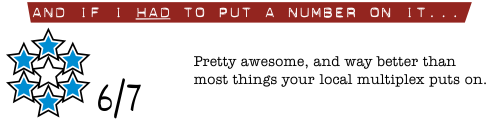
Whether you're a Shelley aficionado, or have only caught fleeting glimspes of the Karloff-guise, this interpretation of the tale is worth your time, money and attention. Meticulously staged, and thought-provoking without beating you over the head with weighted morality, Frankenstein is definitely "theatre", but definitely worth a watch for even the most hardened cinephile.
Oh, and as it turned out, Mrs Blackout enjoyed it very much. So, all good.
Folks in the UK: The other half of the performance (with Jonny Lee Miller as the Creature) is being shown at participating Cineworld, Vue, and Odeon cinemas. Independents are listed on the NT Live website. International screenings are being held, but you'll have to Google your area I'm afraid ;)
Well, it's not really meant to be, I don't think.
I did.
It does.
If you can see Frankenstein at a cinema, do, because it looks like there's no DVD imminent.
I probably will.
If they show it again, I will watch it again.
There isn't.
What's your favourite version of Frankenstein's monster?
Yes, I know it's an obvious question.
That's why I asked it.
*1 You can read my original 2012 review of the show (with Jonny Lee Miller as the Creature) here.
DISCLAIMERS:
• ^^^ That's dry, British humour, and most likely sarcasm or facetiousness.
• Yen's blog contains harsh language and even harsher notions of propriety. Reader discretion is advised.
• This is a personal blog. The views and opinions expressed here represent my own thoughts (at the time of writing) and not those of the people, institutions or organisations that I may or may not be related with unless stated explicitly.