IT: Chapter Two (SPOILERS. NO REALLY, DESCRIPTIVE SPOILERS.)
Cert: 15 / 169 mins / Dir. Andy Muschietti / Trailer
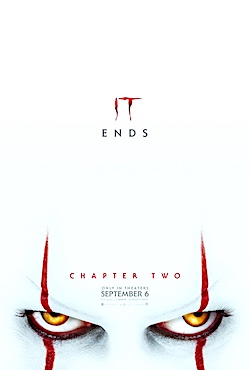
And so, two years on from the beginning of Andy Muschietti's re-adaptation of Stephen King's clownathon, we skip forward 27 years from the original 1989 setting*1. While most of the Losers' Club members moved away from Derry long ago, Mike remains in the town. Over the intervening years, he's become obsessed with the legend of Pennywise the clown and the raft of child murders associated with his appearances. Now that strange occurrences are beginning again as predicted, Mike gets in touch with his old comrades. They made an oath to destroy the creature should it return, and their time is approaching...
THINGS And it works. Largely. Despite the things I'm about to go on and list. It's not always a smooth ride and certainly not a short one, but despite my misgivings this is certainly a counterpart to Chapter One and a proud sibling to that film. While there are pacing issues in the second act, the movie never drags and never feels too long. The casting is strong*2 and it's paid off as the generational links between protagonists is near seamless, with all of the players taking things seriously enough to paper over any small cracks. Bearing in mind that I'm probably not the target audience for this, It: Chapter Two has many things working in its favour.
But rarely before have two halves of the same story felt so strongly interactive, yet like completely separate entities. It's all sourced from Stephen King's original work*3 obviously and Andy Muschietti returns to direct, but whereas Gary Dauberman was one of three credited screenplay writers for Chapter One, here he shoulders that burden alone. And it is something of a burden. While the sequel is definitely a worthy continuation of the Losers' Club story, this feels like it's abandoned a lot of what made the first entry solid, rather than building upon it. We're in more contemporary 'jump-scare and nightmare-logic' territory this time, at the cost of Chapter One's charm and focus.
TIDES By its very definition this isn't a tween adventure. The film, like its central characters, is now more jaded - more cynical. Also like the characters, it seems to have forgotten what held the first movie together. Namely, the clown. Pennywise is almost relegated to a footnote in his own story while we spend time with the grown-up-gang. And that would be fine if the screenplay explored their re-bonding after so many years apart, but what we get instead is a reunion meal, then them literally being sent off on their own for a series of micro-adventures, which by necessity do not involve the fellow club-members.
It's at this point where the movie really begins to sag with the heavy use of interwoven flashbacks*4. These utilise the cast from the first movie (which is great, obviously), and while some have been filmed at the time of Chapter One's production, others have clearly been shot late in the production cycle of the sequel, since the kids have really, noticeably aged. As Muschietti has no doubt learned, you get a narrow production-window with a cast that young so use it wisely (it's all very well going 'yeah, this bit is like a hallucination not a memory', but young Ben there looks like he needs to leave the set and have a shave).
THIEVES As much as IT buzzes along at a gamely rate, the movie is plagued with inconsistencies. The line between reality and illusion isn't just blurred, it's actively ignored. Young Henry Bowers was incarcerated in a psychiatric institution after the events of the first movie, and is now being haunted by his deceased teenage cohort Patrick. Zombie Patrick appears like a figment of the imagination, yet has physical agency in the real world. Then we see Zombie Patrick literally driving a car to break Henry out of jail. Henry continues his reign of psychotic terror, unsure in his own mind exactly what's real anyway. This in itself is arguably a more interesting story than the return of the clown. And then we don't see Zombie Patrick again, as if he'd always just been a manifestation of Henry's mind. But can a manifestation cut a five-foot slit up a chain-link fence? Don't worry about that, it won't be explained*5.
What's more worrying is a running joke established in the first act, that Georgie's older brother Bill has now become a writer of horror fiction and the endings of his books and screenplays are consistently bad. At first this seems like a self-effacing gag on the part of Gary Dauberman or Stephen King. Then around the third or fourth time they make this crack, the feeling arises it this may in fact be a pre-emptive apology for the film the audience is watching. A sort of 'guys, don't say we didn't warn you'. The finale, when it arrives, is more a series of interlinking callbacks designed to produce short-term nostalgia, but that actually make little sense within the context of the story*6.
RIVILLIGE GOLFAREN And so we arrive back at the sewer for the climactic showdown. How is the Losers' Club going to defeat this malevolent force*7 which has been terrifying the town for centuries? That's right, they bully it to death! YAY! With a steadfast 'you're not going to push us around any more', a gang of kids who first met through being picked on by their peers, families and townsfolk - the gang of kids whose collective power should by all rights be unity and compassion - decide to back the creature into a corner and literally shout belittling abuse at it until the thing withers to almost nothing. At this point they step up to physical harm by removing its heart and crushing it to a pulp. The underdogs become the oppressors in a tale as old as time, having finally tasted for themselves the intoxicating liquor of power.
I'm not sure if that's supposed to be the moral of more than five hours of cinematic run-time, but fair play to Dauberman/King for the unflinching realism...
Either that or we'll enthusiastically agree at-length.
There isn't.
Level 1: The voice of BB-8 is in this, and he makes a Jabba The Hutt reference.
Because with the best will in the world, I don't think this is as strong as Chapter One. And while I know every movie has to stand on its own merits, it'd be a bit odd if a viewer didn't compare this to its immediate predecessor...
*1 No, really though. If the child disappearances of IT move forward in 27-year cycles and if Chapter One takes place in 1989, why are we getting this movie in 2019 and not 2016? We didn't even get the opening-half in 2016. How is this brand-synergy? Who's in charge over there? [ BACK ]
*2 Now my first reaction on seeing the full trailer for Chapter Two was 'Wow, James McAvoy and Jessica Chastain? That is some fucking casting!' Then I remembered that both of those were happy to turn up in the execrable Dark Phoenix earlier this year, and that was that little flame of excitement firmly quenched... [ BACK ]
*3 And I know that King has a longstanding tradition of making cameo appearances in screen adaptations of his work, but the five-minute turn he puts in here is bordering on M. Knight Shyamalan levels of 'okay please stop talking now and cut to the next scene thank you very much'. Christ on a bike... [ BACK ]
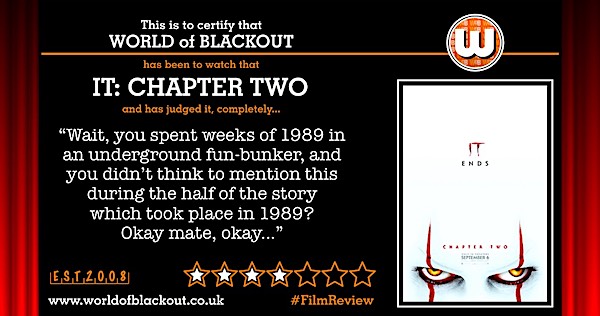
*4 Wait, when the fuck did this 'underground clubhouse' thing happen?? The gang got together when the clown-shit was beginning to escalate in 1989, and Beverly left town the day after it was over. When did they all have the time to hang around in Ben's woodland bunker (y'know, like a secret, isolated underground location is a sensible place to go when you're being group-stalked by a magical force who can appear fucking anywhere)? You were doing this for weeks during the Summer of 1989 and didn't think to even mention that during the story which took place in the Summer of 1989? Okay mate, okay... [ BACK ]
*5 Typical exchange:
"Right, you can't bail because we need all of us to perform the ritual to destroy the clown."
"But... Terry isn't here because he killed himself rather than star in this film, so what does it matter if I just-"
"THAT'S NOT WHAT I MEANT AND YOU KNOW IT, BRIAN. I SAW ALL THIS IN A DREAM WHILE I WAS OUT OF MY BOX ON MUSHROOMS, JUST BRING THE DAMN SHOWER CAP."
And yes, of all the 'tokens' used to represent heroes, I notice they use a quick aside about spiders to give the Jewish kid a shower cap. A fucking lot to unpack there, and this isn't really the place so...
[ BACK ]
*6 Okay look Gary/Stephen, I'll give you the fairground/hall-of-mirrors setpiece. We've already had a brilliant one of those this year, but you started this with the clown-motif so fair enough. But the talking severed head is just an Evil Dead nod isn't it? And you've recreated the Dianoga sequence in the water from Star Wars? And you've thrown in a 'don't look into the Ark' reference from Raiders? Oh, mate.
(like I've said previously, I have not read IT and I don't really remember the 1990 TV version in any detail. If all of these things are in the originals then fair play, but three of the above references still pre-date the 1986 book so my point still stands.
Do not @ me. [ BACK ]
*7 Which is shown earlier to be an alien, by the way. Pennywise may be the current physical projection of the creature's manifestation in the world, but we see through Mike's mushroom-induced vision that 'IT' came to earth and has nested in its own crash-site, hibernating for 27-year stretches between feeding. What ever righteous method the gang use to defeat this threat, it's not a supernatural or metaphorical adversary, but an actual, telepathic, shape-shifting, literal alien. Just keep that in mind...
[ BACK ]
DISCLAIMERS:
• ^^^ That's dry, British humour, and most likely sarcasm or facetiousness.
• Yen's blog contains harsh language and even harsher notions of propriety. Reader discretion is advised.
• This is a personal blog. The views and opinions expressed here represent my own thoughts (at the time of writing) and not those of the people, institutions or organisations that I may or may not be related with unless stated explicitly.
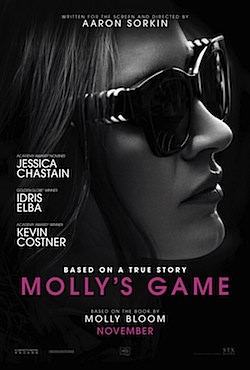
Well, this was a nice surprise to end the month*1; an advance screening of Aaron Sorkin's new film, Molly's Game (due for general release on Dec 26th in the UK, by which time you'll have probably forgotten I wrote about it so promptly, but hey). Jessica Chastain plays the eponymous Molly Bloom, an olympic skier with a demanding father and recurring back injury which sees her taking a year out in Los Angeles. While working in a cocktail bar, Molly is offered a low-level (but crucially, better paid) office job which leads on to her organising illegal poker games for her boss and mixing with the rich and famous as a result. Striking out on her own, Molly runs a successful underground gambling den until the seedier side of the business threatens to pull everything apart. After a raid from the FBI, our subject finds herself in need of a sympathetic lawyer, and it's from there that the tale unfolds.
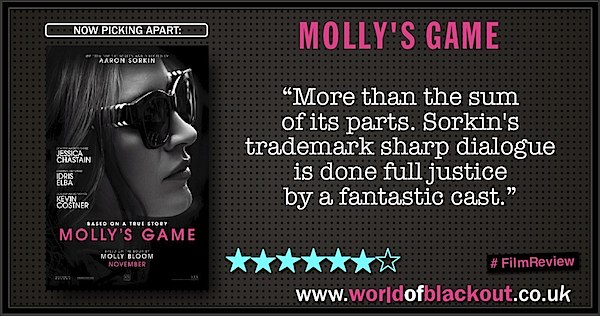
And what can I tell you without spoiling the plot-mechanics? It's good. Really good. Much of the film (although by no means all) revolves around poker, and while I know about as much about this as I do about tennis, Bloom's is a compelling story (although the viewer is always aware that this is a visual-retelling of a sanitised book based entirely on one person's account of things). This isn't a particularly original type of movie, but becomes more than the sum of its parts in Aaron Sorkin's hands, and his trademark-sharp dialogue is done full justice by a fantastic cast.
Chastain doesn't so much steal the show since it's entirely hers to begin with, but with her remarkable screen presence she makes this look effortless and seems to get better with each role*2. Idris Elba puts in a fine supporting performance as Molly's attorney, matching her energy beat-for-beat when it's required (although his accent goes for a right old wander during an emotional monologue in the third act). Elsewhere, Kevin Coster stars as Molly's (deliberately) annoying psychologist, pushy-sports-dad, reliably fleshing out a part which feels slightly underwritten given its significance to the character-aspect.
At just shy of two and a half hours, this is by no means a short ride. As three timelines are set up to tell the story in the first act, it takes a while to get going properly, and the The Properly Dramatic Part™ of the screenplay bides its time in the background. But when that sequence arrives, Molly's Game is lifted to another level entirely. By this point the audience have got to know Molly and are on-side completely, despite the screenplay making absolutely no bones about her flaws and weak spots; but it's a case of liking the character because of those foibles rather than in spite of them that Sorkin sells so well.
Despite landing in the fourth-quarter and being A True Story™, this is unlikely to find its way into many golden envelopes come February/March. Our heroine is admirable, but for few of the right reasons. Yet at the same time, Molly's Game is affecting because of its unpolished emotions. This is the first time Sorkin and Chastain have worked together. I look forward to the next.
The film itself isn't inherently cinematic, but that setting will immerse you in the story more.
It does.
Difficult to say, but 'first page of the CV', certainly.
I shouldn't imagine so.
There isn't.
Level 2: Jessica Chastain starred in A Most Violent Year with Oscar 'Dameron' Isaac.
*1 This showing was the fifth exclusive Cineworld Unlimited screening of November, presented in my local's largest screen and had an outstanding turnout. To the point where I was thinking 'have all these people got Unlimited cards? I'm here all the time and I don't recognise most of them'. Then it occurred to me how few of the amassed crowd had actually given a shit about watching the Cineworld Unlimited screening for The Disaster Artist only two nights previously. Film fans are a fickle bunch. [ BACK ]
*2 Although I'm sure Ms. Chastain has a pre-prepared library of excuses to explain away the gaping exception which is The Huntsman: Winter's War... [ BACK ]
DISCLAIMERS:
• ^^^ That's dry, British humour, and most likely sarcasm or facetiousness.
• Yen's blog contains harsh language and even harsher notions of propriety. Reader discretion is advised.
• This is a personal blog. The views and opinions expressed here represent my own thoughts (at the time of writing) and not those of the people, institutions or organisations that I may or may not be related with unless stated explicitly.
Standard operating procedure, mate. Begin a day's film-viewing with a tense and complex drama unfolding around a subject about which you know little or nothing! But we can only obey the most efficient cinematic schedule, never change it.
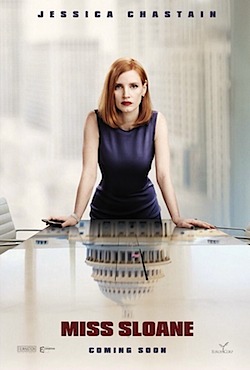
John Madden's political drama stars Jessica Chastain as its subject, a US lobbyist who takes on the task of persuading senators to vote for tighter firearms regulations. The film opens at a congressional hearing in which Sloane is being indicted for violations of Senate ethics-rules. Character closeups then spark a series of personalised flashbacks, to fill in the three months' events leading up to this moment.
The story structure requires thisformat , with its reveals and character-building dependent on the courtroom scene we know is coming. The pacing of the film however, suffers a little under the non-linear timeline, with stretches of backstory becoming longer and taking over the narrative 'now', jarring when we drop back to the trial. Miss Sloane is a densely scripted affair, with a lot of fast talking and legal shorthand thrown at the viewer but with enough smart-arsed quips and shouting to break things up for a civilian audience (ie. the audience).
Alison Pill, Gugu Mbatha-Raw, John Lithgow and Mark Strong all offer sterling supporting performances but this really is Jessica Chastain's show, and she's fantastic in a film which never really gets past quite-good. Constantly engaging and 'dumbed down' enough for even me to follow easily, I'd still be hard pushed to recommend it as an entertaining watch. But the film handles a sensitive subject without resorting to hysterics or even taking sides other than 'they're all shifty, mate'. Miss Sloane is more about the lobbying process itself than what the characters are pushing for.
Best line: "Career suicide's not so bad when you consider that the alternative is suicide-by-career…"
The only real downside for me was the lack of narrative-transformation on the part of our eponymous protagonist. While the events of the film gradually reveal Elizabeth Sloane to be principled but flawed, she's supposed to come across at the film's beginning as an obsessive, inaccessible perfectionist, striking fear into the hearts of those around her rather than awe or admiration*1….
But in an early scene where Sloane washes her hands in a work restroom, we see her then use a paper towel to grab the door handle, forming a barrier between herself and any germs left behind by less diligent colleagues. And in that moment, I thought that's someone with such a fundamental distrust of other people's basic decency and self-awareness that I pretty much just fell in love with the character before the door had swung closed again.
And if I'm on-side from Act I, where's the development, eh?
The Big Short.
Except this is easier to follow and features characters who aren't all uniformly awful.
That won't be essential to get the most out of the film.
I think it does, although the subject matter is largely alien to me, so I can't say for certain.
Maybe not best but certainly on the front-page.
Nope.
Nope.
Level 2: Gugu Mbatha-Raw's in this, and she was in some episodes of that Doctor Who programme along with David 'Huyang' Tennant.
*1 Although at one point, we see Sloane reading a John Grisham novel of an evening. For someone who spends an inordinate amount of time around lawyers for a living, this shows a damning lack of imagination on the character's part. That'd be like expecting an astronaut on the ISS to watch episodes of Star Trek after clocking-off for the day. I'm not saying it wouldn't happen, but everyone else would quite rightly take the piss. [ BACK ]
DISCLAIMERS:
• ^^^ That's dry, British humour, and most likely sarcasm or facetiousness.
• Yen's blog contains harsh language and even harsher notions of propriety. Reader discretion is advised.
• This is a personal blog. The views and opinions expressed here represent my own thoughts (at the time of writing) and not those of the people, institutions or organisations that I may or may not be related with unless stated explicitly.
Why, it was only a week ago that I pondered the increasing phenomenon of the 'Monday Movie Release', positing that it could be a way of further boosting a film's opening-weekend takings. Naturally I'd assumed the same of The Huntsman: Winter's War until I sat down in the cinema after work this evening and quickly realised that last friday was of course April Fools' Day, and would have too telling a move, even for Universal Pictures...
Two worrying things occurred before we even got to the BBFC Title Card. First up was a pre-trailer advert for the upcoming N*ckelb*ck UK tour. Oh, this movie is intended for N*ckelb*ck fans. Or vice-versa, I'm not sure which is worse. Secondly, the final trailer to run before The Huntsman: Winter's War was for... The Huntsman: Winter's War. Yes, this film had a trailer for itself before it. Not only is this a) utterly pointless and b) utterly narcissistic, it's also the trailer which actually gives away the closest thing the movie has to a third-act plot-reveal. So if anyone present had been avoiding spoilers in anticipation, the film's own distributor has made sure they've wasted their time.
[Update #1: 05 April] It appears that the trailer-incident was unique to the cinema I was in. I don't know the exact details, but it sounds like it wasn't planned, anyway. This is fair enough, really; a mis-selected trailer reel makes far more sense than a misplaced marketing decision.
Besides, worse things have happened.
But you didn't come all the way over here to read me banging on about gripes outside the run-time of TH:WW, did you? Oh, no! Right, deep breath…
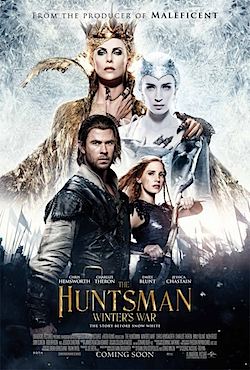
Using 2012's Snow White and the Huntsman as its central anchor, this film is part prequel, part sequel. This time, rather than just banging the coconuts of Twilight and Lord of the Rings together, someone at Universal Studios has realised that there's now a shit-ton of Game of Thrones and Frozen to rip off, too! So in the pot they go, stir until dissolved and serve with a side-garnish of the rope-bridge from Indiana Jones and the net-trap from Return of the Jedi.
But before all that, this excruciating pantomime of slapdash plotting and digitally-simulated sentiment kicks off with a lead-weight narration to explain the things that visual storytelling can't, and enough lensflare and soft-focus to cover any other cracks which may be left showing. Charlize Theron (The Bad Queen™) starts as she means to go on, putting on two and a half stones in weight due to the amount of scenery she chews throughout production, flanked by her screen-sibling Emily Blunt (The Ice Queen™) whose eyes seem to plead a desperate apology every time she looks at the camera (alarmingly frequently), delivering her clunky, stilted lines. "Where are the days when I could be relied upon to pick challenging, meaningful or just engaging roles?" she asks. The audience briefly remembers that she also appeared in Into The Woods and bellows "BEHIND YOU!".
So, the pre-amble is set, the story (…) moves to a certain point, then the events of Snow White are glossed over with a "seven years later" caption-card and it's time for the next act...
[Oh, Snow White's alive during all this by the way. She's mentioned several times, just not shown other than in brief archival footage from the first film. Yeah, imagine what state your screenplay must be in when you can't even get Kristen Stewart to poke her head around the door and lend a little continuity. With Theron only surfacing in the first and third acts, it's a good job McThor was willing to reprise his role…]
Ah, the pièce de résistance! Headlining the film are Chris Hemsworth and Jessica Chastain. The former has retained his inexplicable Scottish accent from the first installment (his home-region in the highlands being somewhere between Cardiff and Gateshead apparently), and as Chastain plays his childhood sweetheart, clan-mate and love-interest, she also has a Scotch-Twang to match (although hers seems to be based around Dublin and Mumbai). I'd be lying if I said I didn't snort out loud with Hemsworth's first utterance (cue a sharp nudge from Mrs Blackout), and I'd be lying if I said I genuinely wanted subtitles for their dialogue, as I lost so much of it due to the vocal stumbling. Interestingly enough, watching Australian Hemsworth struggling with a Scottish accent isn't completely dissimilar to Scotsman Gerard Butler doing battle with an American one. They should definitely make a movie together.
[Clarification: And I know, obviously, that the story isn't set in the real world, so I wouldn't necessarily expect the accents to have geographical authenticity. But we, the audience, are in the real world, and we, the audience need to be able to understand what they, the characters are talking about at any given moment. So, y'know…]
Meanwhile, the actual (ie intended) comic-relief comes in the form of Nick Frost as the only dwarf to return from the first film, accompanied by his screen-cousin Rob Brydon sporting a Welsh accent (because he's actually Welsh; casting-directors, take note) and their respective counterparts Sheridan Smith and Alexandra Roach. The laughs are a little broad, but there's no denying that the sections of the film starring the dimunitive foursome move with a sureness that's sorely lacking from the rest of it.
And speaking of which, the main thread of the movie is Jock McHuntsman's quest to retrieve The Mirror (y'know, the Snow White Mirror-Mirror, mirror) from a goblin fly-tipping site, discovering in the process that the reflective golden dish has gone from being the Russell's Grant Horoscope Column we all know and love, and is now something closer to Necronomicon Ex Mortis, apparently. Even the characters' motivation for this task is clouded, since apparently it's sending Snow White a bit mad/evil and she wants it back, but the Ice Queen wants it as well because she wasn't evil enough to begin with. They're basically screwed whoever they give it to; a premise which makes up the film's final, borderline-animated, act. The rest is shrieking, grunting and a poly-count that illustrates where the budget really went...
Now obviously I was predisposed to being cynical toward this film, but The Huntsman: Winter's War really is an almighty mess. The melee-fight with the Goblin king was pretty great and Charlize Theron's clearly having a whale of a time, but everyone else just seems embarrassed to be there, as well they should. The first film was a rights-dodging retool of a classic tale; the sequel is Universal shouting too loud, and with nothing to say…
[Update #2: 05 April] Contains spoilers: highlight-to-read. Okay, usually when I hit Publish on a review, I've got any ranting out of my system and I can just move on. But TH:WW has continued to annoy me throughout the following day and I don't feel I've made my disdain for the film clear enough. My main issue with its predecessor was that it adapted a classic fairy-tale, but in a very loose manner which managed to twist any moral framework (that framework being precisely what fairy-tales are built on, the biblical-parables of their historical generation), and instead actually send out a counter-intuitive message.
The sequel however, calls itself a fairy-tale (at several points within the film, via the narrator) yet has no discernible moral message. The story, on a purely surface level you understand, keeps repeating the idea that The Ice Queen has "banned" love in her kingdom, and that the burgeoning relationship between Mr and Mrs Huntsman is the catalyst which can't be surprised and will be the weapon with which justice and peace are restored.
In any literary version of the story, Mr and Mrs Huntsman's love would save the day at a crucial point, where any other potential hero/heroine was left floundering, having learned the lesson that brute force won't win all battles and that sometimes understanding and forgiveness are more powerful. How is the happy ending achieved here?While The Bad Queen is stabbing McThor with her sharp tentacles of hate (don't ask), Mrs Huntsman - incapacitated on the floor as The Girl One must always be - yells to him "Hey, try twatting the mirror with that axe you've been carrying around for the whole movie!". So he twats the mirror with the axe, it shatters, so does The Bad Queen and then The Ice Queen (also stabbed, also incapacitated) manages to slay alive long enough to say "Oh, I might have been wrong about that 'banning-love' thing." while McThor and Mrs Huntsman just sort of nod quietly. Love didn't save the day, here. Twatting a giant mirror with an axe to stop a shrieking zombie psychopath queen is what saved the day. That's not an inspiring morality-play, it's a fucking Vin Diesel movie.
The Huntsman: Winter's War isn't a fairy-tale; it's half an idea for a cash-in sequel, poorly told in an array of non-accents. Universal Studios' contempt for their own customers grows more vivid with each release.
And this film is for fans of N*ckelb*ck…
Being beaten around the head with a tin tray for two hours while someone tries to remember the plot of Frozen at the top of their voice.
Only for the shiny CGI.
Nope.
Nope.
I just might.
Nope.
Level 1: Jessica Chastain in A Most Violent Year with Poe Dameron? Chris Hemsworth in those Avengers movies with Mace Windu? Well how about Emily Blunt starring with Obi-Wan or Nick Frost being in loads of things with Unkar Plutt?
No.
This film shares uncredited extra Nick Donald with Star Wars: The Force Awakens. Sure, there are loads of level-2s that are fish in a barrel, but I think it's important to remember that there was at least one person on set who should have known better and could have stopped the production in its tracks by pointing to the script and screaming "Yeah, but WHY?".
Maybe next time, Nick...
*1 I don't even have any footnotes. I poured all my bile, scorn and sarcasm into the main body of text, up there. You're reading this bit for naught, I'm afraid. Mind you, while you're down here I'll just mention that I was quite amused at the film using the term 'wanker'. Sure, it's probably more than you'd expect from a 12A, but bear in mind that you can usually get an in-context fuck-word into the script at that level. What amused me more is that US screenwriters really don't seem to have cottoned on to how that word is used in the UK, bless them. It's mentioned on the BBFC site, and I wouldn't expect the rating to change for it, but I think there'll be more than a few terse comments about its inclusion.
DISCLAIMERS:
• ^^^ That's dry, British humour, and most likely sarcasm or facetiousness.
• Yen's blog contains harsh language and even harsher notions of propriety. Reader discretion is advised.
• This is a personal blog. The views and opinions expressed here represent my own thoughts (at the time of writing) and not those of the people, institutions or organisations that I may or may not be related with unless stated explicitly.
The Martian (3D / thematic spoilers)
Cert: 12A / 141 mins / Dir. Ridley Scott / Trailer
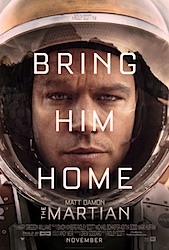
Seriously Hollywood, can you just stop putting Sean Bean in films? You're only encouraging him. Now, The Martian represents great value for money to your average cinema-goer as a) It's almost two and a half-hours long, and b) It's pretty much two films rolled into one. There's the survival-thriller about an unintentionally abandoned explorer, left to fend for himself in a hostile environment which will kill him without a second thought, and then there's the heart-wrenching, rescue-mission, adventure, in which morality and plucky idealism come head to head with practical limitations and financial bureaucracy. I'll leave it up to you to guess which of these wins the battle for screentime…
Credit where it's deservedly due, The Martian is a visually gorgeous film, and to make a pleasant change, the 3D only makes the dusty, ochre landscapes of our celestial neighbour look even more welcoming*1. It just goes to show that 3D can be used well in live-action; it's just usually not. The settings of a desolate planet and semi-claustrophobic space vessel also allow Ridley Scott to retread some of the steps he took in Alien, although as cinematographer Dariusz Wolski was also Scott's DoP on Prometheus, you get the impression that it was an intentional group-decision rather than a subconscious one.
The film itself? Well, as I've intimated, I found it more of a mixed bag. Matt Damon is pretty great and carries the role in a stoically self-deprecating way. The crew of his (ex-)ship, The Hermes, give everything they can, given their limited screentime. Jessica Chastain gets to do most of the lifting (and does it well, as always), but Kate Mara, Sebastian Stan, Michael Peña and Askel Hennie are little more than pencilled in, with the focus falling more on the Earth-bound NASA team charged with formulating an efficient exit-strategy for their stranded astronaut.
And the only real problem I had with the film is that far too much of its time is spent on Earth watching Chiwetel Ejiofor and Jeff Daniels bicker about public relations, while Kristen Wiig and Mackenzie Davis pull concerned faces, and Donald Glover gets to be the clichéd, unconventional, "I've got a crazy idea… but it just might work!" guy who finally unveils a plan which should have been the first thing they thought of.
Short version: Anything which takes place on Mars or in space is awesome. Anything which takes place on Earth is an embarrassing mess full of mis-cast roles and hackneyed dialogue. The more the second one comes into play, the more loudly the wheels of the screenplay squeak. And to be fair, this could be the exact state of affairs in the book, but I wouldn't know as I haven't read it yet*2.
Vaguely spoilery question, highlight-to-read:Speaking of the book, can anyone who's read it tell me if Mark's burning of Martinez's crucifix in order to release the energy required to create life-giving water is covered in any more depth? Obviously the context is given fully in the film, but I thought this might have raised a question on the comfort of religion versus the facts of science, similar to Elixabeth Shaw's quandary in Prometheus. Then it's just never mentioned again.
Back on Mars, there's also the question of gravity. Occasionally, the exterior shots have been filmed in a higher frame-rate and then slowed down to standard to simulate the lower gravity (slower-falling objects, dus-plumes etc). But only very occasionally. The rest of the time, Mark's just padding around (indoors and out) as if the g-ratio is the same as Earth's. When it's not. Which is odd in itself, because quite a lot of work's gone into the zero-g effects onboard the The Hermes. As much as the film loves talking about science, it has a real problem showing it.
Astronaut Watney's mental health is also an issue which seems to be deftly avoided by the film. While his semi-emaciated form appears after months of surviving on dwindling rations, the extent of his inevitable breakdown is characterised only be him referring to himself as A Space Pirate, in a typically glib manner. I know I made pretty much the opposite point for Sandra Bullock's unstable character in Gravity, but in order for Watney to be so rational and upbeat after 300+ days alone on a world which is trying to kill him, he'd have to be unhinged to begin with. Obviously the mental strength and agility of potential astronauts is tested and measured before they get anywhere near a spacecraft, but we learn nothing of Watney's life on Earth, other than the fact that he has parents (…). No bar is set by which the audience can measure his stability, it's all just taken as read that he doesn't turn into a psychopath after a month without human contact.
Ultimately, Ridley Scott seems fascinated by the mechanics of survival on a hostile planet, but less interested in the isolation and insanity which would go hand-in-hand with it.
Watch The Martian for the visuals, and leave the existentialism to Interstellar…
Oh, and as if they would live-broadcast the rescue-mission on TV so that the world could potentially either hear the astronauts dying, or get really annoyed when NASA cut off the audio-feed of the astronauts dying…
For the spectacle, yes.
You're probably not going to watch it more than a couple of times, so a rental.
Matt Damon comes out of this very well, as do the crew of The Hermes.
Everyone on Earth, though..?
In terms of story, I couldn't tell you.
In terms of tension, sometimes.
In terms of visuals, yes.
Nope.
There isn't.
So let me get this straight: You can include a direct Lord Of The Rings reference in the screenplay (in one of Sean Bean's scenes, no less), and an Iron Man reference elsewhere, but no love for the GFFA..?
Okay, The Martian stars Jeff Daniels as the largely unconvincing Head Of NASA™, but in 1981, Jeff appeared in a movie called Ragtime, which also featured the late, great Bruce Boa; better known to audiences either as The Waldorf Salad Guy from Fawlty Towers, or General Rieekan in The Empire Strikes Back.
Shorter version:The Martian is basically a longer and more measured take on this…
*1 Seriously, we've got a pretty good idea of it now, and if that is what Mars looks like, I want to go. Granted, I want to go largely because it looks so much like Tatooine, but even so. Anyway, I'll be the guy standing atop the rock formations, making barking noises and waving a gaderffii stick…
*2 No really, I've barely got time to read all the 'Journey To The Force Awakens' material which is coming out before December 17th. I certainly don't have time to read standalone novels when I can just watch a movie of it in two and a half hours...
DISCLAIMERS:
• ^^^ That's dry, British humour, and most likely sarcasm or facetiousness.
• Yen's blog contains harsh language and even harsher notions of propriety. Reader discretion is advised.
• This is a personal blog. The views and opinions expressed here represent my own thoughts (at the time of writing) and not those of the people, institutions or organisations that I may or may not be related with unless stated explicitly.