Room Cert: 15 / 118 mins / Dir. Lenny Abrahamson / Trailer
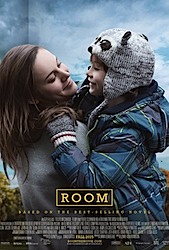
Well, it is January, so if you're going to watch a serious film, watch a. serious. film. And they don't get much more stark than Emma Donoghue's screen-adaptation of her award-winning 2010 novel about a young woman (Joy, Brie Larson) who's been abducted and kept prisoner in a lone room by a local weirdo for seven years, who plots an escape with the aid of her five year old son (Jack, Jacob Tremblay). Yeah. And if it sounds like it's going to be exhausting viewing, that's because it largely is. Room is intriguing and occasionally magnificent storytelling, but it's not the sort of movie you wander into casually, and it's all the better for that.
In terms of the film as a performance-piece, Room belongs utterly to Brie Larson and Jacob Tremblay. Young Jacob's turn as 5yr old Jack is more remarkable for obvious reasons, but that doesn't take anything away from Brie's as his mother, protector and friend. The chemistry between them is absolutely breathtaking in a way I haven't seen before. Elsewhere, Joan Allen and Tom McCamus put in very respectable supporting turns (as does William H. Macy, ableit briefly), but the film's tonal-shift by that point means that it almost turns into a Channel 5 afternoon-movie. An incredibly harsh Channel 5 afternoon-movie, admittedly, but still.
While it's not an equally-timed split, the film is divided into two halves, before the escape-attempt and after it (that's not a spoiler, it's indicated by the trailer). The first of these is far more focused than the second, although that could very well be the point, thematically. That the film almost forgets which direction it seemed to be heading in perhaps reflects the characters themselves. When the story is based solely in 'room', director Lenny Abrahamson brings the claustrophobia in spades, yet always in a way which allows the script to breathe, and to impart the necessary plot-devices to the viewer. In the other half, a restless agoraphobia quickly sets in as (for Joy in particular) we find that escaping the room wasn't the end of the story, and that life outside is frustrating and mundane in equal measure; especially to someone who's forgotten what it means to live in the world.
Certain plot-mechanics of the film don't appear to be resolved (at least, not to the extent viewers would normally expect), but crucially, the story is told almost entirely from young Jack's point-of-view. The answers which aren't forthcoming for the audience are the ones which Jack, as a 5yr old boy, wouldn't get or even think to ask for. In some respects this is a stroke of genius which ensures the film's voice is always Jack's; in others it's slightly frustrating as you occasionally get the feeling you're being palmed off without an adequate explanation, in much the same way as someone would a 5yr old.
But, while Room might not be a film anyone in their right mind would 'quite fancy watching', once it's begun you won't be able to take your eyes off it...
Serious question(s) though (spoilers - highlight to read)
1) Although Old Nick makes Joy face the wall when he's leaving the room, we hear that the entry/exit key-code has four digits (three of those very close together on the keypad, in fact). Since she's left alone for around twenty hours a day, Why hasn't Joy tried to systematically break the code? Even if Old Nick changes it regularly, surely she'd have hit lucky in the seven years of her being there?
2) Is the wardrobe bolted to the wall? Because anyone in their right mind would have walked it into the middle of the room and climbed on top to smash out the skylight, surely?
I only ask because the film doesn't address those points at all, although I don't know if the novel does. As referenced above, it's possible that Joy tried several escapes before Jack was born, but since the story's being told through his eyes, we wouldn't know about it since he doesn't. Jack's a very bright kid though, wouldn't he at least have had the idea, whether he's institutionalised or not? If only out of curiosity rather than a desperation to escape?
2013's Prisoners or maybe even Locke (not for content, but narrative teasing and overall acting).
The cinema will certainly add to the atmosphere, but the film will still be as powerful if you watch it at home.
It does.
Awards-worthy, yes.
No, because this definitely won't be for everybody.
There isn't.
Level 2: Room stars Brie Larson, who appeared in Trainwreck alongside Bill 'BB-8' Hader.
DISCLAIMERS:
• ^^^ That's dry, British humour, and most likely sarcasm or facetiousness.
• Yen's blog contains harsh language and even harsher notions of propriety. Reader discretion is advised.
• This is a personal blog. The views and opinions expressed here represent my own thoughts (at the time of writing) and not those of the people, institutions or organisations that I may or may not be related with unless stated explicitly.
Creed (SPOILERS)
Cert: 12A / 133 mins / Dir. Ryan Coogler / Trailer
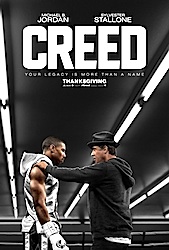
So there's A Young Man right, and he hits people a lot because he never had any real parents and that makes him both sad and angry, then he finds out that His Dead Dad used to hit people a lot as well, only he did it for a job where he got money and won special belts! So The Young Man thinks "why am I working in an office and living with my fabulously rich and kindly stepmother when I could be hitting people for a living?" and he travels to the other side of America to live in a largely unfurnished flat and meet The Old Man who used to hit His Dead Dad, also for a job but also because they both enjoyed it. And The Young Man says to The Old Man 'hey, maybe you could train me to hit people like My Dead Dad used to?' and The Old Man says 'no way kid, I don't do that stuff no more!', but then The Old Man realises who The Young Man is (plus, The Young Man tells him) and remembers he's in A Boxing Film so he'd better do it anyway. So The Old Man trains The Young Man to hit people properly (not like he'd been doing it previously), with a view to getting paid for hitting people and winning special belts.
In the meanwhile, The Young Man meets The Girl One who makes music for a living which sounds like beige wallpaper with a drum machine, and it turns out she's slowly going deaf, which is obviously not a good thing, but at least means there'll be one less person who has to hear the music she makes for a living. The Girl One is fine with The Young Man hitting people and they start going out. Then An English Man With A Beard phones up The Old Man and says "I hear you're training The Young Man who's the son of His Dead Dad? Well, I'm the trainer for The Bad Man and I think they should have a hitting-competition because of a) pride, b) money and c) fun" and The Old Man says "no way man, he won't do that stuff!" but then he remembers he's in A Boxing Film so he'd better do it anyway.
Then, when The Old Man is training The Young Man, he starts being sick a bit over the side of the ring which in a film means he has The Cancer, and the doctors are like "it won't be easy, but we can probably fix that" and at first The Old Man is like "no way doc, I got nothing left to live for anyways!" until he remembers that he has got stuff to live for (plus, his friends tell him), so he decides to get the medical treatment and make The Young Man do his hitting-training by sprinting around a working hospital and doing shadow boxing while medical staff are walking nearby. Then it's nearly the time for the hitting-competition so The Young Man and The Old Man go to Liverpool in England (The Girl One comes over later, too) since that's where The Bad Man is from because a) British people are evil, b) Scousers are apparently even worse. There's a sort of party before the hitting-competition with people asking questions, and The Bad Man says a nasty thing about The Young Man's Dead Dad, which shows that they really don't like each other, to the point where they're prepared to hit each other for money.
Then it is the hitting-competition and the bell rings and The Young Man and The Bad Man start hitting each other. At one point The Young Man gets hit and falls down in slow-motion over the course of about five seconds, which means it was really hard. The Young Man lies still on the canvas floor for a few seconds while A Man In A Shirt counts with his voice, but then The Young Man remembers some things which happened earlier in the film (and also remembers he's in A Boxing Film) which makes him get right up again to continue hitting The Bad Man. They keep hitting each other until The Man In The Shirt says "that's enough hitting, now!" and a bell rings. Then, because neither of The Men are dead, someone else who we haven't met decides which of the men was the best at hitting since he's watched the whole thing*1. The Unseen Man decides that The Bad Man is the best hitter, and for a minute it's sad until The Bad Man comes over to The Young Man and says "your hitting's really rather good, much like your father's" and they make friends and it turns out that The Bad Man was only pretending to be a bad man because it more comfortably fits his sports-persona of enjoying hitting people. You see, we thought The Young Man had lost, but it turns out that he won as well (although not in any legally binding or monetary sense). Everyone is happy by this point.
Even The Young Man who didn't win a special belt.
The Young Man, The Old Man and The Girl one then return to America where the first two of those walk up some steps in about the hundredth lead-weight-reference to The Other Rocky Films.
They are happy. It is the end.
Some people leaving the cinema in front of me absolutely loved all this.
I shouldn't be able to be this bored while watching someone get punched in the face for two hours, surely..?
Other hitting films.
Oh, if you like.
…continually reference The Other Rocky Films? Sure.
Michael B Jordan's pretty great, I've got to say.
That all depends on how effusive you are after watching a children's drama for adults…
There isn't.
Well, technically it's a Level 1 since Creed features a scene with Rocky and the gang watching Skyfall (for no reason at all, admittedly). We see a clip from the tube-crash scene, so technically Creed features an appearance from Daniel 'Stormtrooper' Craig.
But for those of you who say that doesn't count? Level 2: Creed stars Sylvester Stallone of course, who clunked his way through Expendables 3 alongside Harrison 'Solo' Ford…
*1 And this is the second boxing flick within a year where the audience spends two hours watching the underdog claw his way up from the gutter and into the floodlit ring of destiny, face off his opponent and his personal demons, pour his heart, his soul and his bleeding face into twelve rounds of bodily combat… only to get to a draw at the end and have the result decided by some blokes sitting behind a desk. It's a total cop-out for a sporting event, and that cheapness certainly isn't lessened for a film. You wouldn't sit through The Great Escape or The Empire Strikes Back only to switch over to an adjudication panel at the end for their opinion, would you?
DISCLAIMERS:
• ^^^ That's dry, British humour, and most likely sarcasm or facetiousness.
• Yen's blog contains harsh language and even harsher notions of propriety. Reader discretion is advised.
• This is a personal blog. The views and opinions expressed here represent my own thoughts (at the time of writing) and not those of the people, institutions or organisations that I may or may not be related with unless stated explicitly.
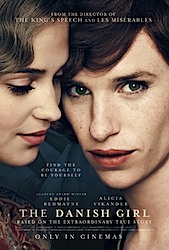
The UK's weather may be all over the place at the moment, but the one thing you can rely on in January is the arrival of All The Important Films, as the notoriously forgetful awards panels are presented with a fresh array of worthy contenders for middle-aged audiences who talk in the cinema. Perched in a respectable position on the ladder of consideration is Tom Hooper's new film, The Danish Girl. The (dramatised) historical biopic follows the landscape artist Einar Wegener (Eddie Redmayne), who was married and in his thirties when he fully realised that he should actually be a she. Einar gradually adopted the female persona of Lili Elbe, and with the support of his wife and portait artist, Gerda (Alicia Vikander), went on to became the world's first patient to undergo gender re-assignment surgery.
Now for obvious reasons the film isn't exactly a barrel of laughs, but it doesn't spend its considerable run-time wringing its hands in melodramatic despair, either. The Danish Girl is more a study of the relationship between Lili and Gerda, as it changes irreversibly with their decisions. Keeping this in mind, the two central performances are the most focused here, and while both are hauntingly powerful, Alicia Vikander is actually more interesting to watch than Eddie Redmayne. That's not to put Eddie down at all, but while Einar/Lili is introverted and conflicted by nature (captured fantastically by Redmayne), the character arc itself is still relatively linear (indeed, it's the very reason the audience are sitting there watching). Gerda, on the other hand, is far more vocal in her coping mechanisms while being equally conflicted, and there's a level of unpredictability which allows Vikander to finally show off her Actual Acting Chops.
Away from the main duo however, Tom Hooper's direction looks a little more slack. Although the costumes and sets reflect 1920s Europe authentically enough (with some carefully selected photography and framing of the exterior shots, of course), much of the supporting cast's acting - as earnest as it is - feels distinctly modern in its tone and mannerisms. I almost get the impression that as long as they learned their lines, they could interpret them how they wanted (Amber Heard's wandering accent being a prime example). The passage of time is also another occasional sticking point, as the central plot unfolds at a very measured pace anyway, then a line of exposition might tell us it's six months later with little else to indicate this than Gerda having a full exhibition's worth of portraits which we haven't seen her create.
Also on my grievance-list for the film is the amount of medical and legal detail which isn't given surrounding the surgery itself. The two part operation is explained in overview (and obviously we don't need detail there), but there's no mention of how Lili is going to become legally female in a society in which most of the medical profession wants her to be institutionalised as gay, schizophrenic or both. And that's without mentioning the a moment late in the film where the question is raised over whether Lili will be able to have children once her treatment is complete. "Oh... I don't know", she replies wistfully, giving the impression that she's asked precisely no questions of her surgeon prior to undergoing a world-first, largely experimental procedure, which would be a bit like getting a builder to knock you up a house without knowing how many bathrooms there'll be.
But as I said, that's not what the film's about; The Danish Girl is really a relationship-study, and a very good one at that. It was never going to be easy to make a film about such a complex subject, but for all my perceived gripes, it isn't simplistic or patronising.
Although I am deducting a point for the ham-fistedness of that final scene, yes ;)
The Theory of Everything (although I think that was a better film), or maybe The Railway Man.
Only if you're desperate to see it soon.
The Danish Girl is more of a Sunday night DVD.
I think it achieves some of it, brilliantly. Other areas need a more focused touch.
In Alicia Vikander's case, this should be at the top of her CV, yes.
Probably not.
There isn't.
Level 1: The Danish Girl stars Pip 'Kaplan' Torrens as well as Miltos 'Un-named (as yet) bar patron' Yerolemou from off of The Force Awakens.
DISCLAIMERS:
• ^^^ That's dry, British humour, and most likely sarcasm or facetiousness.
• Yen's blog contains harsh language and even harsher notions of propriety. Reader discretion is advised.
• This is a personal blog. The views and opinions expressed here represent my own thoughts (at the time of writing) and not those of the people, institutions or organisations that I may or may not be related with unless stated explicitly.
So, here we are again: new year, same cinema, same me. I may as well begin 2016 in the way that I intend to continue it - watching Star Wars. And I'm certainly going to take advantage of my local showing The Force Awakens for the next few weeks, that's for sure. This review contains whacking great spoilers, as is becoming the norm, and while I'm fairly sure that the vast majority of you who want to see the new movie have already done so, I'm still going to use this paragraph to a) warn you of the spoilers which follow the bump, and b) act as a buffer so that any previews of the blog which are pulled through RSS feeds and the like will cut out before getting to the points in question. And this time there's no mucking about, it really does get Grade A Spoilerific from the word go.
But before we say the word go, can I just add as a resident of the UK how annoyed I'm getting by the pre-movie advert for Clash of the Clans, starring Christoph Waltz and James Corden. I mean, it's not awful in and of itself (other than the fact that it features Waltz tearing up his dignity on-camera and features James Corden being James Corden), it's more that I'm getting sick of watching an elongated promo for a game which has no thematic relevance to Star Wars and that I have no interest in playing (let alone playing to the point of buying in-app purchases, which is what the ad is really for). And because the ad runs after the FACT warning but before the BBFC card, I know it's part of the print which is distributed to cinemas. The trailers beforehand have been changing since December the 16th, but this hasn't. In terms of repetitive irritability, the ad is the Force Awakens equivalent of the Anna And The King and Titan A.E trailers back before The Phantom Menace. Neither product initially interested me, but they did so even less after sitting through the promo-reels so many times (trailers didn't change quite as rapidly back in '99).
Anyway, you don't want to hear about that. You came here for spoilers.
Whacking great spoilers.
Go…
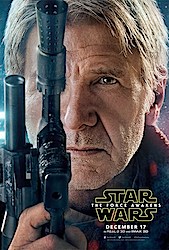
It's been known for some time now that Mr Harrison Ford would have been quite happy had his Star Wars character, Han Solo, been killed in the climactic scenes of Return of the Jedi. Although the story varies in its telling, the general consensus is that Ford felt that Solo would be given more dramatic weight by dying heroically than conveniently surviving another battle, and the character-arc would be more rounded out as a result, from cynic to martyr over the course of the trilogy. Solo's death on (or above) Endor would also put the Rebellion's victory into some personal context for the survivors, showing that battles are won as much by sacrifice as heroics and luck. Alas, it wasn't to be. Everyone's favourite cocky Correllian went on to have three kids with Leia Organa in the Legends-EU, whereas it's been recently revealed that he had at least one with her in the Story Group continuity, too. And everyone lived relatively happily ever after (alas, children falling to the dark side of the Force occurs in both story-threads - what are you going to do, stop them wearing black?).
The planned (or sketched) premature-demise of General Solo was due to occur in the third-act of the third film, of course, whereas the Star Wars saga (both before and afterwards) has significant previous in relation to dispatching noble warriors in the first installment. Obi-Wan Kenobi died (effectively) in A New Hope, duelling Darth Vader on the Death Star while his young protégé rescued the princess and saw her safely to the rebel base on Yavin. And Obi-Wan's own tutor, Gui-Gon Jinn, died thirty two years earlier on Naboo at the hands of a Sith, in The Phantom Menace.
In both of these cases, the death of the elder - Kenobi's sacrifice as a mentor, Jinn's defeat as a warrior - fits Joseph Campbell's monomyth archetype of The Wizard: the teacher or mentor who trains the hero to a certain point, then is removed from the equation, leaving the student to progress further and learn under their own auspices, more properly earning the prize at the end of their journey. Qui-Gon's death was the push that Obi-Wan needed to defeat the Black Knight (Maul) and become a teacher to young Anakin, and Obi-Wan's martyrdom to the Black Knight (Vader) bought Luke the time he needed to escape and go on to become the hero of the Rebellion.
Which brings us back to The Force Awakens. To be perfectly honest with you, prior to the indication that he was only going to show up at the end of the film, I'd have put money on Luke Skywalker being the one to buy the moisture-farm this time around. From the initial casting announcement, logic dictated that a Seasoned-Jedi With A Beard was going to spend the film introducing a young protagonist to the ways of the Force, then meet his significantly-weighted end in a move which would assist or develop them in their quest. But not this time. It's difficult to be a mentor when you're standing at the top of Craggy Island looking like A Drunk Who's Lost A Bet. No, in The Force Awakens, the elbow-patched-tweed-jacket of knowledge is worn by none other than Han Solo.
Well, kinda.
Han shows up when the central character is in need and on the run from the bad guys. Well, more properly he intercepts and detains his old ship which is being piloted by her. And as much as Han wears the wise old curmudgeon hat and points Rey towards the Resistance, who are desperately in need of the shiny Macguffin she's custodian of, he doesn't actually 'teach' Rey too much. Her knowledge of hyperspace-mechanics appears to be largely self-taught and intuitive, indeed it's a point in the script that they often arrive at the same conclusion about such matters simultaneously. And Han doesn't teach Rey in the ways of the Force. He confirms it exists, certainly, but remember this is a confirmation from someone Rey's met only minutes earlier, and who she didn't believe existed any more.
Rey's combat-skills were learned in the wastes of Jakku as a scavenger, and the journey as a fledgling Jedi is guided by her own instincts, and later by Kylo Ren as she reverse-engineers the mind-tricks he subjects her to and proves to be far more adept at them. Han told Rey there was a kettle on-board; he didn't show her how to make a cup of tea. In terms of ongoing tutelage on her own path, there's little more that Han can show Rey.
And yet at the fateful moment when Solo totally mis-reads the situation in asking Ben to tidy his room and ends up as a Sith-Kebab*1 courtesy of the Black Knight (Ren), it's the onlooking and helpless Rey who gets the "Nooo!" moment, and it's Rey who's psychologically primed by the event in her subsequent melee with that same assassin. Han Solo fits the Hero's Mentor stereotype in terms of the overall path being walked, and his death makes absolute dramatic sense, just not narrative sense...
As detailed above, Rey gains little momentum from Han's passing other than a little extra determination in the face-off with Kylo Ren. But in that duel, Finn's prone body nearby gives Rey the impetus she needs to take on Ren, and its her adversary's mention of 'the Force' which really wins the battle for her (or avoids her outright losing, at any rate).
But then, maybe Han's not Rey's mentor in the eyes of the story after all? He's certainly been more of a guiding-force to Kylo Ren aka Ben Solo over the years, hence the latter's hesitation on the Starkiller gantry. Knowing as little as we do about Snoke's apprentice (and knowing that Ren's final decision was seen as a test, either way), what if Kylo Ren killed his former mentor and became the Hero and the Black Knight at the same time, as part of some larger-plan? Although for all the weight of his actions, Ren doesn't seem to have gained any aggression or fighting-prowess by stepping closer to the dark-side, and his Force-sensitivity remains below Rey's. So in terms of this film, Solo's death doesn't seem to have benefitted or hindered Kylo Ren's journey.
Then again, who really has the most right to be upset as Solo topples into the reactor-core below? It's obviously Chewbacca, Han's sidekick for unknown years, who watches the friend he's literally dedicated his life to go spinning off into the abyss. Sure, he lets off a single shot and catches Kylo Ren off-guard when he could have sent a salvo of blasts to finish the job, but the young Luke Skywalker also fired willy-nilly in Vader's direction when Ben disappeared and didn't even land a single hit. What if Chewie's the archetypal Hero in all of this? But that'd be silly, wouldn't it? He's already been shot in the arm during the film because he took his eye off the ball dealing with the pirates he knows. Having the Wookiee go off on a revenge-mission against Solo Jr. is only going to end in tears, not least because he's already given up the captain's chair to Rey by the final scenes. No, this ain't Chewie's journey.
Rey is the farmgirl-hero in The Force Awakens, and Han is the mentor.
The mentor who apparently died for nothing?
Now don't get me wrong, I'm not saying that Solo Sr.'s death at the hands of his dark-sider offspring wasn't emotionally affecting, and I'm not saying it's meaningless in the grand scheme of things.
But Han didn't need to die now, and he didn't need to die there.
The decision to leave him at Episode VII seems like pandering to a 30+yr old request and filling a gap in the already homage-heavy screenplay.
Discuss.
Well, Star Wars?
Failing that, Guardians of the Galaxy or the recent two Star Trek movies.
Absolutely.
It does.
I have issues with parts of it (as you know, dear reader), but it achieves its mandate, yes.
The cast can be A Mixed Bag, but Abrams does well with them.
Oh, probably.
There only bloody is.
Level 0: It's Star Wars.
But since I've been taking the scenic route for this particular movie? Star Wars: The Force Awakens features a brief appearance from Pip Torrens, who starred in 2014's Salting The Battlefield along with Felicity Jones, who appeared in the 2007 TV series Meadowlands, which also starred Ralph Brown, who had a role in 2013's Jack the Giant Slayer, as did Warwick Davis, who popped up in Harry Potter & The Deathly Hallows, alongside Jason Isaacs, who was in 2001's Black Hawk Down, as was Ewan McGregor, the star of 1999's Rogue Trader, a film which also featured Pip Torrens, who starred in Star Wars: The Force Awakens...
Yes, yes, I did one more of those. I may not do another one, though.
For the amount of time/research these take, not one of you - not one - has told me how fantastic they are ;)
*1 Yeah, don't write in telling me that Kylo Ren isn't actually a Sith, I know that already ;) It's just that Sith-Kebab has a better ring to it than Dark-Side Cocktail Sausage.
But only just, mind.
DISCLAIMERS:
• ^^^ That's dry, British humour, and most likely sarcasm or facetiousness.
• Yen's blog contains harsh language and even harsher notions of propriety. Reader discretion is advised.
• This is a personal blog. The views and opinions expressed here represent my own thoughts (at the time of writing) and not those of the people, institutions or organisations that I may or may not be related with unless stated explicitly.