I'm well up for re-watching classic movies on a big screen, a feature that used to be a regular occurrence at my local, but which gradually dropped out of favour with the advent of older DVDs often costing less than the price of a coffee and online streaming subscriptions offering extensive back-catalogues. So although the timing is somewhat baffling*1, I realised looking at Cineworld's listings page that I somehow hadn't watched Groundhog Day since the Summer of 1999, despite absolutely loving the movie. So with that, off I went…
PHIL For the uninitiated, Groundhog Day follows cynical, curmudgeonly, Pittsburgh TV weatherman Phil Connors (Bill Murray) as he reluctantly makes his way to the small town of Punxsutawney PA, where the locals mark a quaint tradition on February 2nd of gathering to speak with a groundhog, 'Punxsutawney Phil'. The creature then predicts whether there will be an early Spring or another six weeks of Winter, and everyone celebrates for the rest of the day regardless. Connors films the early-morning segment with his producer Rita (Andie MacDowell) and cameraman Larry (Chris Elliott). But an unforeseen blizzard closes the roads outward, grounds flights and takes down long-distance telephone lines. The trio are stranded in the town, causing them to stay an extra night.
When Phil awakes the next morning, he's astounded to find that it's Groundhog Day again. And not the following year, it's literally yesterday happening all over again. Shaken, he leaves his hotel to record the weather feature once more, as the day plays out in duplicate around him, including the blizzard. When Phil awakes on February 2nd for the third time, he realises he's trapped in this day. What will he do with this apparent loop? What should he do with it? Well, Phil's got plenty of time to figure that out...
JOAN So because I haven't seen Groundhog Day for so long, I found myself effectively watching with new eyes. No bad thing. My initial feelings were that this would make a good companion piece to Yesterday, coincidentally playing in the screen next door. Both movies feature a protagonist who's worn down by their lack of success, which is to say that both feel they could be receiving more recognition, but neither really knows how to advance their career. In each case a supernatural event occurs, and our heroes find themselves isolated in a world which only they fully recognise. And in each case there's a disbelieving female companion, initially slated as 'the love interest', but who is actually the means by which the protagonist will better himself overall.
But it becomes apparent this actually has more in common with 1988's Scrooged, and not just because of the Bill Murray connection. A Christmas Carol is also a snowbound redemption story, in which a morally floundering hero is presented with lessons that reflect his past (ie current) self and urge him to be more. Yet Groundhog Day is a step on even from that. Dickens' tale sees its lead learning to spread love and goodwill for his remaining time on Earth, returning a wiser man after his spiritual adventure. Groundhog Day happens further down the line than this.
MICHAEL It's surprisingly straightforward, and so glaringly obvious that I'm amazed I never noticed it before. Phil Connors is dead for most of Groundhog Day. Probably in a traffic accident caused by the blizzard he failed to predict. Phil has died and the traffic cop is Saint Peter at the gates telling him he's not finished yet, that he has to stick around. Phil isn't bad enough to be sent to Hell, but he's also not yet good enough for Heaven. The snow is akin to the fog which surrounds the mansion in The Others, the desert sands of Sole Survivor, the walls of the house in Beetlejuice. Punxsutawney is purgatory and Phil has to work off his sins before he can ascend to a permanent afterlife.
Even within the framework of the story, it's not actually the groundhog who predicts another six weeks of winter. That's a knowing show put on by the town elders, the custodians of purgatory. They literally tell Phil what's going to happen at the very start (although he's there for longer than six weeks). 'You've shown us who you are, now winter is going to continue'.
CHARLIE Religious imagery courses through and around the film, from the recurring angels (we'll get to those) to the position of the cross which Phil adopts when he throws himself from the town's highest building, its church. February 2nd, Groundhog Day, is Candlemas in the Catholic calendar. It represents Jesus first being presented to God, his first entry into the temple and the purification of Mary. And although this festival isn't namechecked in the script, it's traditional in the US to eat crepes (pancakes for those of us in the UK) on that day, alluded by the drunk from the bowling alley who is fixated with getting some flapjacks (again, pancakes, a food traditionally eaten in the UK to mark the beginning of Lent).
It's no accident the film chose this day as its setting. Phil is presented, as was Jesus. Phil is eventually cleansed, as was Mary. And given his eventual omnipresence in the town and the number of his suicide attempts, he's arguably the Holy Ghost, too. In one of Phil's confessional scenes in the cafe with Rita, he stops short of calling himself 'the' God. You have to drawn the line somewhere for an American audience, I suppose.
CHOCOLATE FACTORY Even in his day's early iterations, while Connors is still playing with the concept and what he can get out of it, he learns, he adapts, he grows. Even when he reaches the depths of his despair, Phil looks for new ways of whiling away the hours, of blocking out the frustration and eventually of ending it all. Well, until 6am, at least.
At first Phil abuses the system, getting drunk, picking up women, robbing a bank. I mean, why not? He knows there'll be no comeback, may as well try to enjoy his temporal incarceration. But Phil quickly realises that this behaviour isn't making him happy. That's his first real step.
FOOTBALL FACTORY Connors isn't an absolute monster at the beginning of the film, just facetious and worn out by life. He is us, in 2019 more than ever. Groundhog Day doesn't threaten its subject with punishment necessarily, it just patiently extols the virtue of kindness. It's a parable for the whole audience, not just whoever we see as the worst among us (ie someone else).
Phil's path doesn't become truly clear until he starts using his time for good. At first it's a series of daily chores as he tries to atone for his misanthropy by running around town and preventing bad things from happening, almost literally a guardian angel with a checklist. But in the end, when Phil finally breaks the spell, he's learned to be good for the sake of just being a better person. It's a quality he's seen in Rita, who is his salvation in a very real sense.
HUMAN TRAFFIC So eventually Phil begins pursuing the arts (which, for someone who already works in the media, takes a delicious amount of time to arrive). He reads books, he learns the piano, he sculpts an angel from a block of ice (another nod to purgatory/Heaven). Phil helps the helpless, the unsure, the infirm. He learns that death is inevitable, but life is to be cherished and nurtured while that's possible.
Towards the end of his journey, Phil tells the dozing Rita that she looks like an angel when she stands in the snow, and he carves an image of her from compacted snow (not the solid ice he used earlier, this time it's a nod to the marble statues of churches). Phil knows now that whatever happens at 6am, whether it's February 2nd or 3rd, that sculpture won't last. He sees the beauty of fleeting impermanence. He knows, on a subconscious level at least, that Rita is the angel sent to guide him to his redemption. A woman he met for the first time only the day before when she arrived at the TV station to whisk him away.
RUN FOR YOUR WIFE Incidentally, I think Harold Ramis missed a trick in not having the hotel bartender be the only other person in the town who knows what's happening, a la Life On Mars. His sly looks at overheard snatches of conversation suggest that could have been an idea at one point, although maybe it would have been too obvious a wink at the audience.
And so without fanfare, Phil finally succeeds and the calendar flips over. The chronological anomaly isn't explained, but it is resolved*2. We don't see Phil and Rita leave Punxsutawney. We take a last lingering look at the pristine white surroundings of the town before we pan back to the clouds. This is now heaven. Phil has earned his wings and his way out of purgatory. Phil wants to stay, and wants Rita to stay with him. Rita doesn't argue, she's back home anyway.
You want to see one of your favourite movies in a new light?
Try leaving it two decades*3…
Scrooged, Dark City, Life On Mars.
Or, y'know, if you just like fluffy Bill Murray comedies it can be that as well.
Hell yeah. Twice, if you can.
You should already have this but yes.
It is.
Don't know, you tell me.
There isn't.
Level 2: No direct front-of-camera links, but Bill Murray's in this and he provided voicework for 2016's Jungle Book alongside Lupita 'Maz Kanata' Nyong'o.
*1 Why is this on at the cinema, though? It's already quite the year for nostalgia-screenings, of course. Tim Burton's Batman hits 30 in 2019, and The Matrix celebrates its 20th birthday by returning to cinemas this weekend. But as for Groundhog Day? Well, it was first released in 1993, so 26 is hardly a 'round number' anniversary. And then you've got to figure that the titular day in the movie is February 2nd, and the movie originally came out on 12th of Feb in the US, and 1st of March in the UK. So July doesn't fit with the time of year either in- or out-of-universe.
It seems to be that the only reason is to tie-in with Cineworld's latest promo-reel, in which our hero breaks out of his monotonous daily routine via an Unlimited Card subscription. The repetitive nature of Groundhog Day is parodied by Cineworld Phil's own humdrum life, and the section of the film where Groundhog Day Phil decides to use his time to better himself (by say, learning the piano) is reflected with an endless stream of cinematic entertainment and associated discounts. But that doesn't really work, does it? If Cineworld Phil really was trapped in the same day, he wouldn't need an Unlimited card - he could just use the same money to watch different movies each time he wakes up. Then again, Phil would run out of movies to watch in under a week because there'd be no scheduling-change. And that's literally the opposite of what this advert is trying to convey.
It's also worth noting that this special screening was a double-bill. Groundhog Day immediately followed by Groundhog Day. That's the joke. Do you see? You've just watched a film about repetition, and now it's on... again! Given that the timing of the screening is not on Groundhog Day, why? Why do two of them? Three would be a better attempt, two just seems like the idea has been nerfed by committee. You want to run a fun Groundhog Day-themed promo? Show the movie all damned day on a single-ticket. Start the first screening at 6am as an homage to the alarm clock in the movie, and run back-to-back showings until closing time around 11pm. Offer prizes for any punters insane enough to sit through the whole thing.
Back in 2018 (and ON Groundhog Day, I might add), my good pal Brooker raised money for the Alzheimer's Society by watching the movie on repeat for a whole day. That's how you do the joke, Cineworld.
However, I would like to sincerely thank you for screening it again anyway ;)
As the above will testify, I did get something new out of it... [ BACK ]
*2 Yes, I'm looking at you, Richard Curtis. Although I imagine that if Curtis made this movie, even though the love story would run on rails he'd still find a way to mess up the methodology of the repeating day. 'Gobblers Knob' would remain though, providing it was namechecked in the script at regular intervals by either James Corden or Joanna Lumley. [ BACK ]
*3 All of this theory may have been covered before with far more skill, knowledge and detail than I can apply. I'll be honest, I haven't checked. Look, let me have my moment okay?[ BACK ]
DISCLAIMERS:
• ^^^ That's dry, British humour, and most likely sarcasm or facetiousness.
• Yen's blog contains harsh language and even harsher notions of propriety. Reader discretion is advised.
• This is a personal blog. The views and opinions expressed here represent my own thoughts (at the time of writing) and not those of the people, institutions or organisations that I may or may not be related with unless stated explicitly.
Perhaps the biggest surprise with Ari Aster's claustrophobic folk-horror Midsommar is that it's found a release window (appropriately) in the height of summer, rather than the March/October slots usually reserved for more challenging fare.
We follow four young Americans (Dani (Florence Pugh), Christian (Jack Reynor), Josh (William Jackson Harper) and Mark (Will Poulter)) as they're invited for a month-long vacation by their friend Pelle (Vilhelm Blomgren) to his home village in northern Sweden. Rural and more than a little isolated, it's a special time of year for the villagers as they begin a series of longstanding celebrations. But they're more than welcoming to their new guests, and before long the gang are getting involved at every level, no matter how odd it all seems...
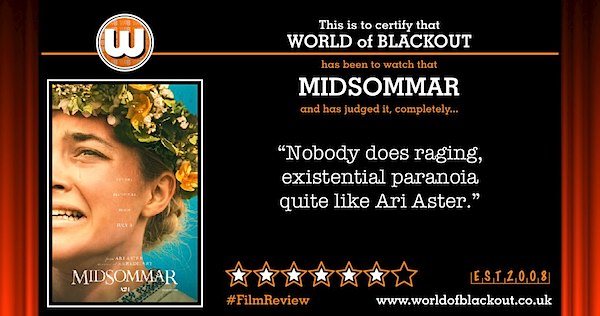
RAGING Nobody does raging, existential paranoia quite like Ari Aster, and his film is surreal, soporific and in places bluntly unsettling. In other words, not something to watch when suffering from a hangover. This could easily have been Hostel for hipsters, but Aster has more restraint than Eli Roth, even if Midsommar does have moments which play like a psychopath's fever dream. It's tempting to think of this as experimental, but Aster knows exactly what he's doing here, and precisely what the outcome will be.
With Pugh, Reynor and Poulter onboard, there was always going to be an expectation regarding the performances, and the cast do not disappoint. True to the longstanding tradition of teen 20-something roadtrip flicks, the group basically spend the movie off their collective box on either over-the-counter pharmaceuticals, or a range of home-formulated psychotropics. There's an interesting contrast and crossover between the two, as American and European cultures clash.
FLORENCING Once our travellers arrive in the village and start exploring, an array of overtly placed pictograms illustrates forthcoming plot-points, underlining the sense of inevitable ritual with the heroes eventually accepting their roles in a play they know can't be re-written. Although this determinism proves to be the film's only real downside, and ends up running like it's on rails. Beautifully shot and scored, hallucinogenically bleak rails, but still. Symbolism, foreboding and fatalism are plaited together until each becomes indistinguishable from the others, and the whole thing is stronger than the sum of its parts.
There's enough here for fans of mainstream horror (providing they can sit out the steadily paced two and a half hour runtime), but there's more to Midsommar than a straight A-to-B shockfest. And while there are spikes of flat-out scare-tactics during the first two acts, these are more akin to dramatic punctuation, a release valve for the escalating unease.
DOUGALLING Aster takes his time almost to the point of self-indulgence, but when the shit finally hits the fan it's been well earned. Much like its A24 stablemate, A Ghost Story, this feels designed to test both the patience and resolve of its audience*1, with no promise of reward other than the first-hand experience of intricate art. It is a thing of terrible beauty.
Midsommar is great and definitely not for everyone, which only makes it greater. I can't wait to see what Aster does with his next adaptation, Bergüraac*2.
*1 The patron next to me had a particularly hard time with some of the more graphic scenes, especially the jump-cuts that switch to close-up gory shots. If you're squeamish, this film is not for you and carries its 18-rating for a reason. [ BACK ]
*2 Sorry, obvious John Nettles joke, couldn't resist, no you shut up. [ BACK ]
DISCLAIMERS:
• ^^^ That's dry, British humour, and most likely sarcasm or facetiousness.
• Yen's blog contains harsh language and even harsher notions of propriety. Reader discretion is advised.
• This is a personal blog. The views and opinions expressed here represent my own thoughts (at the time of writing) and not those of the people, institutions or organisations that I may or may not be related with unless stated explicitly.
Yesterday (part two of two, SPOILERS)
Cert: 12A / 116 mins / Dir. Danny Boyle / Trailer
This is part two of my Yesterday review, and it contains spoilers. If you haven't seen the film yet and you're just wondering whether you should/shouldn't bother (you should), you can read part one here. Under the normal run of things, this would be what I call a second-pass review, hopefully picking up new notes and observations from a repeat screening. This time however, it's more a list of things I noticed the first time round, wanted to confirm with a second viewing and couldn't include in a spoiler-free review anyway.
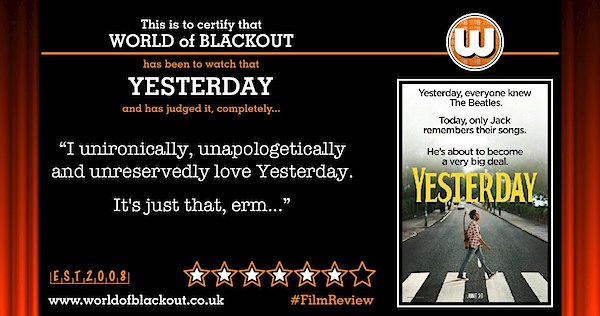
Before I begin this laundry-list of complaints, I should point out again that I unironically, unreservedly, unapologetically love Yesterday. It's twee, it's corny, it's got people in it who I don't like and parts of the film just don't work on a logical level, but I don't care. The phrase 'feel-good' is often used to damn with faint praise, but on this occasion I can think of no greater compliment. Yesterday is glorious.
It's just that, erm...
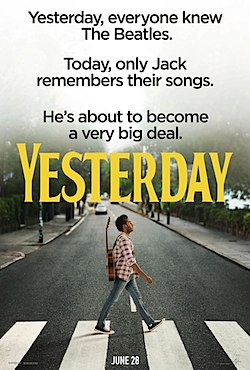
Well it doesn't work, does it? The premise I mean, or particularly its execution. Now I've seen various reviews and articles describe the setup as Jack waking up from his accident to a world where no one remembers The Beatles (including one of the film's own posters, alarmingly). That's not what happens here. Jack wakes up to a world where The Beatles never existed, and there's a massive narrative difference between the two. This isn't a case of global amnesia, the recognised timeline has been altered at some point in the past, then Jack is re-inserted at the juncture point with only memories of the now-alternate reality. If anything, this is an extension of the mechanics explored in Richard Curtis' earlier piece, About Time.
And true to form, Curtis (and to a lesser extent the co-writer of the story, if not the screenplay, Jack Barth) displays a grasp of causality every bit as firm as his one on time travel*1. In the words of Red Dwarf's Holly, "there's no such thing as small" when it comes to changing time. And removing one of the most influential cultural phenomena to ever exist then spinning forward half a century isn't even meant to be small. So let's dive in...
KNOWLEDGE It starts with Oasis. Shortly after realising that no one has any knowledge of The Beatles, Jack decides to check his record collection and sure enough, those discs have disappeared. So the next stop is Google and sure enough, there's no trace of the band on the internet either. Jack begins looking for other artists, to see how widespread the problem is. Bowie, yes. The Stones, yes. And there's a Fratellis poster still on his bedroom wall. But Oasis have disappeared. It's well documented that the Mancunian band were heavily influenced by The Beatles, so Jack sighs and looks at his computer monitor. "Yeah, that figures", he mumbles. Good joke. Everybody laugh.
But we've already seen a flashback of the time that Jack first impressed Ellie at a school concert in 2004, as the youngster played a cover version of Wonderwall by... Oasis. So without the existence of The Beatles and therefore Oasis, Jack wouldn't have played Wonderwall at the gig. He'd have played something else of course, and evidently it still created the pan-dimensional bond with Ellie. But what song was it instead? Why wouldn't this be the next question to pop into Jack's mind? Why doesn't he pick this up with Ellie and ask her details about the concert he can't now remember properly? When Jack's busy in L.A. plagiarising The Beatles in the recording studio, why doesn't he throw a couple of Oasis songs in there, too?
Surely a movie which centers around the enduring legacy of The Beatles should show that their influence spreads throughout pretty much everything which followed in popular music, to some level. Even bands who don't attempt to ape the sound or song structure are aware of The Beatles work, sometimes avoiding those tropes for the same reason as others tribute them. The musical landscape of 2019 would be unrecognisable if The Beatles hadn't formed.
BURST And it's not just the music itself. Countless people have met, bonded, loved and even fought over the some of the greatest songs of the 20th century. The reality that Jack snaps into after his accident would be massively different all over, and there's a fair chance that the people he knew - if they even existed in the new timeline - wouldn't recognise him. To assume that in the absence of The Beatles everything else would continue bimbling along but with a different soundtrack completely undercuts the point of the narrative. If anything, it shows the world is essentially no different for their loss.
And yet there are some bizarre offshoots which get raised. Jack repeatedly asks for Coca Cola and Coke, and no one has a clue what he's on about. Pepsi still exists in this new timeline, but not Coke. We never get to the bottom of this. The implication (since it's not explored) is that a knock-on effect from no Beatles is that Coca Cola has gone, too. But Coca Cola first appeared in 1886, some 54 years before the eldest band members were even born. So are we to believe that The Coca Cola Corporation went bust because the song 'Come Together' was never written and their product didn't get a mention? That was a throwaway line, not an advertisment. The Beach Boys made a reference to the drink too (five years earlier), and Elvis did an actual product placement run in '77. I think Coke were doing alright without the Fab Four.
Then there's the cigarette moment. Apparently in the altered universe, cigarettes either don't exist or just aren't called cigarettes. This all happens in under a minute, also isn't properly explored, then is never referred to again. But the term was coined in 1830, in the French town of the same name. So is the implication that without John, Paul, George and Ringo, the habit died out in the 1960s and now nobody even remembers cigarettes? Well no, because Jack's Google search would have brought up their history until that point. Instead it returns only the name of the town.
Which leads me to believe that something much bigger has changed further back in time, and The Beatles are casualty of this ripple in exactly the same way as fags and Coke. None of this is delved into of course, because we're here for the music*2…
LEATHER ARSE Or at least we are until Curtis and Barth realise that because they haven't properly explained their alternate world and certainly not the actual cause of the rift, there's no way to reset the glitch. The Beatles can't suddenly pop back into existence, because then either everybody's got to suddenly remember them again or everybody's got to magically forget that Jack became famous with their songs. And if Jack pops back into his own timeline then the whole film has been for nothing. So if the previous order isn't restored, the story doesn't have a proper ending.
Instead, Jack makes his confession to a Wembley Stadium full of people with precisely zero of a million questions from everyone afterward, and apparently also not having the arse sued off him by the record company with whom, at that point, he has definitely signed a contract which he voided in a very public fashion. He just goes back into teaching, having dumped a load of tracks on the internet which he intends not to capitalise upon, meaning the record company will claim copyright on the songs themselves anyway since these mythical 'original authors' are nowhere to be found. Great work, Jack.
So because the music-story doesn't end properly, Jack and Ellie's tale just sort of peters out too, lacking the emotional wallop it really deserves after two hours. There's the impression that a lot more is said between them, all off-screen, but by that point the editor has one eye on the credits sequence and the run-time already submitted to the BBFC.
Overall, Yesterday feels like its most interesting aspect has been glossed over to make way for the rom-com, and it feels like the rom-com has been glossed over to facilitate the soundtrack, and it feels like the soundtrack has been hobbled by cramming in too many songs for the film's running time.
And somehow none of that matters, I still absolutely love it…*3
This will be a high water-mark on everyone's CV for some time to come.
Yes, even Ed's.
If you start dissing it, that's possible.
There isn't.
Level 1: I'm sticking with Young Lando. Go on, change my mind.
*1 And much like the retort to any nitpicking of time travel movies, saying "Oh but it's all fictional so it doesn't matter" is not a defence for sloppy writing. The story has to work internally, because if the logic is irrelevant then so are the characters, so is the emotion, and so is the reason for paying £10 to sit in a dark room for two hours watching it. [ BACK ]
*2 Well snippets of the music, as previously noted. I'll go on record now as saying I would happily watch a three-hour cut of this film where each song is played in full rather than clipped out, much like Inside Llewyn Davis and Sing Street. In fact, let's make that a four hour version if someone could throw in a proper deconstruction of the timeline, too. [ BACK ]
*3 And I dread to think what kind of hits this post is going to get by using 'Leather Arse' as the last crossheader, but there we go![ BACK ]
DISCLAIMERS:
• ^^^ That's dry, British humour, and most likely sarcasm or facetiousness.
• Yen's blog contains harsh language and even harsher notions of propriety. Reader discretion is advised.
• This is a personal blog. The views and opinions expressed here represent my own thoughts (at the time of writing) and not those of the people, institutions or organisations that I may or may not be related with unless stated explicitly.
Well, we're barely half-way through the year and already on to the third entry in the Marvel Cinematic Universe, with Jon Watts' Spider-Man: Far From Home landing in cinemas before Captain Marvel and Avengers: Endgame have even hit the Blu-ray shelves.
We're in the post-Endgame timeframe, as the world adjusts to life without the heroes they lost fighting Thanos, as well as the odd fact that everyone who disappeared in 'the snap' has returned, albeit five years younger than those who were spared the cull - adressed early in the screenplay and referred to in-universe as 'the blip'. Young Peter Parker (Tom Holland) is still having to balance student-life with being an on-call Avenger. With an imminent school trip to the cities of Europe, Peter hopes to take a back seat from the costumed life and catch the right moment to tell classmate M.J. (Zendaya) that he's grown increasingly fond of her. But naturally a superhero can't go on vacation in much the same way that Hercule Poirot can't book himself into a Travelodge for the weekend and expect peace and quiet.
And so, Nick Fury (Samuel L. Jackson) and Maria Hill (Coby Smulders) enlist the web-slinger to assist the multi-dimensional newcomer Quentin Beck, aka Mysterio (Jake Gyllenhaal). Beck has come to Earth 616 (ie, the reality we know from all previous movies) from his alternate existence, Earth 813, after it's destroyed by four power-hungry entities known as the Elementals. These aeons-old beasts are attacking major cities with little-to-no warning, and the remnants of S.H.I.E.L.D. need all the help they can get.
CARD Now, perhaps the strongest card played by the movie is how much surface resemblance it bears to its predecessor, Homecoming. The high-school aesthetic eases us gently back into the levity, and a lot of flippant laughs serve to mask more deadpan humour behind. This is a film very much made for people who bought into Parker's pre-Thanos adventure, and viewers who struggled with certain aspects of that will find little to change their minds here. Those aspects are slightly amplified if anything. Of course, Homecoming's strength lay in how self-contained it managed to be in such a sprawling wider narrative. Far From Home has more threads to pull together in that respect, but still manages to do so with its own voice.
But it's not just a disposable action-jaunt. Peter spends the film struggling to form a romantic relationship while people around him breeze in and out of theirs. He's also sorely in need of a mentor-figure, and the shadow of Tony Stark looms over the story and its characters (in a good way).
The title 'Far From Home' is a callback to the 2017 movie and a descriptor for the 2019 sequel, as well as being a nod to The Wizard Of Oz. And much like that classic, there are themes here about identity, responsibility, trust, social-conditioning and most notably Fake News™. In fact, that latter is presented far too boldly to hold the mantle of subtext, feeling both entirely fitting yet painfully on-the-nose. But it's woven into the fabric of the movie and runs throughout (stay until the end of the credits - obviously).
FEAR Holland does well in the title role, by now embedded as Parker for a new generation of cinema-goers, and is supported well by an extensive cast returning from both Homecoming and the wider MCU. Sam Jackson illustrates that irritated Nick Fury is the best (and the funniest) Nick Fury. There's another layer to this performance, but that can't be discussed without minute spoilers, which we aren't doing here. On the newbie-front, Jake Gyllenhaal is on predictably solid form and deliberately hard to read. But the most pored-over casting choice in the next few weeks will be the one*1 who seems to suggest that the live action Spider-Man universes may well be pulling together in much the same way as their animated counterpart. Exciting stuff.
Marvel continue to soar in regard to choreography, cinematography and spectacle, and a fantastic nightmare-type sequence means this is arguably the most visually ambitious entry to date. Michael Giacchino returns on score-duties, capitalising on his fantastic work from the last outing, yet not adding too much to the overall soundscape. But his work retains the identity of Homecoming without being just a rehash, and that's not to be sniffed at.
The expansion of the mythos is on slightly looser ground however, with the Elementals bearing more than a passing resemblance to Spider-Man's 2007's antagonist, Sandman, and one particular character's backstory seeming to riff on Jim Carrey's 1995 Riddler. The well can only go so deep obviously, but if you were going to deliberately evoke a pair of superhero movies from years past, would Spider-Man 3 and Batman Foreverreally be on on that list?
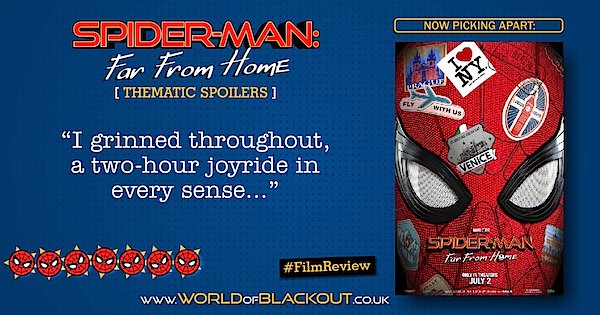
CHOCOLATE Make no mistake, Spider-Man: Far From Home is an imperfect film, but I love that imperfection. It's easy to make something which looks gorgeous but feels empty, and while this never quite reaches the heights of Homecoming, it's still a two-hour joyride in every sense.
Outstanding work and I grinned throughout.
The business-end (not spoilers, but highlight-to-read anyway):
• Is there a Wilhelm Scream? I dunno. Didn't hear an obvious one? • Is there a Stan Lee cameo? There isn't, those days have now past. • Is there a mid-credits scene? There is - stay for this. • Is there a post-credits scene? There is - stay for this.
MCU movies, but the other Spider-Man flick, in particular.
It is.
It is.
Let's not get carried away.
Although this is still fantastic.
Well I LOVE the movie, so only you know if that's likely to happen.
Not that I heard.
Level 1: Mace Windu is in this.
What's more, he can apparently make references to Star Wars references. Very meta.
*1 I won't name the performer in question this time, but I imagine that by the time this review goes live it'll be all over the internet anyway and you'll know exactly who I'm talking about. Because there's no such thing as accidental casting in a movie aimed in no small part at geeks who obsess over every last detail. [ BACK ]
DISCLAIMERS:
• ^^^ That's dry, British humour, and most likely sarcasm or facetiousness.
• Yen's blog contains harsh language and even harsher notions of propriety. Reader discretion is advised.
• This is a personal blog. The views and opinions expressed here represent my own thoughts (at the time of writing) and not those of the people, institutions or organisations that I may or may not be related with unless stated explicitly.