Firstly, a disclaimer. This is a civilian review of a geeky movie. I'm a fan of the Harry Potter timeline in that I've seen all the films in the cinema*1, but it goes no further than that. It's not that I'm dismissive of the series at all, but all those shelves in your brain which are used for storing interconnecting trivia about the history of Hogwarts are pretty much full of Star Wars stuff in mine. The jug can only hold so much water. I only make the point because I can tell (as a fan of film in general) that pretty much every scene of Fantastic Beasts is stuffed with Easter-Eggs, in-jokes and foreshadowing for future installments, yet I can't quite make the connections. No matter, as this is a movie designed to work for mainstream audiences as well as the hardcore faithful, but I'm getting ahead of myself...
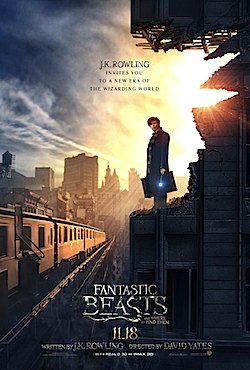
1926. As a conservationist of magical creatures, Newt Scamander arrives in New York with a suitcase already twitching and bulging at the seams. When one of his subjects manages to escape into the vaults of a bank, Newt finds himself enlisting the help of Jacob Kowalski, a No-Maj (the American term for Muggle) baker to recover it. This interaction leads to the involvement of the magical sisters Porpentina and Queenie Goldstein, and uncovers a larger scurrilous plot at the Magical Congress of the USA (Ministry of Magic, basically).
Short version: I loved this. With the story and screenplay written directly by JK Rowling, the authenticity of the continuity never feels in question, and the previous hurdle of adapting novels for the screen is removed altogether. Yet rather than relying on the already-created universe for familiarity, setting the story 70 years earlier and on the other side of the world allows the canon to expand and adapt, rather than rehash. And using the incredibly-British™ Scamander as the audience's window into this new (old) world allows things to unfold naturally, as he experiences them. 1926 is also, it has to be said, a fairly dark period in American history in which to set a light-hearted fantasy movie. While the film doesn't dwell on this too much, it gives rise to more than a few socio-political digs in the script which, naturally, are relevant to both the film's internal setting, as well as the one the audience goes back home to.
And as stated above, every single scene in this movie is rich and bursting with detail (although from a cinematic point of view, it's perhaps worth noting that every exterior location feels like a soundstage, somehow). But the cramming doesn't stop there. Rowling's story spends the first act transitioning the audience over the Atlantic, so there are a lot of comparative references and cultural translations, but at the same time it's setting up pins for future installments (four loosely announced, so far) and remembering to make a solid story out of this film itself. It does, at at times, feel slightly too crammed.
On top of this, I'm not entirely convinced that Redmayne's Scamander is the right lead for the film. He's fantastic in the role itself (as per) under long-time Harry Potter director David Yates' auspices, but the character's bumbling and avoidance of eye-contact begins to hold things back a little. Typically, that's when you'd hand over to Tina and Queenie to pick up the protagonist-reins, but the film is hesitant to really let them take charge. As a result, I don't feel like I got to know any of the three characters as much as I wanted to. And it's coming to something when the most memorable and developed character in a film about wizards is the Muggle who wants to run a patisserie...
But, all in all, this is a fantastic way to begin the next volume in the cinematic series. Rowling knows her universe and she knows her audience; long may she be this central to both…
From the cast, no.
From the director, it's a strong punt.
Nope.
I didn't hear one, but the climactic sequence is pretty much 45 minutes of white-noise, so there could well be one buried that I didn't catch and the insane volume of a cinema auditorium.
Level 1: This film stars Nick Donald and Jorge Leon Martinez, both of whom are basically extras here and who were basically extras in The Force Awakens, but it still counts so you shut up.
*1 Although as it turns out, I've only reviewed one of the Harry Potter movies here, as the rest were released before I started the review-side of the blog full time. Alas, my local didn't take part in the recent Saturday-morning-catchup series (one a week for eight weeks), otherwise I'd have been well up for that.
DISCLAIMERS:
• ^^^ That's dry, British humour, and most likely sarcasm or facetiousness.
• Yen's blog contains harsh language and even harsher notions of propriety. Reader discretion is advised.
• This is a personal blog. The views and opinions expressed here represent my own thoughts (at the time of writing) and not those of the people, institutions or organisations that I may or may not be related with unless stated explicitly.
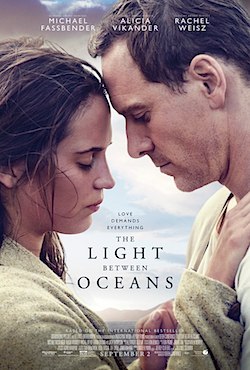
Set shortly after the First World War, surviving veteran Tom (Michael Fassbender) returns home to Australia and takes a posting on a remote lighthouse, hoping for the solitude to reflect on his experiences and a job in which can still contribute to society. After falling in love with, and marrying Isabel (Alicia Vikander), she moves with him to his island, but the two find themselves unable to successfully have children. When a lone rowing boat drifts ashore holding only a dead man and a surviving baby, they're faced with the choice of whether to pass the infant over to the authorities or care for it as their own. Spoiler: they do the second one. What could go wrong? Especially when a woman on the mainland (Hannah, Rachel Weisz) begins to suspect that her daughter is still alive...
Although it's marketed as a romantic drama, The Light Between Oceans goes much deeper than most beach-set weepies, touching on guilt, miscarriage, loneliness, guilt, loss, duty, sacrifice and guilt. Fassbender and Weisz are great as expected here, but Vikander really steals the show, being able to externalise her performance more. The film evidences fantastic direction from Derek Cianfrance too, by which I mean that he's been able to prevent Fassbender from autipiloting into his Irish accent in every other scene (cf almost everything MF has done where his character isn't Irish to begin with).
Combine this with some breathtaking photography of the Australian coast, and it's a film which holds your attention throughout. Speaking of Antipodeans, it's kind of fitting that a film set in Australia should feature such a prominent screenwriters' boomerang as the silver baby-rattle which Tom finds in the rowing boat with the infant. As soon as he slips it into his pocket before setting the boat back out to sea, everyone in the room thinks "yep, we'll be seeing that again before much longer…"
But the only real downside is that the ending of the film feels rushed, with too many previously established plot-points barely even hinted at, never mind fully illustrated for completion. It's almost as if there had been a specific run-time allotted by the distributor, but the producers had been loath to cut any of the earlier material. While this sounds like a facetious exaggeration, many of cinematographer Adam Arkapaw's stunning land and seascape shots feel like they've been cut short by editors Jim Helton and Ron Patane, seemingly in a bid to save precious seconds for a denouement which needs more minutes. We also get some flashbacks courtesy of Hannah surrounding the disappearance of her husband and daughter, which would be fine if Captain Birdseye hadn't spent five minutes telling the same story to Tom in another scene fifteen minutes earlier. It's a very slapdash edit for such a delicate story.
But, for a film of this genre to have engaged me so much, it really must be something special. I haven't even got kids, god alone knows what the parents in the audience were feeling.
+ + + + +
Before I go, a couple of things which crossed my mind during the film:
• Why do we see Fassbender and Vikander up and about during the day so much? 'Lighthouse Keeper' is pretty much permanent night-shift, isn't it? Making sure the flame doesn't go out (this is 1921, pre electrification. Plus, it's on an uninhabited island) and logging everything which does happen in a journal. The place isn't needed as such during the day, so shouldn't Tom be getting his head down so he can spend all night looking out of a massive round window?
• The long-shots of the isolated island show the mountainous section in the middle dwarfing the lighthouse. If the landmass is, as Tom says, between two oceans (rather than being a mainland coastal installation), surely you'd want a lighthouse at both ends of the island? What about those cats sailing in from the other side? They can hope to float the rest of the way on the wreckage of their ships, right?
I don't know very much about lighthouses. Although as long as I had a fast broadband connection and a massive fridge to keep the beer cold, the job sounds ideal.
Oh, and how come Waltzing Matilda isn't a waltz? You had one job, mate…
Difficult to say, 'earnest weepie' isn't really my genre.
As much as I enjoyed it, this is a Sunday night DVD with a bottle of red.
Despite sometimes working against itself, yes.
Although the bar was already high for Alicia Vikander, this could well be a career-best, yes.
Not particularly.
Not at all.
Level 2: The film stars Alicia Vikander of course, who rocked up in Ex Machina last year alongside Domhnall 'Hux' Gleeson and Oscar 'Dameron' Isaac.
(although that's a six for the performances and direction, not the pacing or editing)
DISCLAIMERS:
• ^^^ That's dry, British humour, and most likely sarcasm or facetiousness.
• Yen's blog contains harsh language and even harsher notions of propriety. Reader discretion is advised.
• This is a personal blog. The views and opinions expressed here represent my own thoughts (at the time of writing) and not those of the people, institutions or organisations that I may or may not be related with unless stated explicitly.
Occasionally, you'll watch a two-minute trailer and think 'oh, that looks interesting, I wonder what it's actually about?'. Occasionally you'll watch the two-hour film that the trailer was promoting and end up asking yourself the same question.
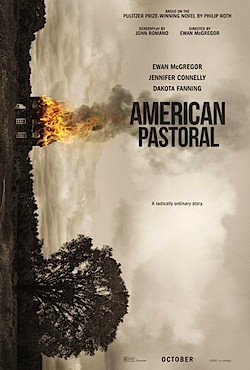
Ewan McGregor directs and stars in this adaptation of the Philip Roth novel of the same name, about a Jewish/Catholic family in Newark, New Jersey, during the 1950s and 60s. The standard tumultuousness os family life is punctuated (indeed punctured) by social and political events of the era, coming to a head when the teenage daughter of the family (Dakota Fanning) becomes involved in a political movement and disappears, much to the disquiet of her parents (Ewan McGregor and Jennifer Connelly).
Spanning a couple of decades (more if you include the modern-setting framing device and narration) key points in modern American history are used to denote the passage of time (as well as McGregor's haircut), which could possibly be a stumbling block for viewers outside the US. By which I mean me. By which I mean, I'm aware of all that stuff happening, but not all of the exact years or even the exact order, so my brain was constantly sidetracked in trying to pinpoint the page on the calendar when I should just have been looking at Ewan's hair. Like some sort of dramatic merry-go-round, Jennifer Connelly, Dakota Fanning and Ewan McGregor each get their chance to gleefully overact before the screenplay has allowed them time to lay the sufficient groundwork.
Like its predecessor*1, the film dissects The American Dream™ with curious but unceremonious precision. Also like its forebear, I think for that to work well, the viewer has to be on the start-line from the beginning. Again, I like to think I'm reasonably familiar with Americana, but I just couldn't jump the cultural gap to get the most out of this (and in that respect, fair play to McGregor for helming the project in the first place). Ultimately, I'm not sure what it's meant to be. Earnest family drama, or quasi-political mystery? Because while each side is intriguing here, they certainly don't sit together well.
American Pastoral is, to be brutally fair, an interesting mess. As if two jigsaws featuring the same scene but with differently cut pieces have been dropped onto the floor together and we get to watch McGregor on his hands and knees, scrabbling against the clock to assemble a whole picture.
An unwieldy analogy which the film has earned.
It reminded me a little bit of Capote.
Which I also couldn't get on with.
It'll be just as uninspiring on DVD, I reckon.
Without reading the novel (and let's face it, I don't have that amount of free time), I couldn't really say.
Well, In the period-setting, McGregor's American accent is every bit as shaky as the cast's 'aged' prosthetics in the modern-set bookends..
*1 Of the ones I've reviewed online, here's my ranking of the entries in this series, from best to worst:
• American Ultra • American Pie Reunion • American Hustle • American Pastoral • American Honey • American Sniper The best part is, I suppose, that you can watch them in any order. The timeline is all over the place and there's almost no narrative continuity.
DISCLAIMERS:
• ^^^ That's dry, British humour, and most likely sarcasm or facetiousness.
• Yen's blog contains harsh language and even harsher notions of propriety. Reader discretion is advised.
• This is a personal blog. The views and opinions expressed here represent my own thoughts (at the time of writing) and not those of the people, institutions or organisations that I may or may not be related with unless stated explicitly.
Ah, a 'late-morning' screening. While the attending crowd was slightly more varied than the ones for Under The Skin and Knock Knock, there was still a strong contingent of Unaccompanied Middle Aged Man™ present. And during the lengthy, slow-motion opening sequence of Nocturnal Animals, I could sense many brows furrowing around the room and mouths falling agape, silently forming the look of "hang on, this is not the film that the trailer sold me…". There is a context for what happens at the beginning, but only in that the context is itself out of context. I won't spoil it, you'll see for yourself when you watch the film.
Confused? Welcome to Nocturnal Animals.
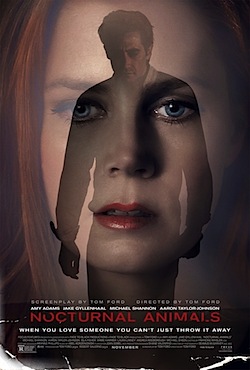
Tom Ford's adaptation of Austin Wright's novel, Tony and Susan, follows Amy Adams (Susan no less), as a fundamentally unhappy contemporary artist who receives a pre-publication manuscript from her ex-husband, Edward, after several years of non-contact. When it turns out that Edward's book is a violently clear allegory for his feelings about their failed marriage, Susan is appalled and enthralled in equal measure. The film splits into a visual adaptation of the work, Susan's reactions to it and a series of progressive flashbacks which reveal the ways their relationship broke down.
Nowhere near as challenging as it'd like to think it is, Nocturnal Animals is, nonetheless, very good at being difficult to like. Probably a little too good, actually. It's well acted and solidly directed, but I couldn't work out if the film has a terrible, clunky script, or a brilliant script of terrible, clunky characters. Maybe they're the same thing, even though they shouldn't be.
With Adams' as the emotionally reinforced artist, Armie Hammer as her second (and externally lecherous) husband, Jake Gyllenhaal as her flawed husband in the flashbacks and the flawed central character in Susan's interpretation of the book, and obstructive or negative supporting characters in all three timelines, I don't think it's unfair to say that there's not a single redeeming character in the whole film. That's not to say if has no redeeming features, but they're scattered loosely down a long, dark road.
The novel Susan receives depicts a man (Tony, from the title or the original book, above) driving through the southern states of America with his wife and daughter when they become ambushed by a gang of rednecks. One thing leads to another and the man is separated from his family while they're raped and murdered. The rest of the story follows Tony as he teams up with a borderline corrupt cop to bring the gang to violent justice. It's basically a 1970s exploitation flick with a framing device.
The bottom line is, for all the stark visuals, subtext and narrative layering, Nocturnal Animals slowly descends to a sort of art-student torture-porn, raising one eyebrow as it plays ironically in a sandpit it thinks it's too good for, all the while throwing in flashbacks and real-world segments which make decreasing amounts of sense*1. True to its title, the film embraces that sense of heightened-yet-detached unreality which is both the confidant and tormentor of the 3am insomniac. But that's no consolation.
With plenty of frowning and yelling but little genuine emotion on display, Tom Ford's film is a compelling artifice of drama. Which might actually be the point, admittedly…
It'll be more atmospheric on a big screen than a small one, yes.
Oh, I have no idea.
No.
No, but I will ask you to explain yourself in great detail.
There isn't.
Level 2: Nocturnal Animals features Isla Fisher, who starred in 2010's Burke and Hare alongside Simon 'Plutt' Pegg, Andy 'Snoke' Serkis, Tim 'Palpatine' Curry and Christopher 'Dooku' Lee...
*1 Okay, this section is in highlight-to-read spoilers for people who've seen the film and hopefully understood it more than I have:
1) The scene with Susan's colleague and the mobile phone which shows a monitor-video of a baby in a crib before a screaming demon leaps into frame, causing Susan to scream herself and drop the phone: I was under the impression that it was one of those prank videos that occasionally does the rounds. Except that her colleague's reaction displays no recognition at all, never mind amusement, once the punchline has been delivered. Okay, her phone screen is now smashed, but you'd at least get a "well, that joke backfired" line in response. So the other alternative is that the video is a nightvision baby-monitor app, as described, and Susan is in such a bad place psychologically that she's hallucinated the demon's appearance causing her to drop the phone. Except that we get no further hallucinations of this nature to suggest a descent into madness. So what gives with that scene?
Oh, and 2, who's the late-teen girl that Susan phones on the Sunday morning, who calls her 'mom'? The story leads us to assume that she doesn't have any children, indeed the 'bad thing' Susan did was aborting Edward's child (the vengeful reason for the couple's daughter's death in the book) at the start of her relationship with Hutton. But in one scene, Susan tells her assistant that her ex-husband is from 'a couple of years ago', which would be nowhere near enough time for Susan and Hutton to have a daughter of this age (and would also explain why neither Adams or Gyllenhaal look that much younger in the flashbacks - certainly not twenty years younger). And apart from anything else, Hutton's presented as such a prize tool that there's no way their relationship could have limped along for eighteen years, child or otherwise. Was Susan impacted so much by the discovery of the bodies in the book that she hallucinated her own aborted daughter back to life? I only ask because the poor girl isn't mentioned before or after that. Bizarre.
DISCLAIMERS:
• ^^^ That's dry, British humour, and most likely sarcasm or facetiousness.
• Yen's blog contains harsh language and even harsher notions of propriety. Reader discretion is advised.
• This is a personal blog. The views and opinions expressed here represent my own thoughts (at the time of writing) and not those of the people, institutions or organisations that I may or may not be related with unless stated explicitly.