Friday, 28 July 2023

Review: Barbie


Barbie
(Spoilers)

Cert: 12A / 114 mins / Dir. Greta Gerwig / Trailer

Life is pretty good in Barbieland. Stereotypical Barbie (Margot Robbie) enjoys an idyllic existence partying, relaxing and socialising with a wide swathe of other Barbies. Beach Ken (Ryan Gosling) joins in but pines from afar, wishing their non-committal relationship could move to the next level, while also enjoying an active social life with all the other Kens. But strange things are afoot, and Barbie notices the shine beginning to rub thin on her daily activities; food tastes bad, showers are cold and she can't shake growing feelings of existential dread.

Visiting Weird Barbie (Kate McKinnon) on the outskirts of town, our heroine learns that her problems stem from angst in The Real World, where the girl who owns the doll is suffering a series of emotional upheavals. This discord has caused a tear in the space-time continuum, and the only chance Barbie has of putting things right is by travelling into The Real World (with Ken in tow) and bringing a little sparkle to Los Angeles before Barbieland falls apart...


BROKEN


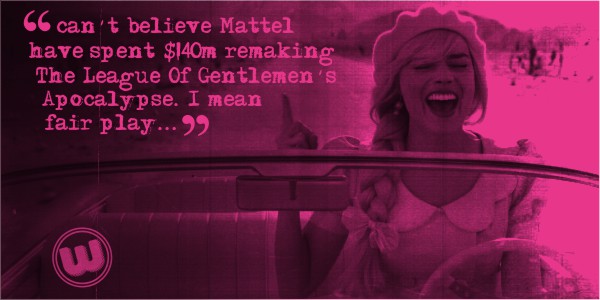
So it seems Mattel have finally broken into the live-action movie IP business by spending $140 million*1 in remaking The League Of Gentlemen's Apocalpyse. I mean fair play, I did not have that on my 2023 bingo card, but at least they've got the action figures on the shelves already so this is a bonus (HASBRO TAKE NOTE).

After riffing on Kubrick's 2001 as per the teaser trailer, Barbie's opening act is everything you'd expect from A Barbie Movie naturally, and archly self-aware as it is, still feels like being kidnapped by a hen party and waterboarded with Lambrini. That said, the production design is a thing of surgically precise beauty, a wry homage to the brand rather than a parody. The players are entirely onboard and carry this in the same vein, and both Robbie and Gosling are perfectly chosen with excellent comic timing. Greta Gerwig's tight direction makes the most of her script with longtime collaborator Noah Baumbach.

There are plenty of laugh-out-loud gags throughout, both in Barbieland and The Real World. A huge supporting cast are having a blast as the various branded iterations of Barbie and Ken, and Michael Cera brings his trademark anxious demeanour as Allan. America Ferrera and Ariana Greenblatt are superb as Gloria and Sasha, the mother/daughter combo caught up in the strife which has opened a gateway between planes of existence. Will Ferrell plays the (appropriately unnamed) CEO of Mattel by playing Will Ferrell™, and Dame Helen Mirren continues to channel the late John Hurt by providing a voiceover that's so cloyingly tongue-in-cheek it actually cheapens both the film and her own IMDB catalogue.

The film wears its feminist credentials on its sleeve and does so very well, even if the message feels very much on the nose a lot of the time. But the fact that this ethos has made it out of a dozen boardrooms and onto mainstream cinema screens in such a prominent style is a feat to be applauded in itself. The version of what we see could not have been made without Mattel's endorsement, and while the impression remains that the paymasters are generally in on the joke, we're also left with the feeling Gerwig and Baumbach are filing off many of their sharper edges. What's more interesting is the boxes the film refuses to tick. Despite the ferocious branding and leaning heavily into the current, financially lucrative, version of its namesake, Barbie is not a children's movie. Children can certainly watch it (within the expected 12A parameters obviously), but it's made for adults - specifically, ones who remember Barbie but don't necessarily have a house full of them any more. And yet at the same time, this isn't an empty, cash-grab nostalgia exercise. It's promoting the product definitely, but it's more about selling the idea of Barbie. Or an idea, at any rate.


POISON


In terms of the actual mechanics of the storytelling, things are a little more... well, vague. The spoilers start here, by the way. Even in a tale of fantastical allegory, the internal logistics have to work for the audience to buy-in on an emotional level. So, if Barbieland™ includes every Mattel doll that's played with then the town would have a population of billions, whereas if there's a separate, self-contained Barbieland for every girl who plays with Barbies then each one would only be populated by the dolls that girl owns. The girl in question here (it's Gloria) only has the few dolls left over from her daughter's recent childhood, not the vast array of specifically vintage and also very up-to-the-minute Barbies on display in the film. There's no clarification over why this is. The Barbieland we get seems to include one of everyone, with no details as to how many other humans are involved at a higher level or how ownership has been assigned. But okay, we'll go with it.

We're told a portal has opened due to a Barbie-fan having a hard time in The Real World, yet in the real world boardroom scene we're told this has only happened once before. As if a lot of people in the real world who've got Barbies aren't having a hard time a lot of the time precisely because of how the real world works. There'd be portals everywhere. But okay, we'll go with it. Likewise, we're told that Weird Barbie has become eccentric because her owner/handler/God went a bit crazy and drew on her with pens, cut her hair with scissors and wedged her legs into permanent splits. Again, kids are gonna be kids and there'd be a lot of these Barbies around town. But okay, we'll go with it.

We don't see the actual, plot-critical portal itself, just a recurring vehicle-montage through Barbieland then the travellers being on Venice Beach, Los Angeles; and vice-versa to return. Barbie and Ken manage to take Gloria and Sasha back through with them, so we'll accept that regular humans can make the reverse trip with no ill effects. But Will Ferrell and the entire Mattel board of directors also manage to surreptitiously follow them, so we've got to assume that it's accessible to anyone on-foot from Venice Beach, yet nobody else has accidentally wandered into this portal that's been open for the duration of the entire storyline. How much more of this do we have to go with?

The Crocodile Dundee, fish-out-of-water routine with Barbie and Ken in LA is executed very well, but doesn't last for long as the pair are soon heading back, as noted above. Meanwhile, most people in the Real World seem remarkably calm about the human iterations of two actual dolls walking around, especially the ones who know exactly what's happened. You'd think this absolute upheaval of mundane reality and revelation of a parallel universe might be a bigger deal, somehow. Similarly, when Ferrell and the gang find themselves in Barbieland, the cultural offset is mined for almost zero reciprocal material. Indeed, the screenplay has no idea what to do with these characters so just forgets about them until the climactic Beach-Off where they have pretty much no constructive part to play (the board's overall plan to 'fix' the situation by putting Barbie back into a branded packaging-box is also weirdly indistinct). For a movie that's genuinely funny, it's staggering how much comedy-potential is wasted here.

Despite all my snarking though, Barbie is good. I don't think it's quite everything it wants to be, but it succeeds in being the film that it (and its audience) needs. It's certainly more than Kenough. It is entertaining and it does also carry a worthwhile message. The feminism, however, is not its subtext - that's very much The Text. Deeper meaning is perhaps more rudimentary than a fuchsia-fuelled crusade for girl-power...


RATT


The inhabitants of Barbieland seem vaguely aware that they're dolls and that The Real World exists, but they know next to nothing about it and show little desire to change this. It's not in the dolls' capacity or programming to realise the limitations of their surroundings or question anything outside of them, and so they're completely unable to deal with deeper philosophical problems about anything that can't be quantified in colourful plastic and simple, methodical activities. Even Margot Robbie's Barbie needs to be railroaded into knowledge by McKinnon's older, cynical sister. When peace and regularity is restored to Barbieland at the end of the third act, this is performed largely by reverting to the status quo prior to the first.

Barbie herself (the Margot Robbie one) finally rejects this of course, like a Tyrell Corp replicant now aware of its lifespan and wanting more. Having understood that revolution won't (or can't) work in her hometown, Barbie opts for evolution instead and journeys to live as a human in desaturated, complicated, messy meatspace. As we close, Barbie's future is an open road, albeit a markedly and necessarily less pleasant one in the process. But she's chosen hope and possibility. Gloria and Sasha's lives may be better as the credits roll but they're not that different, and we all know that Will Ferrell's character will still be Mattel's CEO on Monday morning and Gloria will still be working for him. Stereotypical Barbie was the only character in the movie to take a chance, to make a choice that bold, that permanent. And the choice is open to everyone on-screen of course, but the availability of that choice to everybody? That's the feminism, here. That's the equality. Because of course, the price of that freedom means having to accept that some people will decide they want things to not get better...


Back in Barbieland, the remaining collective of Barbies and Kens (okay, and Allan) also have wider knowledge of how things really work now, and they choose repair their society by setting all this to one side and carrying on as before. They're not ready to make the change, yet. Similar to Never Let Me Go, this might be the most profound point the film makes - that the Barbies' and Kens' perfect, repetitive, superficial lives are our lives, as we blankly rush through our ingrained routine to spend disposable income being distracted by a two hour dopamine-boost in a cinema. Or at a party. In a restaurant. At a shopping mall. In dream houses full of wonderful organised, covetable, accumulating stuff, always thinking about tomorrow and never appreciating the nuances of today, just as we recoil in horror whenever someone mentions the truth that we will not talk about: that fact one day soon, we will die.

We could live more, feel more, choose the genuine thrill of uncertainty. But it's easier to choose not to. Stereotypical Barbie has chosen to truly live, and in doing so has chosen death. And this is a final theme upon which Barbie does not dwell of course, because it doesn't do to be overtly reminded you're wasting your life by a toy advert...*2


And if I HAD to put a number on it…


*1 Wikipedia lists the film's budget (production, not including marketing) at $128-$145m. And while that obviously is a lot of money, it has to be said that bringing in a Hollywood-grade film with a production-design this polished and featuring this cast for under 150 large ones is pretty damned impressive, especially looking at the box office returns it's making... [ BACK ]

*2 There is a very strong chance I've over-thought all this of course, but please do bear in mind that I'm the one who interpreted the U-rated Boss Baby animated movie as being a study of infant-mortality induced PTSD... [ BACK ]

DISCLAIMERS:
• ^^^ That's dry, British humour, and most likely sarcasm or facetiousness.
• Yen's blog contains harsh language and even harsher notions of propriety. Reader discretion is advised.
• This is a personal blog. The views and opinions expressed here represent my own thoughts (at the time of writing) and not those of the people, institutions or organisations that I may or may not be related with unless stated explicitly.

Wednesday, 26 July 2023

Review: Talk To Me


Talk To Me
(Structural spoilers)
Cert: 15 / 95 mins / Dir. Danny Philippou & Michael Philippou / Trailer

Reeling from the recent death of her mother, suburban Australian teenager Mia (Sophie Wilde) attends a party with her best friend Jade (Alexandra Jensen) where a seance-type game is being played. A curious ornament of an embalmed, outstretched hand is used as a bridge between the land of the living and the tormented souls of the dead in limbo. The subject who grasps the hand and recites a mantra is then possessed by whichever spirit answered the call, while friends in the room run a timer and break the connection by blowing out the candle before the player is lost completely.

But when Jade's little brother Riley (Joe Bird) persuades the group to let him try, the combination of his youth and a particularly malevolent visitor result in the boy being catatonically hospitalised. Blaming herself, Mia resolves to rescue Riley from wherever his essence is being held, as well finding time to battle her own demons...


PHYSICAL


So, the Philippou brothers' film is, in a very real sense, a ouija-movie. The setup of bored teenagers using a physical artifact to channel the netherworld and then realising they've bitten off more than they can chew and spending the next 80 minutes trying not to go mad or die is a tried and tested formula. Long-time readers of this blog will know my patience with this sort of thing is usually wafer-thin at best.

Talk To Me, however is different. It's different in that it's pretty marvellous, and that's entirely because of how it handles its premise, rather than the premise itself.

A measured first act teases the results of a previous group messing about with The Hand, before taking the time to build up the characters of Mia and Jade. Neither are presented as bratty, conceited or unusually damaged (do remember these are teenage girl protagonists in a horror movie), and we get enough background information that it while may seem unusual for them to be diving into a seance, it doesn't feel unexpected.


ROCKED


But it's at the point of the first ritual that the film starts carving its own path. The teenagers in the room aren't surprised when contact is made with the other-side. The 'things' that the subject sees are visible only to that person; to everyone else it looks as if they're just hallucinating. But several of the kids have seen this before. Indeed, they've done this before; that's the game. This isn't a group of giggling children pushing a glass around a table, it's a quantifiable experience that can't be faked - and it's treated here as a drug as they take it in turns, filmed by everyone around them on their phones*1 and enjoyed by all. Because as terrified as each of them are when they're 'under', they return energised and wanting to do it again.

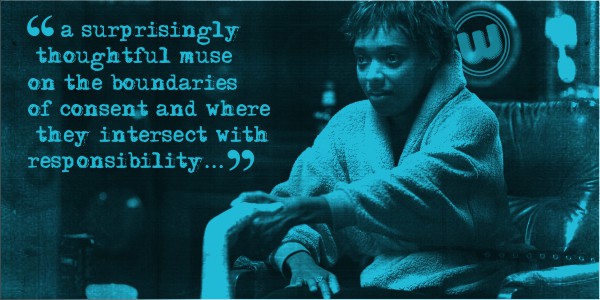
More importantly though, this isn't a film about meddling with the occult. Horror works best as metaphor, and Talk To Me is a study of grief, guilt and mental illness, which isn't altogether unusual for the genre. It is more, however, a surprisingly thoughtful muse on the boundaries of consent and where they intersect with responsibility. The film never asks these questions explicitly and it certainly doesn't offer easy answers, but to even raise this in such an under-the-radar way is a smart move, and one which should be lauded.

We see it play out many times. Once the game's participant is safely strapped to a chair (torso only) and the candle is lit, it's that person who has to reach out and grasp The Hand. It's that person who has to utter the words "talk to me". And after the immediate sight of a decomposing corpse in front of them, it's that person who then has to literally say "I let you in". After this point the dead person takes control of their body (hence the strap), and will remain in place until the candle is extinguished. The subject is fully inhabited by the dead at the absolute mercy of their friends, and they've been a willing player in this game of this from the off. They're reliant on those friends having also experienced this first-hand, and understanding the gravity of the situation amid the 'fun'. So who's to blame when the genie doesn't want to go back in the bottle?

While the already-mythologised origin of The Hand is discussed at one point, there's no second-act scene in a dusty hospital archive where Captain Exposition conveniently reels off a backstory. Likewise, destroying The Hand to magically undo its deeds is never mooted as an option, with Mia actually bringing a cause-and-effect approach to studying its mechanics instead. Although by a certain point in the film it becomes clear that the only light at the end of the tunnel might in fact be its own dark place...


READYTORHUMBLE


Talk To Me is different enough in its detail to set it aside from the standard posession-horror flick, but is rooted firmly enough in the social tradition of those to ensure that points of familiarity strike home. There are a smattering of jump-scares but the film certainly doesn't rely on them, infusing the audience instead with a sense of dread and sadness.

The main selling point though, is the superb work of the huge make-up and prosthetics team, and a host of excellent dramatic performances from the cast (especially Sophie Wilde), rather than the players defaulting to 'horror movie shriek-mode'. And ultimately, this also comes down to the deft writing of Bill Hinzman and Daley Pearson, and the focused direction of Michael and Danny Philippou, who've shown that not only can they play with the big boys - they understand the game far more intimately*2.


Talk To Me is a very neat little genre movie that's not going to change the world, but is punching well above its weight in an overcrowded fight. I don't need to see sequels (that ending is perfect as it is, thank you), or spin-offs or half a dozen Blumhouse efforts trying to emulate everything this does right, although I suspect all that's coming down the line anyway...


And if I HAD to put a number on it…


*1 Okay, so when exactly is this movie set, that the characters have shiny new iPhones and MacBooks, but Jade's still got the Crazy Frog as a ringtone? Is somebody looking after Australia..? [ BACK ]

*2 Which is something of a surprise, because prior to the film there was a short welcome-reel featuring the Philippou brothers and quite frankly they come off like an absolute ADHD nightmare. This was part of Cineworld's Secret Screening programme, incidentally, and between the BBFC card and ten minutes into the movie I counted 19 walkouts. Which is entirely fair enough. There are many people who just don't do horror (there can't be any other mainstream genre so culturally divisive), so getting people out of the house for a mystery movie and then springing something you know for a fact that a few of them will hate seems like an odd move. Because those 19 people won't be coming to the next one. It's also worth noting that the Secret Screenings are no longer exclusive to Unlimited card-holders, so potentially some of those walkouts had actually paid specifically to be there. I hope they got a refund... [ BACK ]

DISCLAIMERS:
• ^^^ That's dry, British humour, and most likely sarcasm or facetiousness.
• Yen's blog contains harsh language and even harsher notions of propriety. Reader discretion is advised.
• This is a personal blog. The views and opinions expressed here represent my own thoughts (at the time of writing) and not those of the people, institutions or organisations that I may or may not be related with unless stated explicitly.

Monday, 24 July 2023

Review: Oppenheimer


Oppenheimer
(Spoilers)
Cert: 15 / 180 mins / Dir. Christopher Nolan / Trailer

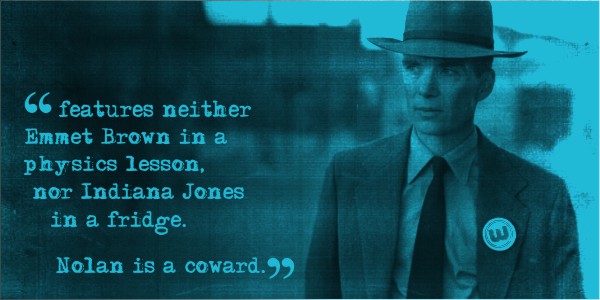
Oppenheimer is a three hour, period-set film about nascent nuclear weaponry from a provenly competent storyteller which somehow features neither a young Emmet Brown sitting in a physics lesson nor Indiana Jones in a fridge.

Christopher Nolan is a fucking coward*1.

And if I HAD to put a number on it…


*1 Okay, I'll keep this as brief as I can. The note about Doctors Brown and Jones is obviously a joke. The score is not. I did not enjoy Oppenheimer. Then again, I genuinely believe that it's a film not created for enjoyment in any traditional sense, quite a demanding piece to watch and unsatisfying by narrative necessity. We should certainly expect no less a challenge from Christopher Nolan though, just as we wouldn't want him to be anything other than himself as a filmmaker. I suppose.

Playing with non-linear storytelling once again, Oppenheimer is framed as two separate interviews with associated sets of intertwining and converging flashbacks, each spanning the same twenty-or-so years from different points of view, where the guy we're supposed to be rooting for is demonstrated as being a dysfunctional, womanising moral-vacuum who's figured out how to most efficiently carry out genocide before the nazis and complains non-stop about this before, during and after the fact. Leaving a spray of failed personal and professional relationships in his wake, we see Oppo systematically piss off just about everybody in his life and then act surprised when they take against him...

Of course, this wouldn't be a Christopher Nolan movie without mumbled, unintelligible dialogue from the most important characters, battling here against Ludwig Göransson's piercing, intrusive score in a sound-mix that was finalised while somebody was hoovering. All of this has the pacing and delivery of high-drama, but with the implication of a storyline rather than the exposition of one. I know Nolan doesn't like to spoon-feed his audience, but Oppenheimer doesn't even have cutlery on the table.

You see, despite the device itself having a supporting role on the film's poster, this movie is not actually about Da Bomb. This is just as well, because shortly into the first act Nolan realises he can't narratively simplify for the audience either quantum physics nor the workings of an atom bomb, so quickly stops trying. What the movie actually is, is three clinical hours of dislikeable characters doing unpleasant but necessary admin and then everyone being unable to cope with the fall-out (literal, as well as metaphorical) of that, interspersed with the micro-management of international and domestic U.S. politics of the 1930s, 40s and 50s. So I was hardly expecting Terminator 2, but this is lots (lots) of middle-aged white guys in suits sitting around withholding information and showing they really can't be trusted (I go to the cinema to get away from that), leaving the cinema audience with quite frankly nobody to root for. Other than the demonstrable sociopath the film is named after. I suppose.

In terms of moral debate, Oppenheimer occupies the same shelf as Eye In The Sky and Red Joan, where hand-wringing and thousand-yard stares nudge aside the brutal practicalities of Not Losing A War. I never thought I'd watch a movie where Matt Damon plays the most rounded and sympathetic character, but here we are.

While the two timeline strands are clearly delineated by the use of colour, the content in each rarely seems complementary or interactive enough to warrant the effort. Like several of the director's recent pieces, the presentation seems needlessly fiddly yet is perhaps the only thing saving a story which would otherwise be grindingly linear. But without a solid grounding in the U.S. politics surrounding the Second World War, it all comes out as a mess anyway. It certainly feels like there's a price of entry here that's separate from the one printed on the ticket...

Biggest bugbear: We know that test-bomb's not going to destroy the world, lads; we're all here in 2023 watching the film and we'd probably have heard about that before now.

Second biggest bugbear: So what are these clandestine, closed-room hearings for, exactly? What are the nefarious powers in faceless American government trying to do to Mr Oppenheimer, who single-handedly won all of that very specific part of the late-war for them? Are the Suits trying to have him silenced? Discredited? Ruined? Killed, even? No, they're trying to remove his security-clearance. They want his badge back, that's all. They don't want the guy swanning around the lab like he owns the place ten years after he built them a super-bomb and has done nothing since but wear out the buttons on the highly-subsidised coffee machine. Just have a bit of dignity and retire, Oppo. Jeez...

Oh and bonus points to Kenneth Branagh, failing to control an accent in a built-up screenplay. Again. Proof positive that our celebrated auteur director was either distracted on-set, or deaf.

In short (and I'll bet you wish you hadn't clicked into this footnote now), Chris Nolan has not made a genuinely great film since Inception. There, I said it. [ BACK ]

DISCLAIMERS:
• ^^^ That's dry, British humour, and most likely sarcasm or facetiousness.
• Yen's blog contains harsh language and even harsher notions of propriety. Reader discretion is advised.
• This is a personal blog. The views and opinions expressed here represent my own thoughts (at the time of writing) and not those of the people, institutions or organisations that I may or may not be related with unless stated explicitly.
Saturday, 15 July 2023

Review: Spider-Man - Across The Spider-Verse


Spider-Man:
Across The Spider-Verse

Cert: PG / 134 mins / Dir. Joaquim Dos Santos / Trailer

It's an odd one alright. I complain quite vociferously about the lack of new available content at my local 'small' five-screen cinema, while simultaneously seeming to ignore popular mainstream releases which should by all accounts be right up my alley. There are fatigue-related reasons that Sony's new Spider-Man movie opened at the beginning of June and it's taken me six weeks to get round to watching it.

While I didn't actively dislike its predecessor Into The Spider-Verse, the film was definitely saddled with the burden of being Sony's Spider-Man rather than Marvel's one. And Sony's output is increasingly like a 1980s pop band touring provincial venues with only one original member, and they're not even the best part of the band but they are somehow the one who won the legal rights to use the name. The 2018 animated feature was too long, too messy, too loud and with too much shit thrown at the wall in an attempt to make something stick.

With all this in mind then, I can confidently report that Spider-Man: Across The Spider-Verse is at least tonally consistent as a sequel.


MILES


The storyline follows on from last time, with Earth-1610's Miles Morales being back in his own world and struggling to find a trajectory as he nears the end of high school while moonlighting as Spider-Man. Meanwhile, Earth-65's Gwen Stacy battles with her own issues as Spider-Woman, living with a father who's unaware of her secret identity and determined to catch 'The Spider' for the murder of Peter Parker. But when a Renaissance version of The Vulture starts tearing through the multiverse, the multiversal 'Spider-Society' is tasked to stop him - which will mean reluctantly recruiting Morales to help...

In theory this is all fine; in practice it's too much simultaneous Content™ again. Visuals which would look outstanding for a three-minute music video become utterly exhausting over two hours. Each and every frame here is a work of art, they just make no sense when they're strung together too maniacally to keep track of. There's more detail than the eye can follow through the film's hyperactive editing, and the whole thing turns into the visual equivalent of white noise. Ironically for a film this active, it creates a soporific effect as the brain starts to shut down rather than keep attempting to process the information. Perhaps I just need to watch it on a smaller screen.

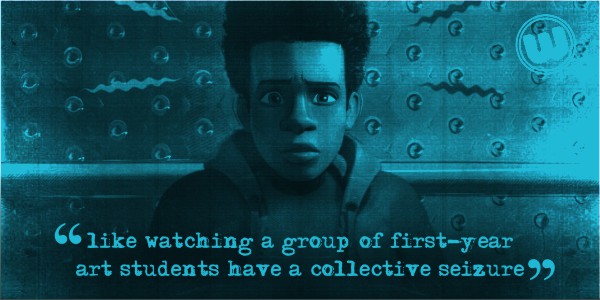
Part of the USP with the animation is that its art style is constantly changing, often within the same scene. Initially it seems to be doing this to reflect the character whose point-of-view we're experiencing, but scenes later in the movie only feature two people yet cycle through half a dozen looks. This precocious presentation results in a film which feels like watching a group of first-year art students have a collective seizure. Elsewhere, earnest and spirited vocal performances are rendered unintelligible by an atrocious sound-mix, poorly placed over intrusive, percussive soundtracking. And since around 60% of the dialogue here is catch-up exposition, Across The Spider-Verse basically has to be enjoyed (...) as a visual experience.


GINA


My real problem is bigger than all of this, though. The following is not limited to Spider-Verse, but certainly includes it. Put simply, multiverses are hands-down the worst thing to have happened to superhero cinema, and that's only getting more problematic. The concept works in print where the possibilities and limitations can be explored at a more careful pace (indeed, with comics it becomes needed as characters are relaunched for evolving audiences after years of literary service; multiverses allow for a soft-reboot), and I've admittedly enjoyed it at certain points previously. But the cinematic iteration of the superhero-multiverse has fast become the equivalent of 3D, a knee-jerk fad to be ordered at an executive level in lieu of creativity. And it's already on its arse.

As well as encouraging filmmakers to overindulge in distracting cameos and needless fan-service, the open-ended structure of parallel realities means that narrative decisions in one movie can be ret-conned, undone or just flat out ignored in the next (yes I'm looking at you, Gamora). When consequence is removed from the storyline then none of it matters on an emotional level, and cinema is supposed to be about empathy. But hey, why mine for a deeper pulse when you can just make the whole thing bigger and louder with more slightly-different versions of the same thing*1? Audiences know by this point not to expect restraint from corporations desperately trying to keep their intellectual property fresh, and the race for More Stuff™ has become just as repetitive as the origins-formula it was trying to supersede.

Even more ironically with Across The Spider-Verse, Miles Morales (and by extension, the whole audience) gets a whole lecture about 'canon events' - concurrences which need to take place across every iteration of the hero's life (here it's the death of Uncle Ben, or equivalent guardian in each timeline), otherwise their path will be too different from all the other spider-heroes and things will become too unpredictable. What this deftly - if unintentionally - illustrates is that Sony are happy to bring in about a hundred different Spider-Mans from all the corners of the property they've got the rights to but are too afraid to do anything different with the character. Spidey's backstory is permanently locked into our pop culture at the same level as Bruce Wayne's, meaning nothing can be changed on a fundamental level without Sony taking a massive gamble in pissing off the legacy fanbase and also not enticing new viewers. In other worse, Spider-Man is precisely the wrong character with which to explore the multiverse. Well done, guys.


DICKIE


Truth be told, when Spider-Man: Across The Spider-Verse slows down and actually concentrates on its character-work, it is pretty superb. But the fact that this only happens twice in over two hours means that the film, on the whole, isn't. A textbook example of Style Over Substance. In all honesty, it feels like I'm done*2.


All I really want out of Spider-Man is a third Andrew Garfield flick to close out his trilogy, and a new set of live-action movies for Miles Morales where possibilities can be broadened. And what are Sony bringing to the table instead? How are they maximising on their end of an historic deal from Marvel currently enjoyed by no other studio? With shit-Dracula and shit-Tarzan. We get the protagonists we deserve.

To make matters worse, I just know that Me in some other part of the multiverse is enjoying the good stuff...


And if I HAD to put a number on it…


*1 "more slightly-differing versions of the same thing" is, to be fair, Marvel's entire cinematic business-model. And I have to admit it's done them well for at least the first ten years of the MCU... [ BACK ]

*2 It's worth noting of course that this is Sony's mess, not that of Marvel Studios. But Marvel's name is on the can and they signed off on this - they do have that veto. Which means they are in a large and instrumental part responsible for it. And even that'd be easier to forgive if Marvel hadn't put out Eternals under their own banner. If they can be slack in what they serve up, they can expect consumers to give few fucks in return... [ BACK ]

DISCLAIMERS:
• ^^^ That's dry, British humour, and most likely sarcasm or facetiousness.
• Yen's blog contains harsh language and even harsher notions of propriety. Reader discretion is advised.
• This is a personal blog. The views and opinions expressed here represent my own thoughts (at the time of writing) and not those of the people, institutions or organisations that I may or may not be related with unless stated explicitly.