
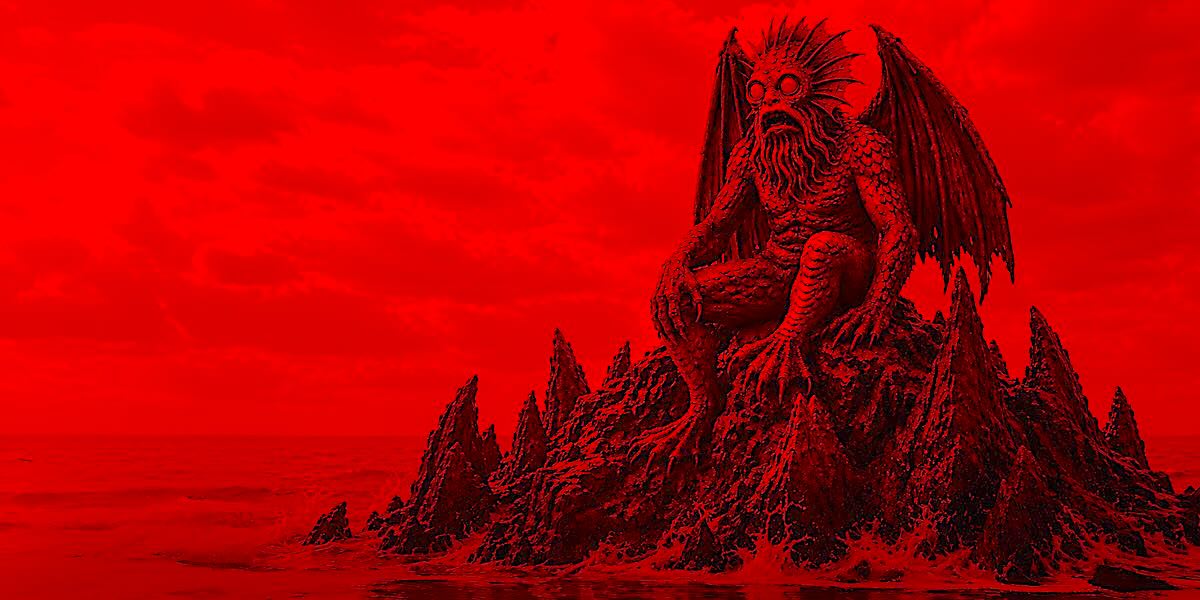
Around half a mile out from the shoreline, the thing stared as Jonathan bobbed in the water. The jagged rock seating the thing was easily large enough to accommodate the creature - arguably uncomfortably. While fitting two onto its surfaces would have been possible, if a squeeze, there were still enough surrounding fangs of granite for the man in the water to grab, that he might have a respite from his efforts to stay afloat. But Jonathan had not grabbed the rock. Whether through fear, embarrassment or just plain confusion, the man in the meticulously engineered wetsuit seemed content for the moment to paddle at a general standstill while he returned the favour and stared at the thing perched - quite casually - on the submarine outcropping.
"What are you doing here?" the thing asked, frowning inquisitively.
Jonathan knew something was being said - and obviously toward him since no one else was present - but he couldn't hear it properly. For one thing, seawater was lapping into his ears, a combination of the ocean's natural waves and his arms repeatedly flapping around his shoulders. For another, the speaker was unclear because of the short, soupy tentacles trailing across the lower half of the its face. The tentacles were not necessarily the weirdest aspect of everything Jonathan was looking at, but he supposed they'd easily make the top five.
The creature was broadly human in size and shape - two arms, two legs, a head - and heavily muscled, but was covered from head to foot in coarse, dark green scales. Quite naked, if standards of common decency could be applied to something so obviously alien, it sat among the stone shards as if on a throne, with occasional ragged strips of seaweed hanging off its own scales, spines and plates. That the creature was of the sea should be evident by this location alone, but it seemed for all the world to be not quite used to being out of it. This, despite the fact that hunched together behind its back were a pair of large, folded, undulating dragon wings. The wings would probably be at the top of the aforementioned weirdness-list. Given the overall bulk of the thing, it seemed unlikely these could be used for flight from a standing position, but Jonathan imagined they would be useful for gliding in a free-fall situation. The thing's chest heaved as it breathed heavily.
"What. Are you. Doing. Here?" it repeated, and Jonathan couldn't tell if the thing was being impatient, condescending or sarcastic. Great. He was being sassed by a sea monster. Worse than that, he realised with sudden clarity that he didn't have a clear answer to this simplest - and most logical - of questions.
The boat? The kayak, yes. He remembered the kayak. He had been out kayaking with Tony. He remembered Tony. That was right, it had been Tony's idea to come out. He wasn't blaming Tony for what happened, but it had been Tony's idea. Jonathan should probably say something. He wasn't sure he was up for the awkwardness of being prompted a third time.
"Tony?" he finally croaked, the sudden combination of breathing, paddling and talking making him realise how tired he already was.
"Tony," the creature replied flatly. "What is 'Tony'?"
"My friend... my friend, Tony", Jonathan rasped, already impatient with the physical and mental demands of holding a conversation in open water.
"And where... is Tony?" the thing inquired, genuinely puzzled.
"Tony's gone," came the reply. No point in lying, but no need to elaborate either. Hell, he was going to have to tell someone sooner or later, he may as well start getting his story straight.
"Gone." A flat affirmation. No judgement there. "...do you mean dead?" Again, a genuine question, albeit one which cut straight to the heart of the matter.
"Yes... yes, he's dead. Look, can I--"
"Why?" the creature interrupted. "Why is he dead?"
Jonathan stared for slightly too many beats.
"He drowned. Tony drowned."
The thing on the rock seemed perplexed by this. Being evidently aquatic however, Jonathan supposed that the idea of drowning seemed as unusual to it as he himself would find death by 'too much air'. The man in the water had nothing more to add, so the silence grew in the gap between them and the sea and the sky.
"Why?" it asked, simply.
A startlingly brilliant question, why indeed? Because humans aren't amphibious? Because Tony couldn't hold his breath long enough to survive? Because water had filled his lungs instead of air? They were all answers to the question. Correct answers. But somehow, Jonathan knew that wasn't what the question - the questioner - meant.
"He... we had an accident... in his boat. We had an accident, there was a wave..."
"Of course there was a wave, this is the ocean."
"No, no I mean a big wave. By the rocks. It took us by surprise."
"And Tony drowned?"
"Well not... yes... I mean, I don't know. It was confusing, you know?"
"I know you didn't drown."
What the hell was this? Jonathan had hardly got his bearings and now he was being, what, cross-examined?
"I tried to help him," the swimmer feebly protested.
The creature leaned forward, bringing its - his? - misshaped head closer to Jonathan's level. "Did you though?"
"Yes, yes! We capsized, both of us! The wave! Tony couldn't get out in time, I couldn't get him out!"
"But you could get yourself out?" The creature seemed intent on getting to the bottom of this.
"Yes, look, I don't know why he couldn't--"
"How did you try to help him?" No reply. "Describe it."
"Look, what the fuck is this? I don't have to explain myself to you!"
"I didn't see you trying to help him."
"What."
"I didn't see you trying to help... Tony, was it? When you capsized. I watched you get out, I watched Tony struggling, then I watched you... watching."
"I..." Jonathan felt like he was in the deep-end in every sense. "If you saw us, why didn't you fucking help? Did you do this? Did you kill Tony?"
"No, I did not kill Tony, er, I don't know your name by the way, I did not kill Tony. The sea did that. You watched it."
Jonathan began to experience what he could only describe as a reality attack, as the gravity and absurdity of the situation settled over him while the sun began to dry his hair with the only warmth he could feel in his entire body.
"What do you want?" Jonathan asked pointedly.
"I want to know why you waited."
"I was waiting for Tony to get out of the fucking kayak. We've both done this in training, we knew how to get out of a flip. I was out. I didn't want to get in the way!"
"Oh," the thing seemed mollified, slightly. "This... 'training'. Did it include rescuing others from 'a flip'? Did it cover helping other people in distress?"
"Well yes, but I don't--"
"And that training," the thing interrupted again, "that instinct, it didn't kick in? You waited, what were you waiting for?"
"...Fuck off! If you watched all this then why didn't you help? Fuck off!!"
"But why would I help? The pair of you seemed to know what you were doing. Especially you. Very capable."
Jonathan was furious by now, and the attention he focused on his ire saw an accusing finger jabbed toward the thing on the rock. The result of this sudden non-paddling was for his head to submerge completely for a few seconds until Jonathan regained his focus, if not his composure.
He swam forward and wrapped his right arm around a protruding pillar, coughing up seawater as he did so. His scaly interlocutor remained quizzically calm, and Jonathan knew the topic of conversation was not yet concluded. Catching his breath he tried the last point again, with what he hoped was more reason.
"Why did you let Tony die, then?"
"No," the thing remained unmoved. "That is what I am asking you to explain."
"I was, I was just waiting, okay? I was trying to get my thoughts straight." While this was not necessarily true in the fullest sense, both parties knew it was the closest Jonathan had come to emotional honesty since he'd swam away from his friend.
"Waiting," the creature mused, "hesitating, stalling some might say. Tell me, er sorry, I don't know your name?"
"It's Jonathan," he grunted, aware that the rock which was keeping him above water was also anchoring him to unforeseen consequences.
"Tell me, 'Jonathan', how long were you going to wait before assisting your friend, Tony? How long did you think it would be before it was too late? How long were you going to keep coming up for air before dropping back under the surface to watch your friend die? Given of course that you did in fact wait longer than all that and then you swam here."
"I... I didn't..." Jonathan then felt what he could only inwardly describe as a wave of rationality watching over him. This was actually fine. It obviously wasn't happening. Logic dictated that Jonathan was not, in all actuality, being interrogated by a know-it-all sea monster, and must instead be suffering from some admittedly vivid trauma response to an incredibly stressful ordeal. Even if the worst came to the worst and he couldn't pass this off as a tragic accident, even if Jonathan found himself explaining his perceived chain of events at Tony's funeral, in a police holding cell or - god forbid - in a courtroom, it wasn't as if the creature from the blue lagoon here was going to walk in and start acting like the counsel for the prosecution. Jonathan wouldn't be mentioning this infuriating bastard to anybody, and the infuriating bastard wouldn't be mentioning any of it. Because it/he wasn't real. And if the creature wasn't real then Jonathan was presumably clinging to an exposed rock and gibbering to himself in the aftermath of a near-death experience; his brain was clearly trying to make sense of everything which had happened, so there was probably no great harm in letting this auto-induced psychodrama run to its natural conclusion, safe in the knowledge that what's said in the ocean stays in the ocean.
"Look," Jonathan began, his voice quickly drifting into a placid finality, "Tony's my business partner. We design wetsuits. Very successfully. The sea is our life! But I knew that if Tony died, his half of the company would get passed over to me. No will, no probate, no fucking about. I'd get it..."
"Right," the sea monster responded, apparently neither surprised nor impressed by this revelation. "And..?"
"And I know Tony hadn't been happy with how things were going. We're making money, shitloads of it, but we'd been arguing about direction and marketing and production and... I know he'd been making plans about leaving. About starting afresh on his own. But with all of the experience - and all the contacts - from our work. And if he left, I'd be fucked, and he knew that."
The thing frowned, "And he could just... leave? Is that allowed?"
"Yeah, it's in the contract from when we set the company up. Either party can leave at any point with a month's notice and demand half of the value of the company on the day of notice, payable within three months. Our solicitor said that wasn't standard but it was me that insisted, and Tony just shrugged and agreed, so it went in."
"And Tony utilised this... this clause?"
"Ha hadn't, but he was going to, I know it. Tony's wife's got a mouth on her, she's been dropping hints to all and sundry."
"So you killed your business partner." Again, there was no moral judgement in the creature's voice, just a methodical setting out of events.
"I didn't fucking kill him, stop saying that, None of this was planned, it just... happened. I didn't kill him, I just... watched him die. That's not the same thing."
"I think legally, you might be on a sticky wicket there..."
"A sticky... you? A sea monster? You're making cricket references? I fucking knew this wasn't real. My imagination needs to raise its game..."
"I haven't always been in the sea Jonathan, I know what cricket is."
This un-nerved the man in the wetsuit more than he thought it should. He'd happily resigned this entire scenario to the racing neurons of brain in crisis mode, but was now having flash-forwards to a murder trial where the primary witness drips saltwater on the courtroom floor and wins the jury round by explaining the intricacies of the LBW rule.
"Listen, if you're so clever then why can't you see that this is what it is? It's very sad, but it's happened now, and I'm sure I'll come to terms with it all with the support of my friends, my family, and the sole ownership of a successful company that I might just end up selling as I slowly process my grief in a conveniently early retirement..."
The thing remained unconvinced. "If you're so clever, why did you swim out to this rock, which was farther away than the shore and in the opposite direction?"
Another brilliantly simple question for which there was - again - no clear answer.
"I was... I wanted to wait. I think. I wanted to get my head around what had happened. There'd be people on the beach, I wasn't ready to start talking about it all before I knew what I should say."
"I noticed."
"Can you fuck off with the sarcasm?"
"Can you start to think? You can barely see the beach from here. You're cold, you're tired, your... 'kayak' was it? That's gone now, and you'll be swimming against the tide. How can you possibly hope to make it back?"
Jonathan had no answer for this. His forward planning had taken reaching dry land for granted.
"And if you do manage to get there," the thing continued, "if your kayak or Tony's kayak - or Tony - have been naturally washed up before you arrive, there are probably going to be questions about what kept you."
The man clinging to the rock was silent now, wishing he could wake up. The creature spoke again, more confidentially.
"There is an alternative..."
Jonathan said nothing, but his grip on the rock relaxed slightly as he looked into the thing's eyes.
"...you wait."
Jonathan held his breath momentarily for more detail, although none was forthcoming. The wordlessness between them was already assuming the shape not of opportunity, but inevitability. This turn of events had always been written into the surfwear designer's future as surely as the final spasm of Tony's water-filled lungs.
"I... wait?"
"You wait."
"What, here? Wait for what?" Jonathan's panic began to rise. "How long can I wait here, you've said yourself I'm exhausted, what am I supposed to do here, how long for, what do you mean 'WAIT'?"
The creature sighed splutteringly, with an air of benign patience. The mood had shifted and a quiet voice in the back of Jonathan's head noted that this might now be the 'good cop' sitting at the desk.
"Yes, you wait here. You wait for things to change. To calm down. To 'blow over'? You wait as long as it takes. Once you make the agreement, the sea will provide."
"Provide?" Jonathan did not understand, although this was hardly surprising. "The fuck do you mean, 'provide'? Stop talking in riddles!"
The scales around the thing's deep green eyes did not flinch.
"Look, you can take your chances swimming back to the shore and whatever questions are gathering for you there, you can take your chances clinging onto this rock and watching the energy that requires reducing your chances of swimming away by the minute, or you can agree to do the wait. Those are your options."
"Why is it 'the' wait, now? Where did the definite article come from?" Jonathan's logical brain had sparked into life with the word 'agreement' and talks of provision. This felt suddenly like a contract was being slid in front of him, although the irony was currently lost on Jonathan that it had been his dogged rigour around contracts which had gotten him into this mess in the first place.
"Do you want prison, do you want to drown or would you rather wait?"
While the man growing colder by the second knew that this was an exaggerated version of his available options, he was also unable to find fault with the spirit of its accuracy.
"Well that's not really a choice, I guess I'll wait." he answered curtly.
"There's always a choice, is that a yes?"
"Yes it's a fucking yes, what is this." A statement, more than a question.
"Excellent, well done you." The thing on the rock seemed to relax slightly. Shoulders softened, its head tilted slightly, but the bubbling voice took on a more procedural tone. "You're to wait here, or hereabouts. You've got a patch of about six or seven nautical miles, depending on tides. If you try to swim further than that, you won't be able to. You'll know when you reach the boundary, but it's difficult to explain, even for me. You can go back to land of course, technically, but by the time you're strong enough to visit, the changes will have started. You need the sea to live, now.
Jonathan had to force his voice above the deafening silence in his brain. "What the fuck are you talking about?"
The creature carried on, reciting an informal list of terms and conditions it had clearly categorised some time ago. "Gills will be first, then your skin will coarsen, the hair will go, then the scales. Your swimming will be stronger from right now. You'll eat fish, shellfish, whatever you can catch or find really, but I hope you like seafood. You'll want to spend the first couple of nights up here on the rock, but it's surprisingly easy to sleep underwater once the gills are functional. Oh, and if you're here longer than around fifty years the wings will start to develop." The appendages on its back gave a joyful shudder. "I still haven't worked out what they're for exactly, but we can't fight biology."
"Hang on, 'we'? Fifty years? Just how long have you been here?"
"Too long, but I'm done now. The troubles that brought me here are long in the past, the witnesses are dead and the case closed unsolved - so I'm told - and I can go back now my replacement is here."
"Repla-- what have you tricked me into?"
"I haven't tricked you into anything, you chose this. Replacement is the release clause. You're to wait until someone comes to take over. The sea... 'changes things'. You'll live longer here. Now, because of these rocks close to the surface of the water, you won't see many people here, but the good news is that you'll really only be noticed if you want to be. Do try and stay out of sight though, the changes are alarming to landers. Imagine what would happen if you saw me walking down your high street."
Jonathan was freezing cold and sweating profusely now. "How... how long am I here for?"
"As long as it takes. Until your replacement arrives. It might only be weeks, days even. Though it could be, er, longer..."
"Wings in fifty years," muttered Jonathan, looking again at the huge folded flaps behind the thing and imagining how resplendent they would look at full span. "You say I can go onto land, though? I could go ashore, I could live there - hide?"
"Be sensible, er Jonathan? Look at me. Where could I have hidden? Unless you find a very understanding fishmonger with a swimming pool in their cellar, how would that even work? Besides, would you rather be trapped there or free here?"
"..."
"Well, relatively free. But yes, you can visit - if you're careful. You'll find you start to seriously dry out if you stay there for longer than, say, the length of an average cricket match. Although they usually take place on sunny afternoons and that obviously exacerbates things."
"So what about you now?" Practical-Jonathan had returned, for how long he did not know. "You're... 'released', but where can you go?"
"I'll start to change back. Not sure how long that will take, but I can begin to feel it already, just like you can."
"Is that what this tingling is?" Jonathan asked, raising a hand gingerly to the side of his neck.
"It is."
"So where will you go?"
"Well, ashore. I don't really have a plan. I have no idea how one goes about financially establishing oneself in this day and age, but I know the cricket club is always on the lookout for staff. I could start there. There isn't a manual for this Jonathan, you just pick up the rules as you go. Think yourself lucky this is me here, my predecessor only spoke French."
"And where is your predecessor?"
"Back safely on land and buried in a picturesque country churchyard after satisfyingly living out the rest of her natural life, I should hope. It was some time ago."
Jonathan had reverted to struggling for the right words, subconsciously aware that time was simultaneously stretching to the unfathomable whilst also growing short. "When will you go?"
"In a moment. I need to leave you to settle in."
"What if I go back before the change? What if I go with you?"
"No, Jonathan. You belong here now..."
And while he detected no malice, sneering or triumph in the sea creature's voice, Jonathan knew this to be unquestioningly true.
"...think of it as a chance to start again," it continued. "Albeit in a while. That'll give you a chance to reflect. To work out who you want to be next time. Even if the world will have changed as well."
"Is this a punishment?" Jonathan asked, sounding very small.
"It's an opportunity. An opportunity not many people get."
"Are there others? Like us? Are there other, what are we, water-people?"
The thing reflected on this for more time than was comfortable. "If there are, I haven't met them. But there are signs that we're not alone. Or weren't always."
"You say I'm to stay in this patch, that I can't go further. What is there, a fence?"
"No, but you'll know. Outside of the boundary the water is different for you. Almost thicker, harmful. You can't swim through it, you'll have to come back."
Jonathan was faintly alarmed by the prospect. "Harmful? Can I be harmed? Can I be killed?"
"It's a bit more complicated than that but yes, harm can come to you. And don't even think about ending it all somehow, your survival instinct is ramping up with the change and it won't let you."
"Actually, I hadn't even thought of--"
"Not yet, but you will in time. That's what you've got now, a lot of time. Right, I need to leave, to work out how I'm going to get ashore unnoticed and where I'm going to lay low while my own changes are happening."
The creature slid down from his stony seat and into the sea with one fluid motion. This made the swimmer cling on to his own fang of rock all the tighter. The buzzing down the sides of his neck was beginning to sting, and it was all Jonathan could do not to scratch.
Bobbing effortlessly on the swell of the ocean, its head and shoulders above the surface, the thing looked undoubtedly like a cheap B-movie costume but was already less 'green'. Still facing the man at the rock, it angled back and started to increase the distance between them.
"Wait, don't go now!" the man cried with mounting panic. "I'm not ready yet, I don't know what to do!"
"I can't stay. And you can't leave," the voice already becoming less distinct as it drifted farther away. "And you only have one thing to do, you wait!"
"But... will you come back? To... to see me?"
"Afraid not Johnson, why on earth would I want to do that?"
"It's Jonathan."
"Okay. Right, goodbye and good luck! You never know, I might see you ashore one day if your wait is only a few years!"
And with that, the creature was gone; slipped beneath the waves between the rock and the faraway beach.
"Years," mumbled Jonathan, to himself, to no-one. "Years?"
With focused difficulty, he heaved his body out of the water to sit on the rock where the thing had been, noticing as he did so the webbing already growing between his fingers. He was suddenly hungry, but didn't know where to begin in rectifying this. What to do next? What to do first?
Jonathan fixed his gaze toward the indistinct specks of people on the beach, and decided the answer would come to him in time.
Ebbscar Times & Gazette, 14 June.
Coastguards were alerted to Ebbscar beach on Sunday when two paddlers are believed to have ran into trouble around the rocks surrounding the south shore. An anonymous call was received at around 11pm by a man saying he had seen the pair in difficulties earlier that day, but had been unable to help. Despite this delayed notification, two empty sea-kayaks were recovered by lifeboat crew members. The body of one man, believed to be in his thirties but without identification, was washed up in the early hours. Police have appealed for witnesses but say the injuries are consistent with drowning.
The whereabouts of the second kayaker are unknown as no further fatalities or rescues have been reported. Ebbscar police are waiting to cross-reference missing persons reports in the days to follow.
Charles Daughtry, supervising manager at Ebbscar lifeboat station, issued a warning to people taking to the sea as the summer begins. "Incidents of this type are not uncommon, tragically, and the rocky area at the isolated south end of Ebbscar beach is particularly treacherous, even for experienced swimmers and paddlers. The majority of the stones there are just under the water-level, and even if you run into difficulties and are seen, we are unable to move rescue craft into the area, My advice to anyone considering swimming or water sports in the sea is simple: this could be the last decision you ever make so stop, consider your options, and wait."
DISCLAIMERS:
• ^^^ That's dry, British humour, and most likely sarcasm or facetiousness.
• Yen's blog contains harsh language and even harsher notions of propriety. Reader discretion is advised.
• Short stories © WorldOfBlackout.co.uk, all entries are fictitious and any resemblance to actual persons, living or dead, or actual events is purely coincidental. Y'know, mostly.
• This is a personal blog. The views and opinions expressed here represent my own thoughts (at the time of writing) and not those of the people, institutions or organisations that I may or may not be related with unless stated explicitly.



 1985 was an iconic year in pop-culture history, bringing us many, many creations that are


