Showing posts with label John Rhys-Davies. Show all posts

Saturday, 8 July 2023

Review: Indiana Jones And The Dial Of Destiny (plot-spoilers)


Indiana Jones
And The Dial Of Destiny
(plot-spoilers)

Cert: 12A / 154 mins / Dir. James Mangold / Featurette

I have to admit that after watching Indiana Jones And The Dial Of Destiny three times, I love the film without it having made a huge jarring impact. Much like Solo, this seems to have slotted perfectly into the continuity with no real controversy (other than That Section In The Third Act which will have the usual suspects clutching at their nostalgic pearls, pining for the narrative realism of a magic box out of the Bible full of ghosts). Indy 5 slides deftly into the water rather than making a splash. And ultimately, this is for the best.

If you haven't seen the movie yet, there's a spoiler-free review here and a second one discussing themes here. Everything following the jump contains heavy plot-spoilers. Watch the film first. Hell, watch the film anyway...
SPOILERS AHEAD!


Still here? Lovely.

So while it fits seamlessly into the narrative and tonal continuity, the fifth entry in the series does feature a couple of glaring departures from its forebears. And the first of these is the very first thing the audience sees after the ads, trailers and a BBFC/MPAA card, with logos for Disney, Paramount and Lucasfilm. In that order. What this means is that there's no cross-fade from the Paramount mountain-ident into the film's opening scene. Which, frankly, people would expect...


Given that Disney are controlling production and distribution of the property now, it's unclear what part Paramount are playing in Indy 5. But you'd be forgiven for thinking that if the company is important enough to credit with full-screen branding, tradition alone would go so far as transforming the mountain into, perhaps, a pile of spent shell-casings in war-torn 1944?

It's not a huge deal, but this is a real shame and the only thing that's definitively missing (read: fixable) in the whole film.

Dial Of Destiny's other departure from the series is a little more complex...


NAILED


At the end of Raiders, the Ark Of The Covenant is closed and then nailed into a crate, to be kept safely out of harm's way (or at least until the US Government find a way to weaponise it, presumably). Similarly, Temple Of Doom sees the Sankara Stones returned to their people, and Last Crusade has the Holy Grail lost into the earth. Even Crystal Skull closes with the titular bonce being reunited with its owner and skipping off through the space between the spaces. Indy doesn't get to keep these McGuffins like Mr Benn sidling back to Festive Road with a memento. That's very much the point of the movies: archaeology is about acquiring and sharing knowledge rather than just hoarding treasure*1.

But as Dial Of Destiny winds down, a senior Henry Jones Jr wakes in his apartment to the ticking of a clock and a slow camera-pan (a callback to earlier in the film and a gorgeous nod to Back To The Future) with Archimedes' Antikythera sitting on the desk right next to him. Helena's left it there. It comes as no real surprise by this point that she's has decided against selling it off, but the dial is still in Indy's possession. Whether it can be used is up for discussion (and we're about to discuss it), but this is not an accident.


TUDORED


Shortly after, there's a lingering moment in the final scene where Indy and Marion reconnect in his kitchenette as the audience holds its breath for Mutt Williams strolling in through the door, to give a full family reunion. In this event, we would instinctively know that Helena had made an unseen, dial-assisted detour on their way back from the beach at Syracuse, managing to drop in on Mutt to have a quiet word about his upcoming enlistment in the US Army. The conversation between Indy and Helena in the second act where he laments his son's death certainly sets up this eventuality.

This doesn't happen, of course. Helena has already demonstrated (and with far greater clarity than her godfather) that she's got a firm grip on not changing the course of history. She's very eager to avoid inadvertently destroying the present they're trying to get back to*2, and so it appears she's brought everyone home without further chronological adjustment. Which is probably for the best.


SEABROOKED


This also results in a far more poignant ending, as Indy and Marion are rebuilding their relationship again (okay, again again) with wisdom, hope and reflection, rather than having their pain magicked away for a fluffy ending which must have been incredibly tempting in the writers' room.

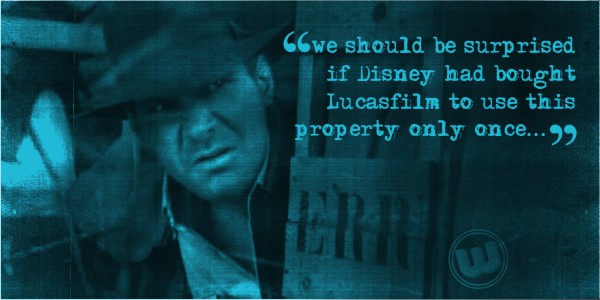
Bur crucially - and for the first time, cinematically - Indy still has the item he's spent the last two and a half hours chasing. This movie may be marketed as the final cinematic outing for Jonsey, but we should be surprised if Disney had bought Lucasfilm to use this particular property only once. And as the final frames in the streets of New York show us, the man is incapable of hanging up his hat for good. Just what form future (or past) adventures will take is unclear, but Helena and the four screenwriters left the dial with Indy for a reason.


SPACE RAIDERED


Then again, crammed into the third-act catchup exposition is the idea that the Antikythera is 'a forced deck'. That it only ever calculated a portal to travel back to Syracuse in 213 BC and that was its sole purpose. Because if Archimedes' time-fissures are happening anyway and the dial is merely a signpost, why has nobody accidentally discovered one without it? Do these rifts always occur in the air and during a storm, so you'd need to be mad to fly into one? And it still doesn't explain why, by 1969, the world hasn't had visitors or explorers from the future. Or maybe it has? The dial isn't a time-machine per se, but it demonstrably makes time travel possible.

Basil Shaw's decryption notes only show us limited references to to/from dates, and even this is vague since he hadn't figured it all out. So do we assume that Archimedes managed to reverse-calculate 1969's entry-point, knowing that the journey must work because he'd seen the result of it in his own past? That fits with the time travel coil-theory and would make this a One And Done item. In which case - its power spent - the Dial Of Destiny itself fits neatly among its enchanted peers. Not quite so different, after all. Indy can finally get one of his artefacts safely into a museum.


Unless he holds on to it again, of course. Just to remind him...



And if I HAD to put a number on it…


*1 A point literally spelled out by John Hurt's Harold Oxley in the fourth instalment, much derided and yet encapsulating the series perfectly. That movie is underrated. I digress. [ BACK ]

*2 Let's not get into the fact that Dial Of Destiny does leave a Syracuse coastline whose archaeological remains apparently contain a two thousand year-old HE-111 bomber plane, along with the non-perishable badges, buttons and firearms of all the nazis who fell out of it. Although because of the film's fixed-approach to time travel, those items were always there anyway. So fair play I suppose. Still, it's odd that in 1969 nobody has found these. Then again, Antonio Banderas' diving crew finally manage to be the ones to stumble across a sunken galleon full of ancient gold that everyone in the local fishing community knew about which is in water so shallow it can conceivably be seen from the surface on a sunny day, so... [ BACK ]


DISCLAIMERS:
• ^^^ That's dry, British humour, and most likely sarcasm or facetiousness.
• Yen's blog contains harsh language and even harsher notions of propriety. Reader discretion is advised.
• This is a personal blog. The views and opinions expressed here represent my own thoughts (at the time of writing) and not those of the people, institutions or organisations that I may or may not be related with unless stated explicitly.

Tuesday, 4 July 2023

Review: Indiana Jones And The Dial Of Destiny (thematic-spoilers)


Indiana Jones
And The Dial Of Destiny
(thematic-spoilers)

Cert: 12A / 154 mins / Dir. James Mangold / Trailer

Go big or go home, they say. Well, I'd already watched Indiana Jones And The Dial Of Destiny in my home town, so next up a trip to the IMAX in London's Leicester Square was in order; just to give that de-ageing some real scrutiny.

On a surface-level, not much has changed on a second-pass. That said, the film seems to film flow more evenly and pacing-dip of the second act isn't as evident. Other minor issues are detailed in the first review and those still stand*1. But just like last time, they really don't derail enjoyment of what is A Rollicking Action Movie™.

What's most impressive about Indy 5 is how neatly it fits into the canon, structurally speaking. With the natural exception of the actual modus operandi (and more on that in the next review), everything that occurs here feels in-keeping with what's gone before. What follows after the jump contains thematic spoilers; there's nothing to ruin the story, but it'll tell you how that story is handled. Read on with caution...

SPOILERS AHEAD!

So as much as this is firmly part of the cinematic family there are, however, significant differences in the execution this time around. As noted in the previous review, Dial Of Destiny features plenty of adrenaline and excitement, but it never quite manages to recapture the swashbuckling feel of earlier entries; of gravity being Indy's most persistent foe. This is to be expected given that our leading man is 80 years old and has already broken bones revisiting one of his old characters, but it's also worth noting that the actual threat to Jones is of a far more conscious nature, here.


DANGER


Throughout the first trilogy, Indy faced danger as much from his environment as his antagonists. It's why those films can be an adventure even if he's the only person on-screen. Rolling boulders, runaway minecarts, treasure-guarding traps, spears and blades, or even just a set of stone stairs receding into the walls of a Mayan temple. There were plenty of obstacles for our hero to overcome before he came face to face with the bad guy. But this level of old fashioned derring-do is almost entirely absent from Dial Of Destiny.

Indy may not be swinging from ropes in this movie, but the man is still running for his life. The difference is that a boulder doesn't keep coming back as its grudge builds. The entire film is effectively one long chase-sequence (be it on land, sea or air), but the recurring and persistent mortal threat Indy really has to contend with is Men With Guns*2. Specifically, nazis with guns. Part of this, of course, is a throwback to the Raiders and Last Crusade, set around the era of the Second World War, and it's a decided choice by Lucasfilm/Disney to revisit a more clearly definable 'enemy' (because while the Russians in Crystal Skull where definitely Baddies™, the Cold War was a lot more nebulous as a concept, plus those guys didn't have a highly recognisable symbol on their uniforms).

While Indy's certainly in dangerous situations here, retrieving The Treasure itself is surprisingly straightforward compared to previous trials.


CONDOR


So on a screenwriting-level, is narrowing the danger down to people rather than place a reflection of the film's time-period, where even the romanticism of Hollywood had given way to a far more blunt realism? By 1969, the war in Vietnam was halfway through its second decade, Nixon had just taken his seat in the White House and the country was reeling from the assassination of Martin Luther King Jr. Optimism was struggling to find a foothold on Earth, even if the Moon was offering a glimmer of progress. The dream factories of California were in an emotional slump which wouldn't turn around until the arrival of Star Wars in 1977*3.

That Doctor Jones' battle with his nemesis here takes on an altogether more mechanical form is a testament to its setting, and it's probably no coincidence that this chimes fairly closely with our own times as well. The third act becomes truly and gloriously fantastical of course, but even then Indy is dropped (literally) into another warzone, where projectiles fly without the aid of gunpowder but are no less deadly for that. There's no time to catch his breath, eventually Indy just has to turn and fight.

With this in mind then, Dial Of Destiny was never going to be - on a fundamental level - 'the same' as earlier entries into the cinematic canon. Allowances have to be made (and have been) for the story that's being told and for what the audience is switching-off from when they sit down in front of it. It's about the insidious determination of fanaticism. It's about the nazis returning. And it's about not giving that an inch.


OLD HOLBORN


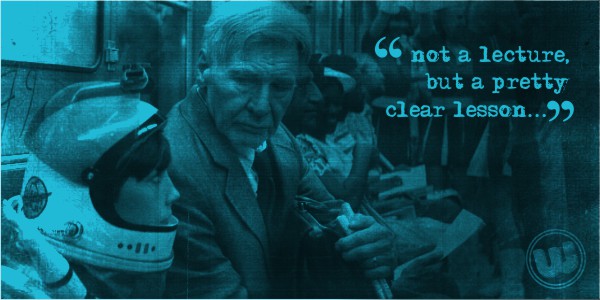
There's no both-siding here, no first-act charismatic charm to the evil. And nor should there be. Jürgen Voller is shown to be thoroughly repellent, and more credit to the writers and Mads Mikkelsen for making this so. Dial of Destiny isn't a lecture, but it's a pretty clear lesson about not letting down our guard, and in this respect it's a great companion piece for Spider-Man: Far From Home. Woke? Yes, and necessarily so.

That's not to say there's no place for rope-swinging, chasm-leaping, dart-dodging adventure in 2023. There absolutely is and god knows it's certainly needed, but at what point does escapism become distraction? There's already plenty of lighter entertainment showing in the other screens, and most of it carrying messages that are far more vapid.


I'm not saying Indiana Jones And The Dial Of Destiny is deep - it's not - but the film does have an acute awareness of what and why it's meant to be. Namely, tinkety-tonk old fruit, and down with the nazis...


And if I HAD to put a number on it…


*1 To reiterate though, the digital de-ageing of Harrison Ford is wildly inconsistent - at times passable, at times horrifying - and watching the film on an IMAX screen only makes those flaws clearer, unfortunately. [ BACK ]

*2 I'd like to say men and women with guns, but do bear in mind that Shaunette Reneé WIlson's chronically-underused CIA Agent Mason is the only one who's trying to prevent her colleagues from shooting everyone in sight. [ BACK ]

*3 That's only due to happen eight years after what we see in this movie. Assuming Indy still lives to the age of his TV-persona, do we think this is a universe where he might sit down and watch Han Solo in Star Wars? After all, one of the best things about Dial Of Destiny is the unspoken reunion between Solo and one of the Millennium Falcon's droid-brains. [ BACK ]

DISCLAIMERS:
• ^^^ That's dry, British humour, and most likely sarcasm or facetiousness.
• Yen's blog contains harsh language and even harsher notions of propriety. Reader discretion is advised.
• This is a personal blog. The views and opinions expressed here represent my own thoughts (at the time of writing) and not those of the people, institutions or organisations that I may or may not be related with unless stated explicitly.

Thursday, 29 June 2023

Review: Indiana Jones And The Dial Of Destiny (spoiler-free)


Indiana Jones
And The Dial Of Destiny
(spoiler-free)

Cert: 12A / 154 mins / Dir. James Mangold / Trailer

Short and sweet then, you don't want to be reading all about Indiana Jones And The Dial Of Destiny at this point, you just want to know if it's worth the journey to the cinema. Your humble correspondent is delighted (albeit predictably so) to report that Indiana Jones And The Dial Of Destiny is worth the journey to the cinema.

We open - as is traditional - with a pre-main-movie adventure, set in the last days of the Second World War. Henry Jones (Harrison Ford) and fellow archaeologist Basil Shaw (Toby Jones) are on the trail of an historical artefact coveted by the nazis (no change there) when they inadvertently stumble over another, potentially far more powerful, one: Achimedes' Antikythera. And so, Indy makes another enemy-for-life in deranged scientist Jürgen Voller (Mads Mikkelsen). Fast forward to 1969, and Doctor Jones is about to retire from professorship in New York when his yearned-for release is interrupted by the arrival of his estranged goddaughter Helena (Phoebe Waller Bridge) and - not unconnectedly - Dr Jürgen Voller. Because you can't keep a good Macguffin down, and another adventure is about to begin...


GRAVITY


Director James Mangold has channeled the ochre colour-palette and emotional gravity of his spin with Logan for this fifth cinematic entry to the series. Considering how reluctant so many of the characters are to get actively involved in life-threatening high jinks, the whole thing zips along (mostly) at an exhilarating pace. The story is linear enough to get by without being overwhelmed by exposition, but also facilitates the introduction of new characters as well as a handful of old favourites. Bathed in a Kodak-glow, cinematographer Phedon Papamichael channels warm vintage tones long before we're whisked off to the Mediterranean, while the three-strong editing team balance the relentless chase sequences with conveying the weight on Indy's shoulders. Meanwhile, John Williams is on outstanding form with a score which fits seamlessly into the canon and channels some of his best work from the Star Wars prequel-era.

It's not all plain-sailing, of course. The film is longer than it needs to be (because we're never more than five minutes away from one of those chase-sequences), there's a definite sag in the second-act, and the mechanics of the crucial central premise itself feel under-explained; not in a mysterious way, more that the writers couldn't agree on how it was actually going to work and so It Just Does. The recovery of each prized antiquity leans toward a straightforward checklist, and the antagonists are always a conveniently-assured two paces behind, despite rarely showing their working-out. All of the cast here are competent and great fun to watch, but swathes of them carry a very 21st century sensibility which feels out of place for 1969. And the worst offender here, unfortunately, is Phoebe Waller-Bridge (who is otherwise excellent as usual). Oh, and that CGI on the wartime-Indy is still far from perfect. It's way better than the Rogue One debacle, but once again the images that look amazing as stills fall down when they're moving, and our hero's face always feels like it's lit separately and from a different angle. The overall effect is of a video-game cutscene; something which really looks like Harrison Ford but is definitely not him on a subconscious level.


INTERSTELLAR


The best trick the movie pulls, though, is that ultimately none of that matters. The love and attention to detail which have gone into this more than make up for its shortcomings in a year where mediocrity seems encouraged. And extra points should be awarded for a bittersweet ending which doesn't take the glaringly obvious feel-good route many other films would have (more on that in the upcoming spoiler-review).


Indiana Jones And The Dial Of Destiny never quite matches the rip-roaring highs of the first three movies (and frankly, no one expected that to be the case), but the energy, enthusiasm and sincerity are more than enough for long-haul Indy fans to love.

Go. Go to the cinema.
Now.


And if I HAD to put a number on it…


DISCLAIMERS:
• ^^^ That's dry, British humour, and most likely sarcasm or facetiousness.
• Yen's blog contains harsh language and even harsher notions of propriety. Reader discretion is advised.
• This is a personal blog. The views and opinions expressed here represent my own thoughts (at the time of writing) and not those of the people, institutions or organisations that I may or may not be related with unless stated explicitly.