Showing posts with label Steven Spielberg. Show all posts

Saturday, 2 September 2023

Review: Jurassic Park (30th Anniversary)


Jurassic Park
Cert: 12A / 126 mins / Dir. Steven Spielberg / Trailer

There's something about the nonchalantly galling nostalgia of anniversary screenings for movies you saw in the first time around and technically weren't even a child then that nobody warns you about. The last time I watched Jurassic Park in a cinema (which I swear blind wasn't that long ago) it was old enough to buy a pint, yet now the fossilised mosquitos and interactive CD-ROMs weren't the only thing in that room feeling ancient...

And truth be told, there's not much to say all these years down the line about a movie that's still perfect. John Williams' score is still majestic, Bob Peck's focused intensity is still magnetic, the jokes still get audible laughs and Gary Rydstrom's sound-design for the Tyrannosaur is still one of the most hair-raising things I've ever heard. The digital and practical effects work is astounding of course, but above all else it's the human reactions to the dinosaurs that really sell this. And not just Ariana Richards' and Joseph Mazzello's terrified scrambling as Lex and Tim, but the sense of awe and jaw-dropped wonder from Laura Dern, Sam Neill*1 and Jeff Goldblum. Meeting the Brachiosaur herds was magical in 1993 and it's magical now. I genuinely still wipe away a tear in that moment. Like I said, perfect.

It's also still horribly relevant. This romp of dinosaurs gone rogue (or more properly, dinosaurs behaving completely naturally) is in its essence a timeless cautionary tale, glossed over with unapologetically self-aware marketing. It's no accident that a parable about the dangers of unfettered capitalism has its own logo'd merchandise literally appearing within the film as part of the problem. The story is blunt in its message (classic Michael Crichton), but hugely accessible in its scope (classic Steven Spielberg). One of the most interesting aspects is how the director actually leaves the audience feeling slightly sorry for park-visionary John Hammond, the gently-spoken entrepreneur whose myopic hubris causes widespread destruction, mutilation and death, while at the same time we're invited laugh at the demise of lawyer Donald Gennaro as he cowers on a suddenly exposed toilet. Remember, he's one of the few professionals who hadn't been bribed or cajoled onto the island to sign-off the project, and was merely working to represent the interests of investors who had well-founded concerns about the park's demonstrably appalling safety procedures. In the first act of Jurassic Park, Gennaro is actually the good guy. This flips of course once he gets dollar-signs in his eyes and is subsequently punished by the narrative as a result. Like I said, blunt.


But perhaps most pleasingly, in the end there's no deus ex machina which gets our protagonists out of trouble. They just have to pick their battles, make it through the night and survive the ordeal*2. Jurassic Park is about teamwork and tenacity in the face of adversity. About weathering the storm and about leaving no one behind. Yeah, even if they caused all this shit in the first place. Like I said, horribly relevant.



And if I HAD to put a number on it…


*1 And for the record, Dr Alan Grant is never more than three lines of dialogue away from Sam Neill's native Kiki accent kicking back into gear, and I don't even mind. That's how much I love Jurassic Park. [ BACK ]

*2 I do hope the poorly Triceratops was okay in the end. The plot-thread of the illness doesn't get resolved in the film (it's explained more in the novel but sill not 'fixed' iirc), and I'm not cool with the thought of her lying there incapacitated while the T-rex goes rampaging about the island willy-nilly... [ BACK ]

DISCLAIMERS:
• ^^^ That's dry, British humour, and most likely sarcasm or facetiousness.
• Yen's blog contains harsh language and even harsher notions of propriety. Reader discretion is advised.
• This is a personal blog. The views and opinions expressed here represent my own thoughts (at the time of writing) and not those of the people, institutions or organisations that I may or may not be related with unless stated explicitly.

Sunday, 29 January 2023

Review: The Fabelmans


The Fabelmans (spoilers. ish.)
Cert: 12A / 151 mins / Dir. Steven Spielberg / Trailer

Cinema is magic, and its creators are magicians. Steven Spielberg, for example, can make 2½ hours of quasi-biographical coming of age story feel like five*1. It's not that The Fabelmans drags, just that it does not let up.

Beginning in 1952, this is the tale of the young Sam Fabelman (Gabriel LaBelle / Mateo Zoryan) spanning twelve years of his life (hence the two actors) as his parents Burt (Paul Dano) and Mitzi (Michelle Williams) move to several cities across the US in an upwardly mobile spiral. Already fascinated by movies and process of film-making, this is massively disruptive for Sammy and his sisters (Keeley Karsten / Alina Brace, Julia Butters / Birdie Borria), and the movie tracks the weaving course of their lives and Sam's growth and self-discovery.


KID


And it's fine. The story about a Jewish kid learning about the world and finding purpose in life through the art of translating ideas to celluloid is superb. The twee, mawkish, shrieking and overbearing soap opera which happens all around it, far less so. The two are intrinsically intertwined of course, and the film itself is named after the family unit, not the protagonist. My problem (and this is very much my problem as a viewer, not the film's as a creation) is that it's so sincere, all of the time. Your mileage will vary but most of the humour feels forced and most of the angst feels gleefully wallowing. I love Michelle Williams as much as anyone, but she's on Ten™ from the very first scene, a high-maintenance character in a film of domestic histrionics and it is draining to sit through.

The subplot with Seth Rogen's 'Uncle' Bennie is so telegraphed and then spelled-out as to be physically painful, and it's a shame since his character initially feels like a breath of fresh air - albeit a breath which is necessitated by the fug of Mitzi's constant drama. Paul Dano puts in a reliable performance as the family patriarch who only understands Science™, but the role demands relatively little of him as a performer, a charge which can be levelled at most of the supporting parts here.


NORTHERN


The real ray of sunlight comes in the form of Judd Hirsch as 'actual Uncle' Boris, the cranky, scrunch-faced black sheep of the family who arrives gibbering in distorted syntax to everyone's consternation. He's also the only character here who effortlessly sees through the bullshit and understands Sam's attraction to the arts - better at that point than Sam does - and the sacrifices which may be required to attain greatness. He is this story's Yoda, and is in it for nowhere near long enough.

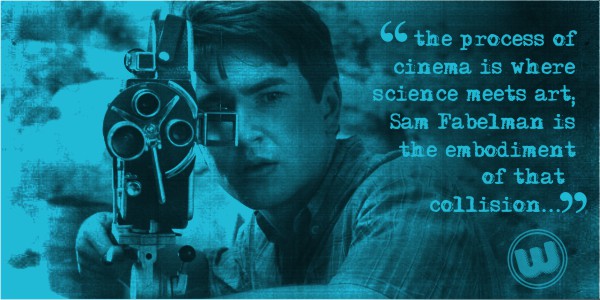
When we see Sam making films - the actual physical process of coordinating, directing and shooting - The Fabelmans is great. Unfortunately, this accounts for less than a third of the film's run-time. But this is the lesson of course: we can't dedicate ourselves completely to creativity because the admin of life will always get in the way to some degree. And we either learn to live with that, or we give up creating. The process of cinema is where science meets art, and Sam Fabelman and his story are the embodiment of that collision.


Steven Spielberg has many weapons in his armoury. Understatement is not one of them. The Fabelmans almost comes over as something that the director needed to get off his chest, rather than an insight-unveiling introspective.

A self-indulgent missive of this intensity is certainly forgivable from a director as accomplished as this, but probably only as a swan-song. Steven, however, seems far from done...*2


And if I HAD to put a number on it…


*1 And while it's nice of the man himself to sit in what looks like a generic hotel suite somewhere and record a special pre-film message to audiences who have come out to cinemas to watch his latest epic, it feels notably strange that one of the world's greatest film directors has recorded one of the least convincing thank-you messages ever.[ BACK ]

*2 Which I'm not complaining about, by the way. I certainly don't get on with all of Spielberg's work, but the man's been responsible for enough absolute bangers for me to appreciate what he's capable of. Okay, very few of those bangers have been made this century, but hey... [ BACK ]

DISCLAIMERS:
• ^^^ That's dry, British humour, and most likely sarcasm or facetiousness.
• Yen's blog contains harsh language and even harsher notions of propriety. Reader discretion is advised.
• This is a personal blog. The views and opinions expressed here represent my own thoughts (at the time of writing) and not those of the people, institutions or organisations that I may or may not be related with unless stated explicitly.

Thursday, 22 March 2018

Review: Ready Player One


Ready Player One (3D)
Cert: 12A / 140 mins / Dir. Steven Spielberg / Trailer


Ah, the evenings are getting lighter and Steven Spielberg returns as only he can, with a sci-fi adaptation that will completely reinforce audiences' existing opinions on Ernie Cline's source-novel. People who loved reading Ready Player One will get a lot out of this cinematic rendering, while those who were 'less enthusiastic' will see their list of gripes brought to three-dimensional life. Anyone who hasn't read the book will see both the pros and cons which others have discussed, and probably develop a headache around twenty minutes in which lasts until they go to bed. Feel free to guess at this point the category into which your humble correspondent falls...

So our digital hero's journey begins in 2045 and follows Wade Watts (Tye Sheridan), aka Parzival in the virtual reality/internet hybrid known as The Oasis. Wade spends his free time hunting for Easter eggs throughout the virtual realm in the hope of winning the grand prize - ownership of the system and half a trillion dollars. Teaming up with fellow adventurer Samantha/Art3mis (Olivia Cooke), the pair form a team to liberate The Oasis from the hands of Nolan Sorrento (Ben Mendelsohn)'s megacorporation IOI, who want to take final control of the game and its participants.

First things first, I didn't dislike this. I feel that's worth pointing out because of everything I'm about to say. Ready Player One certainly can't be faulted for its ambition. The execution however, is another matter. In a very real sense, this is a CGI-animated piece with live-action segments, and the visual effects work and sound design is outstanding all round. That said, it'd be even better if the whole thing would slow down long enough to get a proper look at anything. Even with its rare quiet moments, there's barely a static camera throughout the entire movie.

And it's this frenetic pace which bleeds over into a hastily presented plot setup, as we race from one set-piece to the next, with unintroduced characters reciting industrial amounts of exposition (all the more notable, in a film which basically makes no sense*1). With a runtime of over two hours, Ready Player One is like being waterboarded with Sunny Delight while Peter Kay repeatedly bellows "d'you remember the 80s?"*2 over a blaring synth-rock jukebox soundtrack…

Because the centrepiece of the buzz and attraction around Cline's work, for better or worse, is its array of pop-culture references. While the film is clearly delighted with the Warner Bros, Ambin, Capcom and 20th Century Fox properties its been able to secure the rights to, others are notable by their absence. Marvel's superheroes can be name-checked, but we only see DC's. This could well be for the same mouse-related reason that the definitive movie about nostalgia and iconic pop culture doesn't have any Disney characters in its arsenal, and while the script mentions "padawan" and "Millennium Falcon", visual Star Wars references are buried deep within the noise*3.

It's entirely possible for a movie to depict a chaotic environment without itself devolving into chaos. Ready Player One hasn't nailed it, though. That's not to say that the action is particularly convoluted or difficult to follow - Cline's story structure itself is truly worthy of the Spielberg treatment. But the white-noise approach to the production values, coupled with dubious casting choices*4 threatens to make the whole thing feel like... well, like watching someone else play a game for two-and-a-bit hours. I'm genuinely sad to say that I was pulled out of the film at several points by the thought '...am I supposed to be caring what happens to these characters?'. Which is unheard of for a Steven Spielberg flick.

Ready Player One isn't nostalgia, it's a fan-service simulation of it - which is the point, after all. The metaphors about online and gaming communities were always going to feel heavy-handed in a story about online and gaming communities, but the final product also lacks that sense of eye-widening wonder which Spielberg has effectively written the book on, over the last four decades. All I got here was a sense of overload.

There's a point in the first act where Parzival stands at a mirror and asks "...does it look like I'm trying too hard?". This is a crystallisation of the whole film.


So, what sort of thing is it similar to?
It feels like a cop-out to say Tron and The Matrix, but Tron and The Matrix...


Is it worth paying cinema-prices to see?
If you watch it at all, the cinema is the place to do so, yes.


Is it worth hunting out on DVD, Blu-ray or streaming, though?
This is so visually dense that it lends itself to rewatching, and in the highest definition possible.


Is this the best work of the cast or director?
Okay, let's not go mad here.


Will we disagree about this film in a pub?
Nope.


Is there a Wilhelm Scream in it?
Yes. It's in the first five minutes and it's pitched down an octave or so.


Yeah but what's the Star Wars connection?
Level 1: Orson Krennic, Unkar Plutt and Ansiv Garmuth are in this.


And if I HAD to put a number on it…


*1 Mendelsohn's evil corporate overlord shtick feels for all the world like Agent Smith in The Matrix, if Agent Smith couldn't actually control anything in The Matrix he's meant to be in charge of so just ran around after Neo shaking his fist. [ BACK ]

*2 Although at one point when Parzival rips out a Saturday Night Fever sequence in a club, Art3mis responds with "woah, old school!. Even though that's only six years older than all the 1983 references the film is so in love with, which at the time of the story taking place is sixty years previously anyway. Like nostalgia began in 1980 and ended in 1995. [ BACK ]

*3 That said, Parzival's belt/holster looks an awful lot like Han Solo's ANH one, but with the Thundercats sigil etched into the buckle-plate. If only the rest of the film was this subtle with its referencing. [ BACK ]

*4 Full disclosure, I can't warm to Tye Sheridan. I'm sure he's an accomplished actor, I just haven't yet seen him in anything where I've enjoyed the performance. In Ready Player One, the live-action Wade manages to be more unlikeable than his outlandish digital alter-ego, Parzival. Which is quite something. Simon Pegg brings his own unique brand of insincerity to the film, plus Mark Rylance is overacting. Again. These are strange days when Olivia 'mahogany' Cooke manages to be one of the best performers in a movie. [ BACK ]


DISCLAIMERS:
• ^^^ That's dry, British humour, and most likely sarcasm or facetiousness.
• Yen's blog contains harsh language and even harsher notions of propriety. Reader discretion is advised.
• This is a personal blog. The views and opinions expressed here represent my own thoughts (at the time of writing) and not those of the people, institutions or organisations that I may or may not be related with unless stated explicitly.

Saturday, 27 January 2018

Review: The Post


The Post
Cert: 12A / 116 mins / Dir. Steven Spielberg / Trailer


Well, we're still in January so Worthy Chin-Stroke Film Season continues with Steven Spielberg's telling of the Pentagon Papers affair of 1971, in which the US government tried to stop the press (chiefly the New York Times and titular Washington Post) from publishing documents claiming they'd lied to the public over the Vietnam War. A srs-stry requires a srs-cst of course, and Meryl Streep and Tom Hanks have been drafted in to do the heavy lifting. Cue two hours of polyester shirts*1, hand-held camerawork and actors talking over each other to give the impression of fast-paced chaos.

And it's fine.

While I appreciated the overall exposition as someone who wasn't alive at the time of the film's events, the script feels a little over-written in some places (yet wilfully obfuscating in others). And although the visuals of the movie are undeniably on-point for the 1971 setting, and cinematographer Janusz Kaminski captures the documentary-feel of the storytelling, this always felt like a modern-day facsimile of the era, rather than an immersive environment. Although I suspect Linus Sandgren's outstanding work in Battle Of The Sexes has rather spoiled it for everyone else, now (speaking of such matters, dear lord Tom Hanks does a lot of manspreading in this movie).

Another of the director's regular collaborators, John Williams brings a score which is great at the pomp and urgency of the proceedings, but occasionally becomes too sweeping and lyrical for the story it's attached to. Although the same can be said of Spielberg's direction, to be fair.

But the film tells its story with the conviction of a committed cast and crew; I can't fault it for that. There were, however, two main stumbling blocks preventing me from enjoying it more...

Firstly, I couldn't forget that I was watching Meryl Streep and Tom Hanks, not newspaper proprietor Katharine Graham and editor Ben Bradlee. This is isn't necessarily a new problem of mine with Mr Hanks, but Streep usually manages to disappear into her roles, becoming the character completely. And it's not like she's has nothing to work with here, I was just always aware that I was watching an actor, acting. The problem could well be the star-wattage of the cast - Streep or Hanks on their own have more chance of blending into a scene with their supporting players, but together their light just shines more brightly than any film they're part of.

Secondly, I couldn't forget that the while the presented issues concerning press-freedom may well be very prescient in 2018, it's also a far more complex situation now. Freedom of speech is more than a right, it's a responsibility, and the needle sways both ways in 2018. Now admittedly, that's not what The Post sets out to cover, but it was in my mind throughout. And while I also don't particularly like dragging my own politics into what is supposed to be a casual movie-review blog*2, the film's stars took what can only be described The Bare Minimum Amount Of Prodding to wade into current events while promoting the film. All The Politics isn't something you can really brush aside with this movie as that's precisely what it's about.

So, all in all, The Post is basically fine. I found the story itself interesting, but got little more out of the feature than that. A well-assembled documentary would have been just as good from where I was sitting. Your mileage will vary.

Oh, and we get the fourth Insidious movie in 2.35:1 aspect-ratio, but Steven Spielberg's delivers his awards-nudger 'tv-sized' 1.85:1? Have a word, mate…


So, what sort of thing is it similar to?
The Fifth Estate, Spotlight.


Is it worth paying cinema-prices to see?
Well, pretty much everyone else seems to think so.


Is it worth hunting out on DVD, Blu-ray or streaming, though?
Unless your thing is historical politics or Spielberg, this is a rent/stream.


Is this the best work of the cast or director?
It's not.


Will we disagree about this film in a pub?
I wouldn't think so.


Is there a Wilhelm Scream in it?
Hang on, you've put a Vietnam jungle battle-scene at the beginning of the film and there's still no Wilhelm? Insane.


Yeah but what's the Star Wars connection?
Level 1: As noted, this film's got the one and only John Williams on score-duty…


And if I HAD to put a number on it…


*1 The period-detail of sets and wardrobe is reliable enough in all the right places, although at one point Hanks' wife (played by Sarah Paulson) lifts a framed photo from the side cabinet in their lounge, showing the couple reclining on a sofa with John and Jackie Kennedy. "That picture makes me sad", she says, to which I inaudibly replied "Yeah me too, love. It looks like it was put together by the intern using MS Paint. Why can't film production companies employ dececent graphic artists to put together faked historical photos in movies? They're the one thing other than the cast that the camera always lingers on, put some bloody effort in." [ BACK ]

*2 Although y'know, as I've linked to articles at the New Statesman and the Guardian, you can probably guess which side of the fence my own deckchair is on. It's not that I'm not on the side of The Post, I absolutely am. I'm just more worried that The Post isn't always on the side of The Post, and hasn't noticed. [ BACK ]

DISCLAIMERS:
• ^^^ That's dry, British humour, and most likely sarcasm or facetiousness.
• Yen's blog contains harsh language and even harsher notions of propriety. Reader discretion is advised.
• This is a personal blog. The views and opinions expressed here represent my own thoughts (at the time of writing) and not those of the people, institutions or organisations that I may or may not be related with unless stated explicitly.

Monday, 30 January 2017

Adaptation: Minority Report


The A-word.
It's the bane of cinephiles, everywhere.

That book you love; the comic you remember; the show you used to watch; the game you lost an entire summer playing? Oh, someone's adapted it and it's getting made into a movie! Whether a cause for pre-emptive celebration or foreboding caution, it leads to only one thing: expectation. And expectation is the death of the 'clean' movie-viewing experience; no matter how closely the film sticks to its source material, or how much it tries to distance itself, it will be faced with the hurdle of comparison.

And while the movie industry loves the pre-built marketing buzz of 'now a major motion picture!', they loathe the comparative references which will be made from the first review onwards. Because many punters will expect to get exactly the same reaction from a completely different medium, to a story they already know. And therein lies the problem.

In this monthly series, we'll look back at some of the most respected and best-loved properties which have made the perilous journey to the big screen; often with some controversy, and almost always with far too much hype. This isn't so much a review of the films themselves, more an appraisal of their suitability as an adaptation.


Minority Report
Minority Report
Philip K. Dick (1956)

And so we begin with Philip K. Dick's Minority Report, the 1956 short story of a man caught in a system of 'Precrime', whereby a monitored trio of precognitive mutants read the imminent future for cases of murder and treason. The details are then passed on to a dedicated police unit (with an identical set of results passed to the military as a set of 'check and balances'), who are dispatched to arrest the offender before they have a chance to commit the crime. Although in some cases, the offender isn't yet aware that they intend to murder their victim(s). Precrime are almost literally the thought-police.

That's right, I'm starting 2017 by reading about institutionally-sanctioned prejudice in a book from 61 years ago. But I digress…

Bearing in mind that my default approach to sci-fi and speculative fiction is cinematic (rather than literary), my first thought was that the initial setup of the story seems reminiscent of Robocop , with The Establishment focusing more on a pre-emptive deterrent, rather than in-situ engagement of criminals. Not withstanding the obvious flaw in the system (we'll get onto that), the fact remains that with a system of punishment in place that addresses the 'crime' while leaving the victim still alive, Precrime would indeed act as a first-stop deterrent. For murder, at least. The narrative seems to suggest that reports of theft and assault are automatically filtered out of the system, and are presumably picked up by the authorities in the regular manner.

Dick's philosophical time-cruncher is only a forty-two page short story, and - like all the best speculative fiction - isn't so much concerned with the advancement of technology, but more the non-advancing nature of the humans with access to it. At the core of the story, the machines which facilitate the scrying are only tools connected up to the people (albeit 'mutants') at the centre. But then, people are only biological machines, after all. Minority Report is more a brief study of the illusion of free-will, and the margin of error involved when anybody tries to second-guess someone's true motives. Again, cf 2017.

Most of all, I love that the thought-analysing machines in this future state are still printing off slips of card. Can we hold on to that, please?

The central figure one John Anderton, the developer of Precrime and a police commissioner about ten years or so from retirement (so not a young protagonist, something worth bearing in mind for a movie adaptation, I'm sure). In a system where the last recorded murder was over five years ago, its inventor has convinced everyone - including himself - that constant surveillance and preemptive intervention is for the public good. And it's all the more baffling since the one obvious flaw in punishing someone for a fixed crime in a fluid timeline is something which doesn't seem to have occurred to him until he ends up accused of murdering someone he hasn't yet met. Once this happens, the penny seems to come clanging down with ironically startling rapidity.

Even for a 'short' story, Minority Report takes its time in getting round to this caveat, although when it does, Dick's writing is reassuringly self-aware. The tale unfolds into corporate conspiracy, rather than personal vendetta, and the already unclear waters of right and wrong are muddied with the pollutant of 'for the right/wrong reasons'. And while it's nicely compact, this is a story just crying out for expansion.

The book (I'm going to call it that) is good fun and far more accessible than I've found Philip K Dick on previous attempts. I can't help but wonder how 'out of reach' this non-specific future would have seemed in 1956, because in the 2017 of consumer algorithm profiles and social media tracking, Minority Report feels closer than ever...


Minority Report
Minority Report
Steven Spielberg (2002)

Oh, I see the Murder Cards™ have been replaced with carved, wooden lottery balls. Makes as much sense as anything, I suppose…

Given an entire plot makeover and with Steven Spielberg, Tom Cruise and Colin Farrell, the budget for this adaptation is clearly larger than the starting concept. Thankfully, the film's always more than being A Tom Cruise Movie™, event though the translation's still more generic that it should be. And sure, it's more heavy-handed in its message than the written-version, but that's probably a combination of the larger narrative and the visual storytelling method. The film is less of a philosophical thriller, and more the arch action movie that the cast-list would suggest.

As a plot-device and overall concept, Precrime seemed more practical in the book version of this. Equally overblown and with the same moral stumbling-block of course, but less ostentatious. While the how of the story remains largely the same, screenwriters Scott Frank and Jon Cohen take significant liberties with the who and why. All for the good of the feature-length adaptation, of course.

On the plus side, this is exactly the kind of exploration than the story needs. Although if anything, the film's far longer than it needs to be at just under 2h20m. Minority Report hits the ground running with a show, don't tell methodology, but the extended narrative time means there's a lot of exposition in here, over and above what's really needed. And it's perhaps ironic that for a sci-fi movie, Anderton's newly-added 'broken cop' backstory could have been written by a computer. In what could be the film's signature sequence, it displays the morbid fascination with eyeballs that occurs in other adaptation of Dick's novels (more of those in future entries to this series), but which is absent from the source book (a bit I was looking forward to, if anything).

This film version is set (ie captioned) in 2054, which puts a specific future-date on things, this time round. Although bizarrely, if Cruise's hand-wave-operated computers with translucent holo-displays don't date the movie enough, the Nokia-logo product placement and COPS referencing certainly do.

Overall though, not a bad movie by any means, even if it's a slightly unremarkable one, in the long-run of cinematic history…


Is the original thing any good, though?
It is, although it's more like an idea in longhand; the first, bare-bones draft of a novella. It also feels in places like it was written in an afternoon.


Is the film-version any good, though?
It is. The creative team behind the film have fleshed out the initial idea (warts and all) in ways which allow it to be expanded more fully. Okay, this leads to the potential setbacks of the system being more glaringly obvious, but it's not like everything in the real world's been thoroughly foolproofed, either.


So, should I check out one, both or neither?
As much as I enjoyed the paper-version, you won't really get much more out of it than just watching the movie. Although, perhaps uniquely, it'll probably take less time to read the book.


Oh, is there a Wilhelm Scream in it?
I didn't hear one.
Although I wasn't listening out for it, truth be told.
.


Yes, but what's the Star Wars connection?
Level 1: Well apart from those police-cruisers which look an awful lot like Jango Fett's Slave 1 ship from Attack of the Clones (2002), the city-scape and assembly-line chase sequences which bear more than a passing resemblance to Attack of the Clones (2002) and John Williams' score which bears more than a passing resemblance to his work on Attack of the Clones (2002)… Lor San Tekka's in this (from the Star Wars in 2015, admittedly).


DISCLAIMERS:
• ^^^ That's dry, British humour, and most likely sarcasm or facetiousness.
• Yen's blog contains harsh language and even harsher notions of propriety. Reader discretion is advised.
• This is a personal blog. The views and opinions expressed here represent my own thoughts (at the time of writing) and not those of the people, institutions or organisations that I may or may not be related with unless stated explicitly.

Saturday, 23 July 2016

Review: The BFG


The BFG (3D / PLOT SPOILERS)
Cert: PG / 117 mins / Dir. Steven Spielberg / Trailer


In order to explain my greatest bugbear(s) with Mr Spielberg's latest work, I have to drop some pretty big plot-points which will only hold context with you, dear reader, if you're already familiar with the story. They're called spoilers, and they begin thusly…

Some way into the third act of the film, the BFG character indicates on (well, off) a map that 'Giant Country' is located somewhere between Greenland and Norway. Now, it's about 650 miles from London (where the scene takes place) to the northernmost point of mainland Britain, and when our friendly central character earlier abducted the protagonist in the middle of the night (also in London) he then runs (and jumps, when it comes to the path of rock-stacks over the sea) to 'Giant Country'.

Even accounting for his height of 70 feet or so, he's only shown to be running at around 50mph, tops. Even in a straight line, it's going to take around 12-13 hours to reach the top of Scotland (and this journey begins at 3am, as the story explicitly states), never mind the further distance he has to cover across the sea. Let's be generous and say he can achieve twice that speed. It's possible (although unlikely) that the further north he travels, the less chance there is of him being seen by humans (this will affect his route and add extra time, though). At best, It'd still be around 10am (broad daylight) when he gets to the Highland shoreline, with the girl held in a single blanket (but not wrapped around her) and wearing only a night-dress. While the temperature will increase with the onset of daybreak, it'll also get colder the further north they travel, plus she's being whizzed (largely unprotected) through the air at around 100mph (and the faster they go, the colder it will feel to the captive). Let's be honest, Sophie would have died from shock and exposure by the time they reached Carlisle.

And if you can get over that, you'll have no problem accepting a story where, at its climax, The Queen of the United Kingdom sends a military task-force to blindly invade a previously undiscovered country and forcibly relocate the indigenous inhabitants, all on the assurance of one science-defying person that she's never met before and his radicalised recruit. I'm sure that all looked better on paper….

+ + + + + + +

Now, this film wasn't really aimed at me. The reason my inner-cynic was allowed to rampage throughout the run-time was the disengagement I felt, separating me from the events on-screen. It's not that I actively disliked The BFG at all, more that it frustrated and even bored me.

One of my most recurrent problems of the first two acts is that I couldn't tell when the story was actually meant to be taking place*1. The damp, cobbled streets of London, complete with slightly old-fashioned cars and the orphanage with the wrought-iron signage suggested the 1940s or 50s, as did the apparent lack of modern technology on display (although television gets a mention midway through the script). The rural setting of Giant Country is suitably timeless, then an extra strolls across the London set wearing a bomber jacket and baseball cap. This hung around the back of my mind, nagging at me, until a brief snippet of the aforementioned Queen features her making a phone call to 'Nancy/Ronnie', securing the action firmly in the 1980s. While it's admittedly refreshing to see a movie set in that time-period which doesn't have a Rubik's Cube lurking in every other shot, knowing the setting earlier would have at least given me more cultural grounding for the story.

The animation is superb in and of itself, but the stylisation and physics of the giants never quite sits properly in the real-world surroundings. A work-colleague of mine is looking cautiously forward to this movie, but is worried about the Americanisation of one of her childhood favourites. I'm pleased to say that it largely avoids that trap, although the requisite John Williams score feels a little heavy-handed. Very accomplished, of course (and far more engaged with the film than his work for SW:TFA), but it's always "on", filling in the gaps which the film needs to let it breathe.

And on the actually positive side, I have to say that Mark Rylance is on suitably great form, both in his voice-work and motion-capture performance. The real star of the film is Ruby Barnhill as Sophie, though, especially given the amount of greenscreen work she puts in. She's emotive, sincere and never patronising or annoying, which is almost unheard of for this sort of thing. And yet the closer the film puts the main characters (physically), the less they work together, somehow, and neither character seems to really develop.

Have you ever eaten a cake, baked by someone you know (and whose previous cakes you've loved), full of ingredients you like, which looks nice but seems to taste of cardboard and packing foam? That.

While I'm struggling to put my finger on precisely why The BFG didn't work for me, a movie this noncommittal and anachronistic from the director of Indiana Jones, the author of Charlie and the Chocolate Factory and the screenwriter of E.T. should be downright impossible, never mind allowable…


So, watch this if you enjoyed?
I'm genuinely not sure…


Should you watch this in a cinema, though?
If you're a fan of previous versions of the story, sure.
If it's just the kids that want entertaining during the holidays, Finding Dory comes out this time next week
.


Does the film achieve what it sets out to do?
For my money? No.


Is this the best work of the cast or director?
To reiterate: Ruby Barnhill is superb in this movie.
She's set a high bar for herself, but great things await her
.


Will I think less of you if we disagree about how good/bad this film is?
Oh, probably not.
You'll have to explain yourself, though
.


Yes, but is there a Wilhelm Scream in it?
There isn't.


Yes, but what's the Star Wars connection?
Level 1: The film's got Bill 'voice-consultant for BB-8' Hader in it.
Well, a voice/mo-cap version of him, at least.


And if I HAD to put a number on it…


*1 Unfortunately I'm not very familiar with the story itself. And while that would certainly put me on the back foot if I'd been watching a sequel or spinoff, it really shouldn't matter here.

DISCLAIMERS:
• ^^^ That's dry, British humour, and most likely sarcasm or facetiousness.
• Yen's blog contains harsh language and even harsher notions of propriety. Reader discretion is advised.
• This is a personal blog. The views and opinions expressed here represent my own thoughts (at the time of writing) and not those of the people, institutions or organisations that I may or may not be related with unless stated explicitly.